

Thin Film Battery Market Size, Share and Trend Analysis Report : Global Opportunity Analysis and Industry Forecast 2023-2032
According to a new report published by Allied Market Research, The thin film battery market size was valued at $0.4 billion in 2022, and is estimated to reach $2.5 billion by 2032, growing at a CAGR of 19.8% from 2023 to 2032.
Thin film battery’s ability to rapidly charge and discharge energy enables increased productivity by reducing the time required for recharging intervals. This is particularly valuable in applications such as wireless sensors, remote monitoring systems, and industrial equipment, where uninterrupted operation is crucial.
Download PDF Brochure: https://www.alliedmarketresearch.com/request-sample/10134
Asia-Pacific was the fastest-growing region in the thin film battery market growth in 2022. Thin film batteries are small and flexible energy storage devices that have attracted considerable interest in the Asia-Pacific region due to their numerous applications. Within the healthcare sector, thin film batteries have proven to be invaluable for medical devices like smart patches, drug delivery systems, and implantable devices.
The major players operating in the thin film battery market include Angstrom Engineering Inc., Enfucell, Excellatron, Front Edge Technology, Inc., Imprint Energy, LG Chem, Molex, NEC Corporation, Soleras Advanced Coatings, and STMicroelectronics.
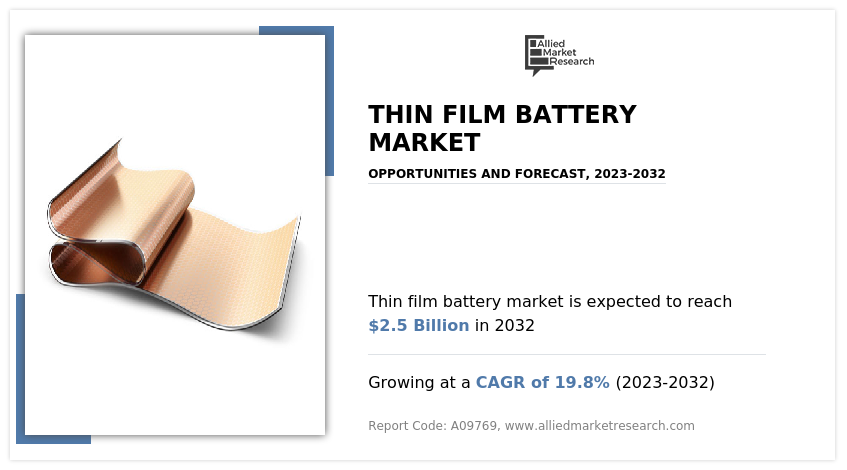
Thin film batteries are advanced energy storage devices that employ thin layers of different materials to store and provide electrical energy. They consist of electrodes, electrolytes, and protective coatings, which are deposited onto a substrate using thin film deposition methods.
The key advantage of these batteries is their ability to rapidly charge and discharge, which greatly improves user convenience by reducing the time spent on recharging.
Thin film batteries offer a compelling solution for portable electronic devices such as smartphones, smartwatches, fitness trackers, and portable medical devices. Thin film batteries offer a significant advantage in terms of compactness and weight compared to traditional batteries. This advantage allows manufacturers to create smaller and lighter devices without sacrificing power capacity.
Consumers can enjoy sleek and comfortable designs with enhanced portability. Additionally, the high energy density of thin film batteries enables longer device runtime, reducing the need for frequent recharging and enhancing user convenience.
The healthcare sector has embraced portable and wearable medical devices, ranging from glucose monitors and insulin pumps to smart patches and implantable sensors. These devices require compact and lightweight power sources that can seamlessly integrate into the human body or be worn comfortably. The consumer electronics market continually seeks to develop smaller and more portable devices, such as smartphones, smartwatches, and fitness trackers.
These devices rely on efficient power sources to provide extended battery life and enhanced functionality. Thin film batteries offer a higher energy density in consumer electronics compared to traditional batteries, allowing for longer usage time in compact designs. Moreover, their flexibility enables integration into unconventional form factors, leading to the development of innovative and user-friendly devices.
Advantages
- Lightweight and Flexible: Their thin design allows for applications in portable and wearable electronics, as well as integration into flexible devices.
- High Energy Density: Can provide higher energy density compared to traditional batteries, allowing for longer-lasting power in smaller packages.
- Rapid Charging: Thin film batteries can often be charged faster than conventional batteries due to their design and materials.
- Long Cycle Life: Typically exhibit good cycle stability, leading to longer lifespan in applications.
By chargeability, the rechargeable segment was the highest revenue contributor to the thin film battery market share in 2022.
By voltage, the below 1.5V segment was the highest revenue contributor and accounted for almost half of the market share to the market in 2022.
By application, the wearable devices segment was the highest revenue contributor to the market, in 2022, with a CAGR of 19.4%.
- Consumer Electronics: Used in smartphones, tablets, and wearable devices where space and weight are critical.
- Medical Devices: Ideal for powering small medical implants and devices due to their compact size and flexibility.
- Energy Harvesting: Can be integrated into energy-harvesting systems, such as solar cells, to store generated energy.
By region, North America was the highest revenue contributor, in 2022 followed by the Asia-Pacific region.
Buy This Report (300 Pages PDF with Insights, Charts, Tables, and Figures): https://bit.ly/3SOpqlH
Future Trends
- Advancements in Materials: Research is ongoing to develop new materials that enhance performance and reduce costs.
- Integration with IoT: As the Internet of Things (IoT) expands, thin film batteries may play a crucial role in powering connected devices.
- Sustainability: Increased focus on environmentally friendly materials and recycling processes for thin film batteries.
Key Benefits For Stakeholders
This report provides a quantitative analysis of the market segments, current trends, estimations, and dynamics of the thin film battery market analysis from 2022 to 2032 to identify the prevailing thin film battery market opportunities.
The market research is offered along with information related to key drivers, restraints, and opportunities.
Porter’s five forces analysis highlights the potency of buyers and suppliers to enable stakeholders make profit-oriented business decisions and strengthen their supplier-buyer network.
In-depth analysis of the thin film battery market share assists to determine the prevailing market opportunities.
Major countries in each region are mapped according to their revenue contribution to the global thin film battery market forecast report.
Market player positioning facilitates benchmarking and provides a clear understanding of the present position of the market players.
The report includes the analysis of the regional as well as global thin film battery market trends, key players, market segments, application areas, and market growth strategies.
Other Trending Reports:
About Us:
Allied Market Research (AMR) is a market research and business-consulting firm of Allied Analytics LLP, based in Portland, Oregon. AMR offers market research reports, business solutions, consulting services, and insights on markets across 11 industry verticals. Adopting extensive research methodologies, AMR is instrumental in helping its clients to make strategic business decisions and achieve sustainable growth in their market domains. We are equipped with skilled analysts and experts and have a wide experience of working with many Fortune 500 companies and small & medium enterprises.
Pawan Kumar, the CEO of Allied Market Research, is leading the organization toward providing high-quality data and insights. We are in professional corporate relations with various companies. This helps us dig out market data that helps us generate accurate research data tables and confirm utmost accuracy in our market forecasting. Every data company in the domain is concerned. Our secondary data procurement methodology includes deep presented in the reports published by us is extracted through primary interviews with top officials from leading online and offline research and discussion with knowledgeable professionals and analysts in the industry.




