

Thermoelectric Generators Market Overview
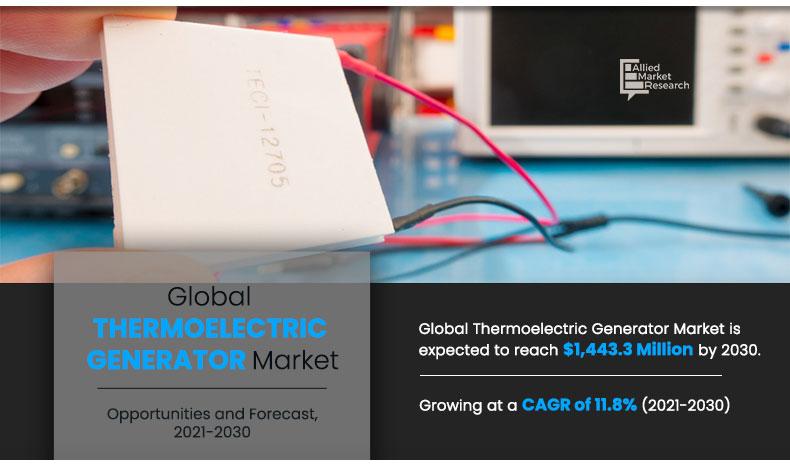
According to a new published report by Allied Market Research, the global thermoelectric generators (TEG) market size was valued at $472.5 million in 2020, and is projected to reach $1443.3 million by 2030, growing at a CAGR of 11.8% from 2021 to 2030.
What is a Thermoelectric Generator?
A Thermoelectric Generator (TEG) is a device that converts heat energy directly into electrical energy using the Seebeck effect. TEGs are used in various applications where waste heat can be harvested to generate power.
Download PDF Brochure: https://www.alliedmarketresearch.com/request-sample/2414
North America accounted for the largest share of the market in 2020, while Asia-Pacific was the fastest growing region.
North America thermoelectric generators market share is expected to grow during forecast period, owing rise in demand generators by automotive, aerospace, healthcare and others.
The global thermoelectric generators industry report is consolidated in nature with a few players, such as Gentherm, Inc., Ferrotec Holdings Corporation, Yamaha Corp., Thermo Electric Company, Inc., Laird Thermal Systems, Komatsu Ltd., Kyocera Corporation, Phononic Devices, Evident Thermoelectrics, and II-VI Marlow, Inc., which hold significant share of the market.
Increase in concerns toward the development of the renewable energy sector and huge investments made by various governments in the sector fuel the thermoelectric generators market growth.
Surge in demand for energy across various end-user industries such as automobile, aerospace, and defense and rise in concerns about environmental and emissions issues, particularly global warming, have propelled the demand for thermoelectric generators.
Thermoelectric generators and thermoelectric materials that were previously utilized primarily in niche applications are now gaining high popularity with the introduction of wider automotive applications and the efforts to exploit waste-heat-recovery technologies.
Key Characteristics
- Operating Principle:
- Utilizes the temperature difference between two materials to generate voltage. When one side is heated and the other is cooled, electrons move from the hot side to the cold side, creating an electric current.
- Materials:
- Common thermoelectric materials include bismuth telluride, lead telluride, and silicon-germanium alloys, known for their high thermoelectric efficiency.
- Design:
- Typically consists of thermoelectric modules made up of multiple thermoelectric elements arranged in a series or parallel configuration.
Thermoelectric generators are not only highly reliable and durable but they are also environmental-friendly, as they do not include chemical products.
Temperature differences are converted into electrical energy by thermoelectric generators. The seebeck effect and the Peltier effect are two key physical phenomena involved in this process. The seebeck effect describes the conversion of temperature differential into electric current at the interface of two materials, whereas the Peltier effect is the opposite of the seebeck effect.
Thermoelectric materials turn temperature differences into electric voltage to create electricity directly from heat. To be acceptable for the thermoelectric conversion process, these materials must have both high electrical conductivity and low heat conductivity.
End-use Industry of thermoelectric generators market includes automotive, aerospace, industrial, consumer and healthcare.
The aerospace segment accounted for the largest share of the thermoelectric generators market in 2020, while Industrial segment is projected to witness growth at the highest CAGR of 12.4%.
Applications
- Waste Heat Recovery: Used in industrial processes, automotive exhaust systems, and power plants to recover waste heat and convert it into electricity.
- Spacecraft Power: Employed in space missions to generate power from radioactive decay heat, providing a reliable energy source.
- Remote Power Generation: Suitable for powering sensors and devices in remote locations where traditional power sources are unavailable.
Based on the application, the global thermoelectric generators market is segmented into waste heat recovery, energy harvesting, direct power generation and co-generation.
The waste heat recovery segment accounted for the largest share in 2020 and projected to witness growth at the highest CAGR of 12.4%.
Based on the material, the global thermoelectric generators market is segmented into bismuth telluride, lead telluride and others.
Thermoelectric generators market for the bismuth telluride segment accounted for the largest share in 2020 and projected to witness growth at the highest CAGR of 12.0%.
Procure This Report (268 Pages PDF with Insights, Charts, Tables, and Figures): https://bit.ly/42zs0Br
Advantages
- No Moving Parts: TEGs have no mechanical components, leading to high reliability and low maintenance.
- Environmentally Friendly: They can effectively convert waste heat into usable electricity, enhancing energy efficiency.
- Compact Size: TEGs can be designed to fit into small spaces, making them suitable for various applications.
Impact Of Covid-19 On The Global Thermoelectric Generators Market
Some of the major economies suffering from the COVID-19 crises include Germany, France, Italy, Spain, the UK, and Norway.
In many countries, the economy has dropped due to the halt of several industries, especially transport and supply chain. Demand for the application has been hindered, as there is no development due to the lockdown.
The demand–supply gap, disruptions in raw material procurement, and price volatility are expected to hamper the growth of the thermoelectric generators market during the COVID-19 pandemic.
Conclusion
Thermoelectric generators offer a promising solution for converting waste heat into electrical energy, contributing to energy efficiency and sustainability. Ongoing research and advancements in materials and technology continue to enhance their performance and applications.




