
The thermoelectric generators market is gaining strong attention as industries search for efficient ways to convert waste heat into usable electricity. Thermoelectric generators (TEGs) operate through the Seebeck effect, enabling direct conversion of temperature differences into electrical power without moving parts. Their reliability, low maintenance requirements, and long operational life make them attractive for applications across automotive, aerospace, industrial manufacturing, and remote energy systems. As industries focus on energy efficiency and sustainability, thermoelectric technology is increasingly viewed as a viable solution for reducing energy losses and improving overall system performance.
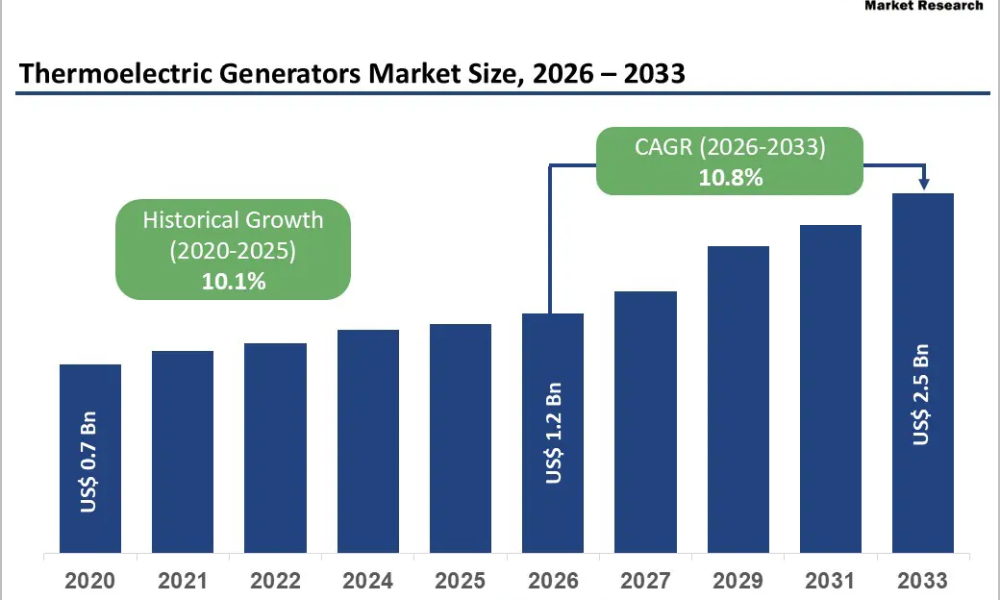
According to Persistence Market Research, the global thermoelectric generators market is expected to be valued at US$ 1.2 billion in 2026 and is projected to reach US$ 2.5 billion by 2033, expanding at a CAGR of 10.8% between 2026 and 2033. The growth is largely driven by increasing investments in waste heat recovery technologies and the rising need for alternative power generation systems. The automotive sector remains a leading segment due to the use of TEGs for improving fuel efficiency and reducing emissions. Geographically, North America is emerging as a leading region because of strong technological innovation, industrial adoption of energy-efficient solutions, and growing research initiatives in thermoelectric materials.
Get Your FREE Sample Report Instantly Click Now: https://www.persistencemarketresearch.com/request-customization/35398
Key players operating in the thermoelectric generators market include:
- Gentherm Inc.
- Ferrotec Corporation
- II-VI Marlow
- Laird Thermal Systems
- Tecteg Power Generator
- Tellurex Corporation
- Thermonamic Electronics Corp. Ltd.
- Hi-Z Technology Inc.
- KELK Ltd.
- RMT Ltd.
- Global Thermoelectric Inc.
- GreenTEG AG
- Micropelt GmbH
- Komatsu Ltd.
- Cristopia Energy Systems
Key Highlights from the Report
➤ The global thermoelectric generators market is projected to grow from US$ 1.2 billion in 2026 to US$ 2.5 billion by 2033, registering a CAGR of 10.8% during the forecast period.
➤ Rising adoption of waste heat recovery technologies across automotive and industrial sectors is accelerating market growth.
➤ Increasing investments in renewable energy technologies are boosting the development of advanced thermoelectric generator systems.
➤ Automotive applications are emerging as a dominant segment due to the ability of thermoelectric systems to improve vehicle fuel efficiency.
➤ North America leads the thermoelectric generators market owing to technological advancements and strong industrial infrastructure.
➤ Continuous research in thermoelectric materials is improving conversion efficiency and expanding application possibilities.
➤ Growing demand for reliable off-grid power sources is driving the adoption of thermoelectric generators in remote and defense applications.
Market Segmentation
By Material
- Bismuth Telluride
- Lead Telluride
- Skutterudites
- Magnesium Silicide
- Others
By Application
- Waste Heat Recovery
- Energy Harvesting
- Direct Power Generation
- Others
By Industry
- Automotive
- Industrial Manufacturing
- Energy & Utilities
- Consumer Electronics & Wearables
- Telecommunications
- Healthcare
- Aerospace & Defense
- Others
By Region
- North America
- Europe
- Asia Pacific
- Latin America
- Middle East & Africa
Customize This Report for Your Exact Requirements: https://www.persistencemarketresearch.com/request-customization/35398
Regional Insights
North America holds a significant share in the thermoelectric generators market due to strong research capabilities and the presence of advanced manufacturing industries. Governments and private organizations are actively investing in energy efficiency technologies and sustainable energy solutions. The region’s automotive and aerospace industries are integrating thermoelectric systems to improve energy utilization and reduce operational costs. Continuous innovation in thermoelectric materials and system designs further strengthens the region’s leadership position in the market.
Asia Pacific is also witnessing notable growth as industrialization and energy demand continue to rise across developing economies. Countries such as China, Japan, and South Korea are investing heavily in clean energy technologies and advanced electronics manufacturing. The increasing adoption of waste heat recovery systems in power plants, steel manufacturing, and automotive industries is supporting the expansion of thermoelectric generator deployments. Government policies promoting energy conservation are also contributing to regional market growth.
Market Drivers
One of the primary drivers of the thermoelectric generators market is the increasing emphasis on energy efficiency and waste heat recovery. Industrial processes, automotive engines, and power plants produce a significant amount of heat that is often wasted. Thermoelectric generators offer a practical method to capture this energy and convert it into electricity without requiring complex mechanical systems. This capability not only improves energy efficiency but also reduces overall operating costs, making TEGs an attractive solution for energy-intensive industries.
Another important driver is the rising focus on sustainable and clean energy technologies. As governments implement stricter environmental regulations and carbon reduction targets, industries are seeking innovative technologies to minimize emissions and energy losses. Thermoelectric generators provide an environmentally friendly solution since they operate silently, require minimal maintenance, and produce electricity without fuel combustion. Increasing research in advanced thermoelectric materials is also improving device efficiency, further encouraging adoption.
Market Restraints
Despite promising growth, the thermoelectric generators market faces certain restraints that may limit its expansion. One major challenge is the relatively low energy conversion efficiency of current thermoelectric materials compared with other power generation technologies. Although ongoing research is improving efficiency levels, many applications still require higher performance to justify large-scale deployment. This limitation can discourage adoption in industries that require high power output.
Another significant restraint is the high initial cost associated with thermoelectric generator systems. The materials used in TEGs, including specialized semiconductors, can be expensive, increasing the overall system cost. For small and medium-sized enterprises, the high upfront investment may be a barrier to implementation. Additionally, integrating thermoelectric generators into existing infrastructure can require complex engineering modifications, which further adds to deployment costs.
Market Opportunities
The thermoelectric generators market presents strong opportunities with the increasing development of advanced thermoelectric materials and nanotechnology. Researchers are exploring new compounds and nanostructured materials that can significantly enhance energy conversion efficiency. Improved materials can enable broader adoption of thermoelectric generators across industrial, automotive, and consumer electronics sectors. As technological advancements continue, the cost-performance balance of TEG systems is expected to improve.
Another promising opportunity lies in the growing demand for off-grid and remote power generation. Thermoelectric generators are highly reliable and can operate in harsh environments without maintenance, making them ideal for remote monitoring systems, defense equipment, and space exploration technologies. As industries expand operations in remote areas and require stable power sources, thermoelectric generators are expected to play a crucial role in supporting these energy needs.
Frequently Asked Questions
➤ What are the main factors influencing the Thermoelectric Generators Market growth in the coming years?
➤ Which companies are the major sources in the thermoelectric generators market industry?
➤ What are the market’s opportunities, risks, and general structure in the thermoelectric generators market?
➤ Which of the top thermoelectric generators market companies compare in terms of sales, revenue, and prices?
➤ How are market types and applications and deals, revenue, and value explored in the thermoelectric generators market?
Ready to Dive Deep? Buy Full Report Today: https://www.persistencemarketresearch.com/checkout/35398
Recent Developments:
- March 2024: Gentherm Incorporated announced advancements in thermoelectric technology aimed at improving energy efficiency in automotive applications.
- September 2023: Ferrotec Holdings Corporation expanded its thermoelectric module manufacturing capacity to support rising demand for industrial waste heat recovery systems.
Future Opportunities and Growth Prospects
The future of the thermoelectric generators market looks promising as industries continue to seek innovative solutions for energy efficiency and sustainability. Technological breakthroughs in thermoelectric materials and device architecture are expected to improve conversion efficiency and reduce production costs. As global demand for renewable energy and waste heat recovery technologies increases, thermoelectric generators are likely to become an integral part of next-generation energy systems. Continued research, supportive government policies, and expanding industrial applications will play a crucial role in shaping long-term market growth.




