
Market Overview
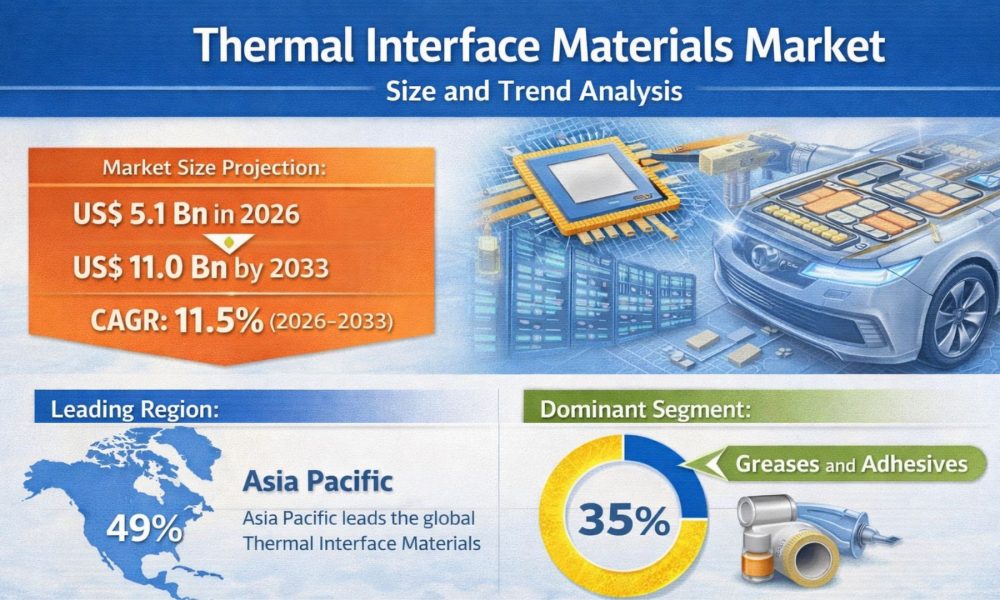
According to Persistence Market Research, the global Thermal Interface Materials (TIM) market is valued at US$ 5.1 billion in 2026 and is projected to reach US$ 11.0 billion by 2033, expanding at a robust CAGR of 11.5% from 2026 to 2033. This strong growth reflects the rising importance of thermal management solutions across high-performance electronic systems.
Thermal interface materials are thermally conductive substances placed between heat-generating components (such as processors or batteries) and heat sinks to enhance heat dissipation and minimize thermal resistance. Their role is critical in improving device efficiency, reliability, and lifespan, especially in compact and high-power electronic applications.
Get Your FREE Sample Report Instantly – Click Now: https://www.persistencemarketresearch.com/samples/36414
Key Market Drivers
Surge in Consumer Electronics Demand
One of the primary drivers of the TIM market is the rapid proliferation of consumer electronics such as smartphones, laptops, gaming consoles, and wearable devices. As devices become smaller and more powerful, efficient heat management becomes essential to prevent overheating and maintain performance.
Thermal interface materials enable better thermal conductivity and device longevity, making them indispensable in modern electronics. The continued expansion of digital lifestyles and increasing disposable income globally are further accelerating demand.
Growth of Electric Vehicles (EVs) and Automotive Electronics
The automotive sector, particularly electric vehicles (EVs), is emerging as a significant growth avenue. EV batteries, power electronics, and advanced driver-assistance systems (ADAS) generate substantial heat, necessitating advanced thermal management solutions.
TIMs help maintain optimal operating temperatures, ensuring safety, efficiency, and durability of automotive components. As EV adoption rises globally, the demand for high-performance thermal interface materials is expected to increase significantly.
Expanding Applications Across Industries
Thermal interface materials are widely used across multiple industries, including:
- Telecommunications and data centers – supporting high-speed networks and server cooling
- Medical devices – ensuring reliability of sensitive electronic equipment
- Industrial machinery – improving operational efficiency
- Aerospace and defense – managing heat in high-performance systems
The growing adoption of automation and Industry 4.0 technologies is further fueling demand, as efficient thermal management becomes critical in advanced manufacturing systems.
Product Type Insights
The TIM market includes a wide range of products such as:
- Thermal greases and adhesives – widely used due to strong thermal conductivity
- Elastomeric pads – preferred for ease of installation and handling
- Phase change materials (PCMs) – gaining traction due to superior thermal performance
- Tapes and films – used in compact and lightweight applications
Among these, phase change materials are expected to witness the fastest growth due to their ability to store and release heat efficiently, making them ideal for advanced electronics and construction applications.
Regional Analysis
Asia Pacific Leads the Market
Asia Pacific dominates the global TIM market, driven by strong electronics manufacturing hubs in countries such as China, Japan, South Korea, and India. The region benefits from high production volumes of consumer electronics and increasing investments in industrial automation.
North America and Europe
North America and Europe also represent significant markets, supported by advancements in high-performance computing, electric vehicles, and data center infrastructure. The presence of leading technology companies and strong R&D capabilities further boosts demand in these regions.
Emerging markets in Latin America and the Middle East & Africa are gradually gaining traction due to infrastructure development and increasing adoption of advanced technologies.
Emerging Trends
Advancements in Material Technology
Continuous innovation in material science is leading to the development of advanced TIMs, including graphene-based and composite materials with enhanced thermal conductivity and mechanical strength.
Increasing Demand for Miniaturization
As electronic devices become more compact, the need for thinner and more efficient thermal interface materials is growing. This trend is pushing manufacturers to develop high-performance, space-efficient solutions.
Integration with Next-Generation Technologies
The rise of 5G, artificial intelligence (AI), and cloud computing is driving the need for efficient thermal management in data centers and communication infrastructure, further boosting the TIM market.
Market Challenges
Despite strong growth prospects, the market faces certain challenges:
- High cost of advanced materials
- Availability of alternative cooling technologies such as liquid cooling systems
- Design complexities in integrating TIMs into compact electronic devices
However, these challenges are partially mitigated by the cost-effectiveness and versatility of thermal interface materials compared to alternative solutions.
Get a Customized Market View in One Click: https://www.persistencemarketresearch.com/request-customization/36414
Competitive Landscape and Key Players
The thermal interface materials market is moderately consolidated, with several global players focusing on innovation, partnerships, and product development to strengthen their market presence.
Key players operating in the market include:
- 3M Company
- Henkel AG & Co. KGaA
- Indium Corporation
- Fujipoly
- Dow Inc.
- Honeywell International Inc.
- Shin-Etsu Chemical Co., Ltd.
- Sibelco
These companies leverage strong R&D capabilities and strategic collaborations with electronics and automotive manufacturers to develop advanced thermal management solutions.
Conclusion
The global Thermal Interface Materials market is set for rapid expansion, driven by the increasing need for efficient thermal management in electronics, automotive, and industrial applications. With a projected CAGR of 11.5% through 2033, the market reflects strong momentum supported by technological advancements and growing end-use industries.
As demand for high-performance, compact, and energy-efficient devices continues to rise, thermal interface materials will play a crucial role in enabling next-generation technologies. Ongoing innovation and the expansion of application areas are expected to further enhance market growth in the coming years.
About Persistence Market Research:
Persistence Market Research delivers strategic research solutions that drive business growth. Founded in 2012 and registered in England and Wales in 2023 as Persistence Research & Consultancy Services Ltd., we have completed 3,600+ custom and syndicated studies and supported 2,700+ projects for leading research firms. Combining traditional methodologies with modern tools, we provide actionable insights to multinational corporations, consultants, investors, and government bodies, earning strong trust through long-term client relationships.
Contact Us:
Persistence Market Research
Second Floor, 150 Fleet Street,
London, EC4A 2DQ, United Kingdom
USA Phone: +1 646-878-6329
UK Phone: +44 203-837-5656
Email: [email protected]
Web: https://www.persistencemarketresearch.com




