
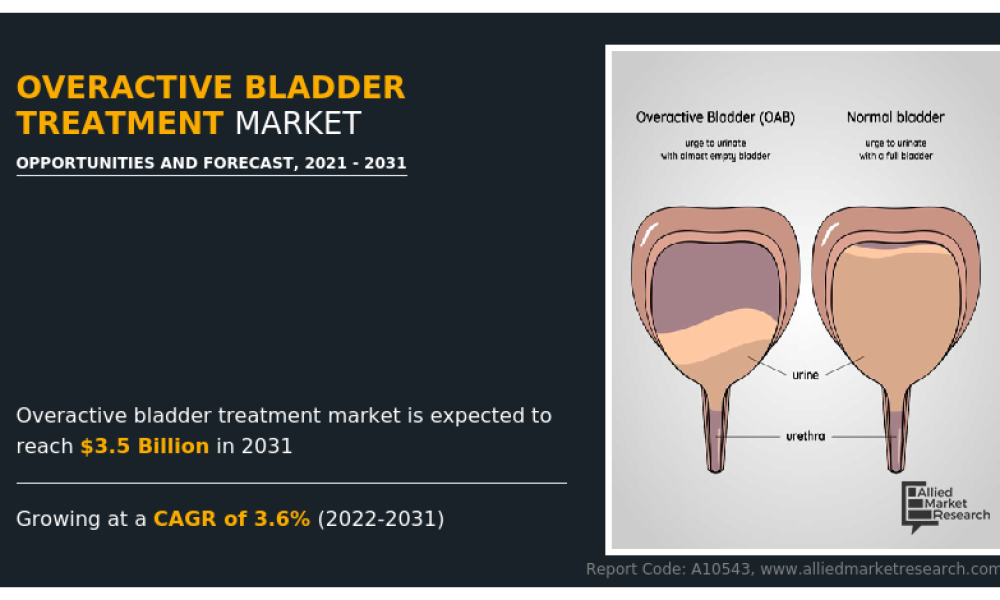
The global overactive bladder (OAB) treatment market is on a steady growth trajectory, projected to expand from $2.4 billion in 2021 to $3.5 billion by 2031, with a CAGR of 3.6%. OAB is a widespread urological condition characterized by sudden urinary urgency, frequent urination, and incontinence, affecting millions worldwide.
As the aging population grows and awareness about OAB treatments increases, pharmaceutical advancements and non-invasive therapies are shaping the market. This article explores key trends, drivers, challenges, and opportunities in the OAB treatment industry.
Understanding Overactive Bladder (OAB)
OAB occurs when bladder muscles contract involuntarily, leading to:
Urinary urgency (sudden, uncontrollable need to urinate)
Frequency (urinating more than 8 times a day)
Nocturia (waking up at night to urinate)
Urge incontinence (leakage before reaching the bathroom)
Common Causes of OAB
✔ Neurological disorders (Parkinson’s, stroke, multiple sclerosis)
✔ Bladder abnormalities (infections, tumors, stones)
✔ Aging-related muscle weakness
✔ Medication side effects (diuretics, antidepressants)
✔ Lifestyle factors (caffeine, alcohol, obesity)
Key Market Drivers
1. Growing Geriatric Population
By 2050, 1 in 6 people will be over 65 (WHO).
Older adults are more prone to OAB, increasing demand for treatments.
2. Rising Awareness & Diagnosis Rates
Increased public health campaigns and diagnostic tools boost early detection.
More patients seek medical help instead of ignoring symptoms.
3. Advancements in Drug Therapies
Anticholinergics (e.g., oxybutynin, tolterodine) – Traditional first-line treatment.
Beta-3 adrenergic agonists (e.g., vibegron, mirabegron) – Newer, with fewer side effects.
Botox injections – FDA-approved for severe OAB cases.
4. Shift Toward Non-Invasive Treatments
Patients prefer oral medications & minimally invasive procedures over surgery.
Sacral neuromodulation (SNM) devices (e.g., Medtronic’s InterStim Micro) offer long-term relief.
5. Impact of COVID-19
COVID-associated cystitis (CAC) increased OAB cases.
Post-pandemic, supply chain recovery boosted drug availability.
Market Segmentation & Trends
By Drug Class (2021-2031 Forecast)
| Segment | Market Share (2021) | Growth Outlook |
|---|---|---|
| Beta-3 Adrenergics | Largest segment | High adoption due to fewer side effects |
| Anticholinergics | Fastest-growing | Cost-effective, widely available |
| Botox Injections | Niche market | Used for severe, refractory OAB |
By Disease Type
Idiopathic OAB (unknown cause) – Most common (70% of cases).
Neurogenic OAB (nerve-related) – Fastest-growing due to rising neurological disorders.
By Distribution Channel
Retail Pharmacies – Dominant due to easy access.
Online Pharmacies – Rapid growth (discounts, home delivery).
By Region
| Region | Market Share (2021) | Growth Drivers |
|---|---|---|
| North America | Largest (40%+) | High healthcare spending, key players (AbbVie, Pfizer) |
| Europe | Steady growth | Aging population, advanced healthcare |
| Asia-Pacific | Fastest-growing | Rising awareness, expanding pharma industry |
| LAMEA | Emerging market | Improving healthcare access |
Challenges & Restraints
1. Side Effects of Medications
Anticholinergics cause dry mouth, constipation, blurred vision.
Botox injections may lead to urinary retention.
2. High Treatment Costs
Beta-3 agonists & neuromodulation devices are expensive.
Limited insurance coverage in developing nations.
3. Preference for Alternative Therapies
Pelvic floor exercises (Kegels), acupuncture, and lifestyle changes compete with drugs.
Future Opportunities
1. Personalized Medicine
Genetic testing & AI-driven diagnostics could tailor treatments.
2. Emerging Markets (Asia, Africa, Latin America)
Untapped patient populations present growth potential.
3. New Drug Developments
Novel therapies targeting bladder nerves & muscles in pipeline.
4. Telemedicine & Digital Health
Remote consultations & wearable bladder monitors improve patient care.
Key Players & Recent Developments
Major Companies
AbbVie Inc. (Acquired Allergan, expanding OAB portfolio)
Astellas Pharma (Markets mirabegron, a leading beta-3 agonist)
Pfizer Inc. (Produces Detrol for OAB)
Teva Pharmaceuticals (Generic OAB medications)
Sumitomo Pharma (Launched Gemtesa, a new beta-3 drug)
Recent Industry Moves
✅ 2023: FDA fast-tracks new OAB drug trials for better efficacy.
✅ 2022: Urovant Sciences partnered with Pierre Fabre to expand Gemtesa in Europe.
✅ 2021: Medtronic’s InterStim Micro gained FDA approval for sacral neuromodulation therapy.
Conclusion
The OAB treatment market is evolving with new drugs, minimally invasive therapies, and digital health innovations. While North America leads, Asia-Pacific is the fastest-growing region.
Key Takeaways:
🔹 Beta-3 agonists & anticholinergics dominate the market.
🔹 Online pharmacies & telemedicine are reshaping access to care.
🔹 Aging populations & rising awareness will drive future demand.




