
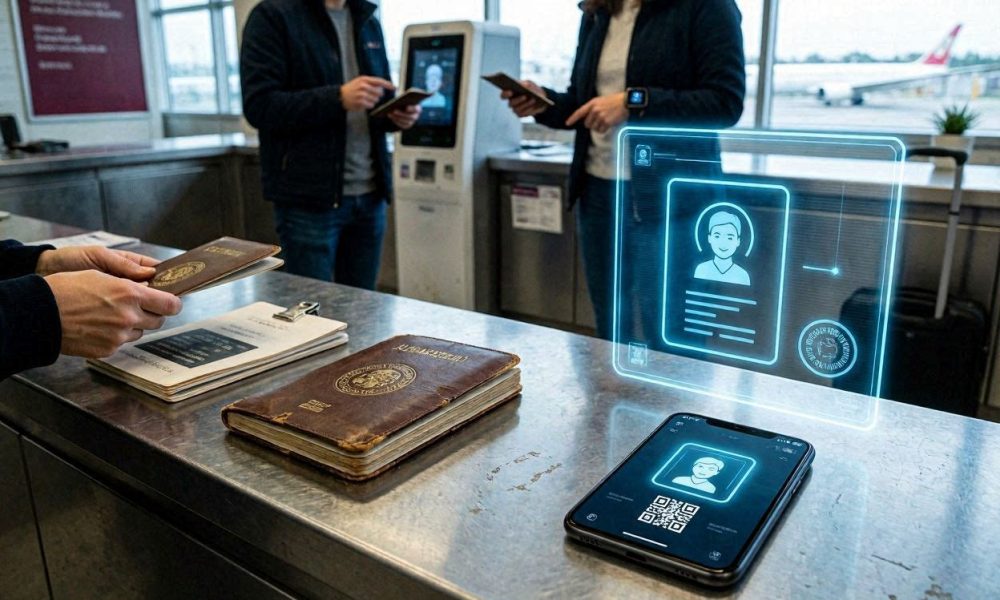
Will your smartphone eventually replace your blue book? The EU and others test the limits of paperless travel.
WASHINGTON, DC, May 9, 2026.
The physical passport is not dead, but in 2026, it is being pushed into a new role, as governments, airlines, airports, technology companies, and border agencies test whether a smartphone can carry enough trusted identity data to replace parts of the traditional travel document journey.
For more than a century, the passport booklet has been the central artifact of international movement, yet the rise of Digital Travel Credentials, biometric gates, mobile wallets, electronic chips, and pre-clearance apps is forcing governments to reconsider how identity should move through airports.
The blue book is becoming a backup for a digital identity layer.
The phrase Digital Travel Credential sounds technical, but the idea is simple, because a traveler’s passport chip data can be converted into a secure digital credential that can be stored on a mobile device and shared before arrival.
That credential does not usually eliminate the need for a physical passport today, because most systems still require the traveler to carry the booklet, present it when asked, and use it as the legal source document for the digital identity file.
The real shift is operational, because governments want travelers to submit passport information, facial images, and identity data before reaching the border, allowing authorities to pre-check travelers and reduce pressure at inspection points.
In that model, the passport booklet remains the legal anchor, while the smartphone becomes the convenience layer that moves identity data earlier in the journey, before the traveler reaches the kiosk, gate, or immigration booth.
The European Union is pushing paperless travel closer to reality.
The European Union has become one of the most important testing grounds for digital border modernization because its Entry/Exit System now records biometric and travel data for non-EU short-stay travelers rather than relying on traditional passport stamps.
That system represents a major step away from ink-based border management, because the traveler’s passport, fingerprints, facial image, entry date, exit date, and stay calculation can now be managed through electronic records rather than manual stamp review.
Reuters reported that the EU’s new biometric border system is intended to replace passport stamping with digital records linking travel documents to biometric identity, while helping authorities identify overstayers, combat identity fraud, and manage irregular migration.
The next stage is not simply a faster booth, because the EU’s digital travel plans point toward a future in which travelers can create digital credentials based on biometric passports and submit identity information before arriving at external borders.
Digital credentials are designed to move checks away from the border counter.
The most important promise of Digital Travel Credentials is not that they make passports disappear, but that they allow identity verification to begin earlier, reducing the number of checks that must happen under pressure at the border.
Instead of waiting until a traveler stands in front of an officer, a digital credential can enable authorities to pre-screen identity data, verify document information, conduct risk assessments, and route travelers more efficiently upon arrival.
This is especially valuable at crowded airports, ferry terminals, rail crossings, and land borders, where even small delays per traveler can create long queues, missed connections, public frustration, and political pressure on border agencies.
In theory, the traveler arrives with fewer unresolved identity questions, while officers focus on exceptions, mismatches, watchlist issues, biometric failures, or travelers whose records require closer examination.
The smartphone is becoming a controlled identity wallet, not just a travel convenience.
A Digital Travel Credential is not merely a photograph of a passport stored in a phone, because a passport image in a photo gallery has no cryptographic trust, no controlled issuance, and no reliable protection against manipulation.
A proper credential must be created from the passport’s chip or a trusted government record, be protected by encryption, be linked to the traveler’s device, and be designed to reveal only the information required for a specific travel or identity check.
That distinction matters because travelers already store passport scans in emails, cloud folders, airline apps, and hotel booking systems, yet those copies can expose personal data without providing secure proof that the document is genuine.
The future travel wallet aims to reverse that weakness by giving travelers a way to present verified identity data without unnecessarily handing over a booklet or sharing uncontrolled images of sensitive passport pages.
The United States is already testing digital identity at airports.
The United States has not replaced the passport for international travel, but domestic airport identity verification is moving quickly toward mobile credentials, digital IDs, biometric comparison, and app-based document workflows.
U.S. Customs and Border Protection continues to support Mobile Passport Control, which allows eligible travelers to submit passport and customs declaration information through an app before inspection at participating locations.
That program does not replace the passport, yet it aligns with Digital Travel Credentials by shifting data submission earlier, reducing manual processing, and allowing officers to handle travelers with more information.
The broader U.S. airport environment is also changing as digital driver’s licenses, passport-based wallet credentials, TSA identity readers, facial comparison, and mobile authentication tools expand across domestic checkpoints and selected travel settings.
Apple’s passport-based Digital ID highlights the market’s limits and momentum.
Apple’s passport-based Digital ID has become one of the most visible examples of how consumer technology companies are moving into identity presentation, as it lets eligible users create a digital identity credential from U.S. passport information.
The Associated Press reported that Apple’s Digital ID can be used at selected TSA checkpoints for domestic identity verification, but it cannot replace a physical passport for international travel or border crossings.
That limitation is critical because it shows where the market stands in 2026: smartphones are increasingly accepted for domestic identity checks and limited travel workflows, while international passport replacement remains constrained by law, standards, border recognition, and government trust.
Still, consumer adoption matters because travelers who grow comfortable using phones for identity checks at domestic airports will likely expect similar convenience at international borders when governments make those systems legally available.
The physical passport remains hard to kill because it solves problems phones cannot.
A passport booklet works without a battery, operating system, cellular signal, app update, cloud account, facial unlock, charging cable, mobile wallet platform, or device manufacturer policy, which makes it uniquely resilient during international travel.
That reliability matters during emergencies, evacuations, detentions, border disputes, cyber outages, phone thefts, hardware failures, consular interventions, and travel through countries where digital credential readers are unavailable or inconsistently deployed.
A physical passport also carries visas, entry endorsements, consular evidence, emergency stamps, and national symbols that remain legally and diplomatically meaningful in places where digital infrastructure is limited or politically incompatible.
For those reasons, the smartphone is more likely to reduce physical passport handling before it replaces the booklet entirely, especially for international travel, where every country must recognize the credential before it becomes truly universal.
The legal passport and the digital credential are not the same thing.
The passport is a government-issued travel document recognized under international norms, while a Digital Travel Credential is usually a digital representation of data derived from that document and governed by separate technical and legal rules.
This difference matters because the legal right to cross a border is not created by the phone itself, but by the citizenship, nationality, visa status, admissibility record, and issuing authority behind the credential.
A traveler may carry a perfectly functioning digital credential and still be required to produce the booklet, answer questions, provide fingerprints, show a visa, or submit to secondary inspection if the border authority requires it.
The phone may accelerate the process, but it does not eliminate sovereign discretion, because every state retains the authority to decide how identity must be proven before a traveler enters its territory.
Privacy will determine whether travelers trust paperless borders.
Digital travel systems promise convenience, but they also raise difficult privacy questions about data retention, consent, profiling, biometric storage, cross-border sharing, device security, commercial platform involvement, and the rights of travelers who prefer physical documents.
A physical passport reveals information when opened and presented, while a digital system may create additional records about when identity was shared, which device was used, what data was transmitted, and how long authorities retained it.
Travelers may accept biometric and digital checks when they reduce queues, but public trust can erode quickly if governments or companies fail to explain what data is collected, how it is protected, and whether alternatives remain available.
The success of Digital Travel Credentials will therefore depend not only on technical accuracy, but also on transparent rules, strong encryption, narrow data use, independent oversight, and meaningful options for travelers who cannot or will not use smartphones.
Cybersecurity is now part of passport security.
The old passport-security debate focused on forged ink, altered photographs, stolen blanks, and counterfeit stamps, but the new debate includes device compromise, credential theft, wallet vulnerabilities, cloud exposure, phishing, malware, and misuse of identity data.
A secure digital credential must protect passport data on the phone, during transmission, within government systems, and at the reader, because criminals will attack wherever the weakest link is.
This is why digital travel systems rely on encryption, device binding, biometric unlocks, secure elements, cryptographic signatures, and limited data sharing, all designed to prevent a copied credential from functioning like the original.
The problem is not only technical, because travelers must also avoid storing passport images in an insecure manner, sending document scans over unprotected channels, or handing devices to unknown parties who may copy sensitive information.
Biometrics make digital travel possible, but also more sensitive.
A paperless border needs a way to link the phone credential to the living person, which is why facial comparison has become central to digital travel experiments, automated gates, airline identity systems, and passport modernization.
The phone may store or present the credential, but the face is what connects the traveler to the passport chip image, live camera capture, and government record that confirms the credential belongs to the person using it.
This biometric link helps prevent someone from using another person’s phone-based travel credential, but it also makes the system more sensitive because biometric data cannot be changed like a password if it is mishandled.
A responsible digital travel system must therefore balance convenience with safeguards, ensuring that facial data is captured only when necessary, retained only as permitted, protected carefully, and reviewed by humans when automated comparison fails.
Airlines want digital credentials because document checks slow the journey.
Airlines have a practical interest in Digital Travel Credentials because document verification begins long before the border, including booking, check-in, bag drop, boarding, immigration compliance, destination requirements, and carrier liability rules.
If travelers can share trusted passport data before departure, airlines may reduce manual document checks, shorten airport queues, prevent denied boarding issues, and give destination authorities greater confidence before the aircraft departs.
That vision supports the airline industry’s long-standing goal of seamless travel, where passengers move from curb to gate with fewer repeated document presentations and more identity verification happening securely in the background.
However, airlines cannot independently replace passports because they must rely on government recognition, border-system acceptance, international standards, and clear rules about liability when digital credentials fail or when travelers lack physical documents.
Digital credentials could reshape second passport planning.
The rise of Digital Travel Credentials will also change how lawful second citizenship, relocation, and mobility planning are evaluated, as travelers may eventually manage multiple passports, visas, and identity permissions through digital wallets.
A second passport will still require lawful issuance, government recognition, tax alignment, and integrity of compliance, but its practical use may increasingly involve electronic credentials derived from the physical booklet and verified through biometric systems.
Professional advisory firms such as Amicus International Consulting monitor these changes because digital borders are reshaping how citizenship, passport validity, identity records, banking access, and cross-border privacy work together.
The value of a lawful second passport will not be measured solely by visa-free access, as digital verification will test whether the document, chip, biometric record, tax identity, and legal status remain consistent across systems.
A smartphone passport could widen the travel divide.
Digital travel may make airports faster for some travelers, but it could also create new barriers for people without compatible smartphones, stable internet access, digital literacy, biometric comfort, or confidence in government data systems.
Older travelers, children, low-income travelers, refugees, emergency evacuees, privacy-conscious individuals, and people from countries with limited digital infrastructure may face challenges if paperless systems become the preferred route through modern borders.
Governments will need to preserve physical alternatives because international travel cannot depend entirely on private devices, app stores, battery life, facial-recognition accuracy, or access to the newest phone models.
The digital border could improve efficiency, but only if it avoids becoming a two-tier system in which connected travelers move quickly while others face longer lines, greater suspicion, or reduced access to basic mobility.
The passport booklet may become less visible, but not less important.
In the most likely future, travelers will still carry passports, but they will handle them less often because the credentials will be checked digitally during pre-clearance, bag drop, security screening, boarding, arrival, and immigration processing.
The booklet may remain in a pocket while the phone presents selected identity data, the face confirms the traveler’s presence, and the border system checks the passport record through trusted digital channels.
This would not be the death of the passport, but the quiet demotion of the booklet from the central visible object of travel to the legal backup supporting a faster digital identity experience.
The passport’s authority would remain intact, while its daily role would shift from repeated presentation to occasional confirmation, emergency fallback, visa placement, and proof when digital systems cannot complete the journey.
The world is moving toward a hybrid travel identity.
The future is unlikely to be fully paperless or fully physical, because the safest model combines the legal resilience of the passport booklet with the speed of digital credentials and the accuracy of biometric verification.
That hybrid model gives governments flexibility, allowing them to speed up routine travel while preserving physical proof, officer discretion, consular intervention, and alternative pathways for travelers who cannot use digital systems.
It also gives travelers redundancy, because the phone may accelerate the journey, but the booklet remains a recognized document when the device fails, the app locks, the battery dies, or a border demands traditional proof.
For lawful mobility planning, second passport advisory services will increasingly need to account for both physical documents and digital credential ecosystems, since the next travel identity will operate across booklets, chips, wallets, biometrics, and databases.
The physical passport is not dying, but its monopoly is ending.
The strongest prediction for 2026 is not that smartphones will replace passports tomorrow, because international travel still depends on legal recognition, physical fallback, global standards, and border agencies that move cautiously when sovereignty is involved.
The better prediction is that the passport’s role will split, with the booklet remaining the legal root of trust while the smartphone becomes the everyday interface for faster document submission, identity sharing, and biometric travel processing.
The blue book will survive because it is durable, universal, diplomatic, and legally recognized, but it will increasingly sit behind digital systems that allow travelers to move with fewer visible checks and less repeated handling of documents.
The death of the physical passport has been overstated, yet the death of the passport-only journey is already underway, as smartphones, biometric cameras, government apps, and digital credentials begin changing how identity crosses the border before the traveler even arrives.




