
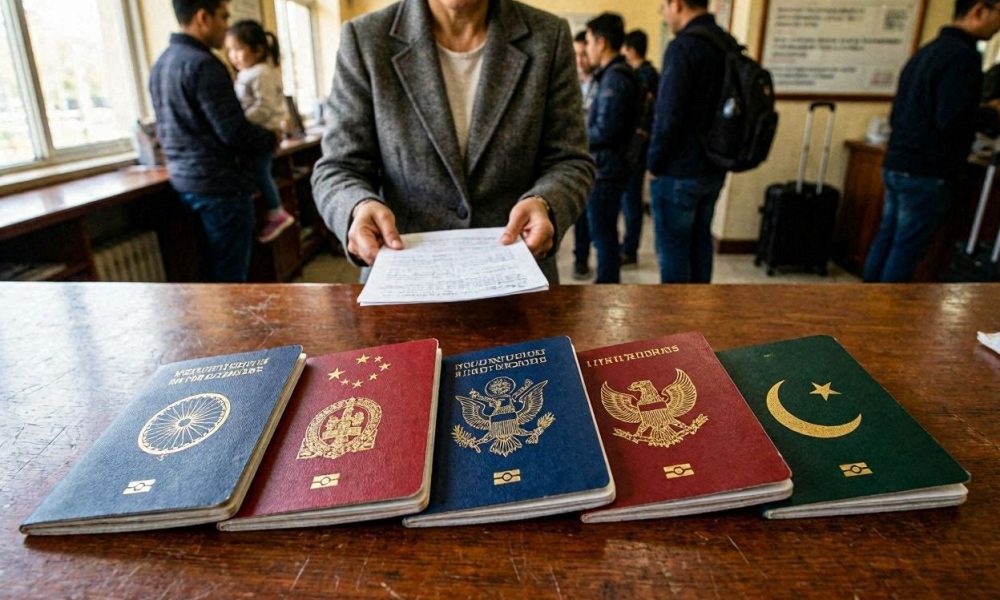
Global issuance trends as travel demand surges and new biometric systems go live across major economies.
WASHINGTON, DC, May 9, 2026.
The global passport machine is running at historic speed in 2026, as governments face surging travel demand, post-pandemic renewal cycles, expanding overseas workforces, growing student migration, biometric border modernization, and citizens who increasingly view a passport as a basic contingency document rather than an occasional travel accessory.
Across the world’s largest economies, passport agencies are no longer simply printing booklets for holidaymakers, because they are operating national-scale identity factories that must issue millions of secure documents while integrating chips, polycarbonate pages, online applications, facial biometrics, police checks, consular services, and automated border compatibility.
The highest-volume passport countries are defined by population, mobility demand, and administrative capacity.
The countries issuing the most travel documents are generally those with large populations, expanding middle classes, major overseas workforces, strong international education pipelines, heavy business travel, high renewal backlogs, or large numbers of citizens living outside national territory.
India, the United States, China, the United Kingdom, Japan, Germany, France, Canada, Brazil, Mexico, Indonesia, and several Gulf states all belong in the wider conversation because each combines a large citizen population with a rising demand for biometric travel documents.
Precise global comparisons remain difficult because countries publish passport statistics differently: some report fiscal years, some report calendar years, some include passport cards, some count only ordinary passports, and others release partial or delayed public figures.
Even with those differences, the trend is clear, because passport issuance has become a major public-service pressure point as international mobility resumes, biometric systems expand, and citizens renew documents that expired during years of disrupted travel.
India has become one of the clearest passport volume leaders.
India stands near the top of any serious 2026 issuance discussion because its population scale, expanding international student market, overseas employment demand, business migration, family travel, and large diaspora connection have created extraordinary pressure on the passport system.
Official Indian parliamentary material reported that passport issuance rose from 55 lakh in 2010 to 1.43 crore in 2024, showing how quickly demand has expanded as more citizens engage with global education, employment, tourism, and business networks.
That scale means India is not merely issuing documents for elite international travelers, because the passport has become a mainstream mobility instrument for students, nurses, engineers, seafarers, technology workers, entrepreneurs, families, and first-time international applicants.
Regional reporting from the Times of India described how Pune passport issuance nearly doubled over five years, a local example of the broader national surge driven by demand for education, employment, tourism, and business.
India’s passport growth reflects a deeper social transition.
The Indian passport boom is not only a government-processing story; it also reflects the emergence of a large, internationally mobile population that expects access to foreign universities, Gulf employment markets, technology hubs, tourism corridors, and family reunification routes.
As passport offices expand appointment systems, mobile outreach, digital processing, police-verification coordination, and online service platforms, India’s issuance capacity is becoming a critical part of the country’s global labor, education, and diaspora infrastructure.
The transition to e-passports and more advanced biometric systems will add another layer to this expansion, because high-volume issuance must now support chip personalization, data security, digital signatures, and compatibility with automated border systems abroad.
For travel-document manufacturers and identity technology providers, India represents one of the most important markets in the world, because even small process improvements can affect millions of applicants and reshape the pace of global document issuance.
The United States remains one of the world’s largest passport producers.
The United States is another passport powerhouse because its Department of State issued 27,348,416 passports in fiscal year 2025, including passport cards, according to official U.S. passport statistics that show record-level demand after several years of travel disruption and renewal pressure.
That figure places the United States among the largest publicly documented passport-issuing systems in the world, reflecting the size of the American traveling public, the importance of overseas tourism, and the demand for identity documents accepted across international borders.
The United States also faces a unique document environment because passport cards, books, overseas consular renewals, child passports, emergency documents, and high-security Next Generation Passports all exist within a massive federal issuance operation.
American demand has remained strong because citizens increasingly view passports as essential for family travel, emergency relocation, international business, cruise departures, dual-citizenship planning, overseas study, and contingency preparedness in an unpredictable world.
The U.S. system shows how volume and security must move together.
High issuance volume creates operational pressure, but it also increases the importance of security, because millions of new documents must be personalized correctly, protected from fraud, delivered securely, and designed to work with modern e-gates worldwide.
The U.S. Next Generation Passport uses a polycarbonate data page, laser engraving, updated artwork, and embedded technology to reflect the global shift toward travel documents that are more durable and resistant to alteration.
For American travelers, the passport remains both a mobility document and a federal identity credential, which means the system must balance customer service, national security, fraud prevention, consular access, and international interoperability at an extraordinary scale.
The United States demonstrates that the passport office has become a strategic identity operation, because every document must be useful to a citizen and trustworthy to a border authority thousands of miles away.
China belongs in the volume conversation, even when public issuance figures are harder to compare.
China is unavoidable in any discussion of high-volume passport issuance because its population scale, outbound tourism capacity, business travel, student movement, and expanding international engagement make it one of the most consequential travel-document markets in the world.
Publicly comparable annual passport issuance figures are less consistently available than in the United States, India, Japan, or some European countries, which makes precise ranking difficult without access to internal administrative data.
Even so, China’s potential issuance base is enormous because a relatively small percentage shift in outbound travel demand, student movement, or passport ownership can translate into millions of applications across provincial and municipal service systems.
China’s passport ecosystem is also closely tied to digital governance, border control modernization, outbound tourism policy, and the dynamics of international travel reopening, making it a major force in the global travel-document industry, even where statistics are less transparent.
Japan shows how passport volume can rise even when ownership remains comparatively low.
Japan issued approximately 3.62 million passports in 2025, according to its Ministry of Foreign Affairs, while the number of valid passports reached roughly 22.82 million by the end of that year.
Those figures are important because Japan has historically had a lower passport-holding rate than many other developed economies, meaning that issuance growth can reflect renewed outbound travel demand, adoption of online applications, and post-pandemic normalization rather than population size alone.
Japan’s travel-document system also matters because the country maintains a highly trusted passport, strong administrative capacity, and sophisticated e-passport standards, which make its issuance practices closely watched by other advanced economies.
Although Japan does not match India or the United States in annual volume, its combination of technology, public trust, and international mobility power makes it a major benchmark for secure document issuance in Asia.
The United Kingdom combines high circulation with a major design transition.
The United Kingdom remains a high-volume passport country because tens of millions of British passports are in circulation, millions of renewals are processed during peak cycles, and overseas British nationals rely heavily on consular and digital application systems.
The UK passport system also entered a new design phase with the rollout of a passport featuring the King’s coat of arms, enhanced holograms, translucent elements, unique laser-marked page numbers, and updated national imagery across the booklet.
That transition matters because design changes are not merely symbolic, since a high-volume issuer must introduce new security features without disrupting service standards, confusing travelers, or creating inconsistencies at foreign borders.
The British experience shows how passport volume and national identity intersect, because every redesign must balance heritage, fraud resistance, production scale, public recognition, and compatibility with automated inspection systems in Europe and beyond.
Europe’s largest economies issue fewer documents individually than India or the United States, but together they form a massive passport zone.
Germany, France, Italy, Spain, the Netherlands, Poland, and other European states collectively represent one of the world’s largest secure-document ecosystems, especially when national passports are considered alongside biometric residence permits, identity cards, and Schengen border modernization.
Individual annual passport issuance may not always rival that of India or the United States, but European governments operate in a dense travel environment where citizens renew documents frequently, cross borders, and rely on highly standardized identity systems.
European issuance trends are also shaped by biometric border systems, including automated gates, chip verification, digital signatures, and the broader modernization of Schengen entry and exit controls for third-country nationals.
This makes Europe a passport technology powerhouse, because its influence comes not only from issuance volume but also from standards, procurement models, document design, and regulatory expectations that shape global secure-document practices.
Canada illustrates how a moderate population size can still produce major passport pressure.
Canada does not have the population scale of India, China, or the United States, yet it remains a significant passport issuer because a high share of citizens travel internationally, hold cross-border family ties, and require reliable documents for U.S., European, Caribbean, and global mobility.
Canada’s modern passport features multiple versions of the holder’s photo, visible chip and antenna elements, color-shifting features, tactile components, and security designs intended to support both public confidence and border verification.
The Canadian market also shows how issuance pressure can appear suddenly when renewal cycles converge, especially after years in which travelers delayed applications, allowed documents to expire, or postponed international travel during disruptions.
For a country with extensive diaspora links, snowbird travel, global education flows, and cross-border business ties, the passport office is not merely an occasional service counter but a core provider of mobility infrastructure.
Brazil, Mexico, and Indonesia represent the next tier in scale.
Brazil, Mexico, and Indonesia belong in the high-volume conversation because each has a large population, significant international labor movement, growing middle-class travel demand, and administrative pressure to modernize identity systems while expanding access to passport services.
Brazil’s passport demand is shaped by tourism, business, migration, and dual-nationality issues, as well as by its role as South America’s largest country, while Mexico’s issuance environment is heavily influenced by cross-border family, labor, and consular needs.
Indonesia’s passport system is driven by population scale, overseas labor mobility, pilgrimage travel, student movement, and regional business travel, making it one of Asia’s most important long-term growth markets for biometric travel documents.
These countries may not always publish globally comparable annual issuance figures in the same format, but their demographic scale and mobility demand make them central to future growth in passport issuance.
Gulf states are smaller, but their document systems are strategically important.
The United Arab Emirates, Saudi Arabia, Qatar, and other Gulf states do not issue passports at the same scale as India or the United States, yet their travel-document systems are strategically important because they operate within high-mobility, digitally advanced, internationally connected economies.
The UAE, in particular, has become known for modern identity infrastructure, high levels of international mobility, digital government services, and secure document upgrades that align with its broader role as a global aviation and business hub.
Saudi Arabia’s issuance environment is shaped by major administrative modernization, pilgrimage logistics, growth in outbound travel, and the movement of citizens through increasingly digital government platforms.
These states show that passport influence is not measured solely by annual document counts, as technological sophistication, airport infrastructure, visa diplomacy, and digital identity integration can make smaller issuers highly influential.
The surge is being driven by travel demand and by fear of being caught without documents.
Passport demand is rising because people are traveling again, but also because more citizens want documents before they urgently need them, especially after recent years showed how quickly borders, conflict zones, health rules, and consular conditions can change.
Families now renew passports earlier for children, students apply before admission cycles are complete, professionals prepare for overseas work before contracts are finalized, and high-net-worth families treat passports as part of wider contingency planning.
The passport has therefore shifted psychologically from a document of leisure to one of readiness, thereby increasing baseline demand even among people who may not travel immediately after receiving it.
This change affects government planning because passport offices must handle not only predictable renewal cycles but also demand spikes triggered by economic opportunity, geopolitical anxiety, border-rule changes, and migration planning.
Biometric systems are making every high-volume issuer more technical.
The countries issuing the most passports are also investing in systems that make each document harder to forge, easier to verify, and more compatible with automated inspection at major airports and land borders.
Modern passport production requires biometric photo standards, chip encoding, PKI certificates, laser personalization, secure inventory control, polycarbonate data pages, data protection rules, and manufacturing processes capable of producing millions of documents without weakening quality.
That technical complexity means passport offices are becoming technology agencies as much as public-service agencies, because they must manage databases, cryptographic trust, chip personalization, vendor contracts, cybersecurity, and fraud detection alongside ordinary customer service.
For citizens, the process may still feel like filling out forms and submitting photographs, but behind the counter, the passport has become a sophisticated identity product governed by secure manufacturing and digital verification rules.
High volume creates higher fraud pressure.
The more passports a country issues, the more attractive its system becomes to fraudsters seeking stolen blanks, false applications, corrupt intermediaries, opportunities for identity theft, courier weaknesses, or genuine documents obtained through deception.
Large issuers must therefore protect every stage of the chain, from application submission and identity proofing to printing, chip encoding, delivery, renewal, revocation, and lost-document reporting.
A single weakness can scale quickly when millions of applications are involved, which is why high-volume countries invest heavily in staff vetting, audit trails, document-number reconciliation, biometric comparison, and secure logistics.
This is also why modern fraud increasingly targets the identity foundation rather than the finished booklet, because polycarbonate pages and chip authentication make post-issuance alteration harder than manipulating records before issuance.
The private mobility industry is watching passport volume because issuance trends shape compliance expectations.
High passport issuance affects banks, immigration firms, relocation advisers, tax planners, aviation companies, insurers, and private security consultants because each new document enters a wider ecosystem of onboarding, screening, travel, and identity verification.
Professional advisory firms such as Amicus International Consulting monitor these trends because lawful mobility planning now depends on the interplay among government-issued documents, biometric screening, banking compliance, tax identification, and cross-border privacy strategies.
The practical question is no longer only whether a client can obtain a passport, because the document must remain coherent with residency records, financial profiles, citizenship status, travel history, and the identity trail examined by institutions.
As passport volume rises, compliance systems become more automated, and clients who once thought of passports as simple travel booklets must now understand them as machine-readable components of a larger identity architecture.
Demand for second passports is part of the same global surge.
The surge in ordinary passport issuance has also influenced second-citizenship and lawful relocation planning, as more people now view mobility documents as essential tools for family security, tax planning, banking access, and geopolitical risk management.
A second passport can support lawful international mobility, but its value depends on the issuing country’s credibility, the integrity of the applicant’s records, the strength of the document, and the ability to pass electronic and biometric inspection.
This is why second passport advisory services increasingly focus on lawful eligibility, government authorization, documentation integrity, tax records, and long-term usability rather than treating the document as a standalone product.
The strongest second passport strategies are built for a world where borders read chips, banks compare records, governments share data, and automated systems look for inconsistencies across multiple identity documents.
The 2026 passport powerhouses are building the infrastructure of future mobility.
India and the United States stand out as the clearest publicly documented high-volume leaders, while China remains a major but less transparent force because of its population scale, outbound travel potential, and administrative capacity.
Japan, the United Kingdom, Canada, Germany, France, Brazil, Mexico, Indonesia, and major Gulf states form the next tier of important issuers, each contributing to global demand through different combinations of population, mobility culture, renewal cycles, and technology adoption.
The global picture is not simply about which country prints the most booklets, because the real story is that passport issuance has become a core function of national identity infrastructure.
As biometric systems go live and travel demand continues rising, the countries that issue the most passports will also shape the standards by which identity is verified, fraud is detected, mobility is managed, and citizens prove who they are when crossing the world’s borders.




