
It is reported that Jensen Huang, CEO of Nvidia (NVDA), said on Tuesday that the scale of China’s artificial intelligence (AI) chip market may reach 50 billion US dollars in the next few years.
In addition, Jensen Huang revealed to customers during his visit to Beijing in mid-April that the chip design will be adjusted to comply with export regulations. The new chip samples are expected to be delivered for testing as early as June. At the same time, the “China-exclusive version” of its next-generation Blackwell architecture is also being developed simultaneously.
Seize the opportunity of “AI computing power main line”
From the perspective of the market structure, Nvidia has long dominated the AI chip market. Its CUDA ecosystem provides developers with rich tools and resources and has a large user base. Nvidia said that it will continue to optimize chip architecture, improve computing power and energy efficiency to meet the growing demand for AI applications.
At present, the AI field has ushered in explosive growth. Many large models have not only exceeded the hundreds of billions of parameter scale, but also achieved disruptive breakthroughs in multimodal interaction, real-time computing power reasoning, and vertical scene landing, which has attracted global attention.
Another thing worth noting is that the recent performance of companies related to the AI computing power industry chain of listed companies has been outstanding, confirming the continued high prosperity of the industry. With the surge in global demand for AI large-scale model training and reasoning, investment in computing power infrastructure has accelerated, and the layout of companies in subdivided fields such as optical modules and data centers has led to a significant increase in the overall AI market.

Related listed companies have fully entered the market
Microsoft (MSFT)
It is reported that the US technology giant Microsoft released its financial report, and many core indicators far exceeded market expectations. Among them, Azure and other cloud service revenue increased by 33%, setting a new high in the past year. AI services contributed 16 percentage points to Azure’s growth, which was further increased from the previous quarter.
CEO Satya Nadella emphasized that thanks to the continuous increase in AI computing power, AI assistant Copilot, Azure OpenAI services and cooperation with DeepSeek have further expanded the customer base. The company plans to invest a total of US$80 billion in AI infrastructure in fiscal 2025, with the goal of increasing AI training computing power by 5 times by 2026.
Google (GOOG)
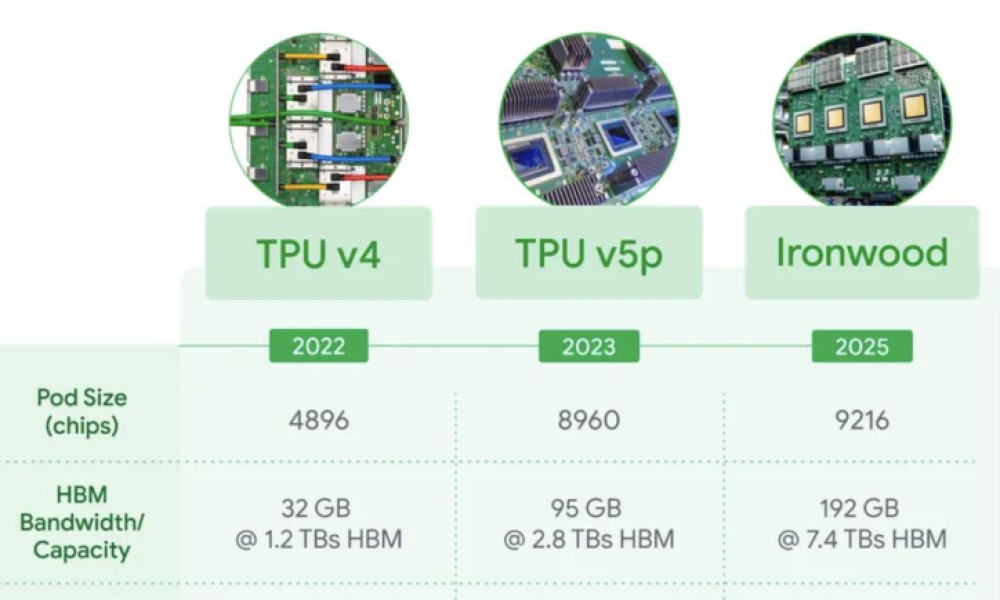
According to reports, Google’s first AI reasoning-specific TPU chip has been released, with a FP8 peak computing power of 4614TFlops, which is 3600 times the performance of the second-generation TPU in 2017 and 10 times the performance of the fifth-generation TPU in 2023. It is specially designed for deep thinking models.
In fact, the design idea of Google TPU v7 is to minimize data movement and latency on the chip while performing large-scale tensor operations. The TPU v7 system also has a low-latency, high-bandwidth ICI (inter-chip communication) network that supports coordinated synchronous communication at the full cluster scale, and the two-way bandwidth is increased to 1.2 Tbps, which is 1.5 times that of the previous generation.
Google plans to integrate TPU v7 into Google Cloud AI supercomputing in the near future to support businesses including recommendation algorithms, Gemini models and AlphaFold.
Amazon (AMZN)
According to reports, the growth of Amazon’s AWS business is mainly due to the rapid development of generative AI, the acceleration of enterprise cloud migration and the support of technological innovation. At the same time, the company released a financial report emphasizing that AWS continues to grow in generative AI and non-generative AI products. AWS’s AI business has an annual revenue run rate of billions of dollars and is growing at a triple-digit percentage every year.
Alibaba (BABA )
It is reported that in terms of AI applications, Alibaba announced the launch of a new generation of Tongyi Qianwen model Qwen3, which has only 1/3 of the parameters of DeepSeek-R1, significantly reduced costs, and surpassed the world’s top models such as R1 and OpenAI-o1 in performance in the ChatBot Arena and other lists, becoming the world’s strongest open source model.
In addition, only 4 H20s are needed to deploy the full-blooded version of Qwen3, and the video memory usage is only one-third of that of models with similar performance. Alibaba said that Qwen3 is the first “hybrid reasoning model” in China, which will integrate “fast thinking” and “slow thinking” into the same model, and can “reply” answers to simple needs with low computing power, and “deep thinking” in multiple steps for complex problems, which can greatly save computing power consumption.
WiMi (WIMI)
According to the data, WiMi efficiently captures the AI computing power market, and lays out computing power hardware + computing power software + AI applications at the forefront. Its AI chips have significant advantages in energy efficiency and computing power efficiency, and support multiple needs such as lightweight language models and multimodal generative models, and will fully enjoy the dividends of the global AI industry chain.
At present, WiMi has built a full-stack innovation system covering chip design, algorithm optimization and scene implementation by integrating edge computing chips, quantum information technology and AI algorithms. In addition, as models such as DeepSeek drive the exponential growth of inference computing power, WiMi plans to lay out a new quantum computing power ecosystem through software and hardware collaborative optimization, accelerate the integration of quantum computing and AI, explore a new computing power ecosystem, and increase the market share of computing power chips.
Conclusion
With the in-depth application of AI technology, the market demand for AI computing power continues to rise, especially the market demand for high-end chips has increased significantly. In the future, with the breakthrough of large model technology and the continuous expansion of industry application scenarios, the computing power industry chain will continue to maintain a high level of prosperity, especially in computing power infrastructure, vertical applications, and ecological synergy. This trend not only improves the overall prosperity of the computing power sector, but also brings unprecedented market opportunities to related companies.




