
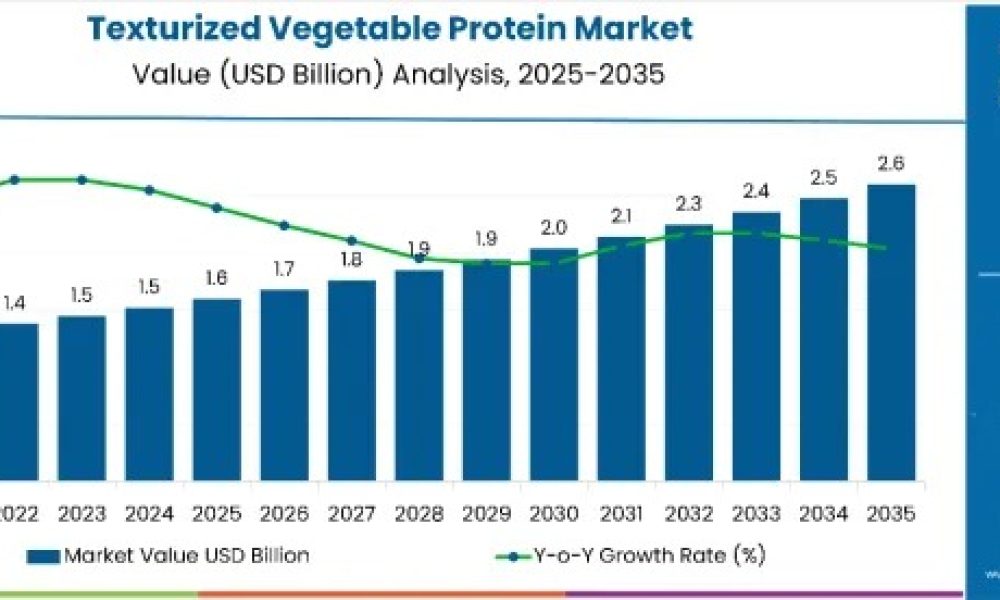
The global texturized vegetable protein market is projected to maintain steady, fundamentals-driven expansion over the next decade, supported by consistent industrial demand, gradual capacity additions, and wider adoption across food manufacturing applications. The market is estimated to be valued at USD 1.7 billion in 2026 and is forecast to reach USD 2.7 billion by 2036, advancing at a value-based CAGR of 5.0% during the forecast period. Growth reflects stable consumption patterns, replacement demand in processed foods, and improved availability across both developed and emerging markets.
TVP continues to play a critical role as a cost-efficient, functional protein ingredient used extensively in meat alternatives, ready-to-eat meals, frozen foods, and institutional catering. Its ability to deliver consistent texture, reliable performance, and extended shelf life positions it as a preferred solution for large-scale food processors navigating cost pressures and evolving consumer preferences.
Explore trends before investing – request a sample report today!
Market Expansion Anchored in Operational Efficiency and Supply Stability
Growth in the texturized vegetable protein market is being reinforced by investments in process optimization, better capacity utilization, and quality consistency. Manufacturers are prioritizing operational efficiency, stronger supplier partnerships, and broader regional distribution networks to remain competitive. Stable demand from industrial buyers—particularly food manufacturers and foodservice operators—continues to underpin long-term revenue visibility through 2036.
At the same time, the industry operates within ongoing challenges related to raw material price volatility, regulatory compliance, and regional operational constraints. Companies are responding by diversifying sourcing strategies, refining product portfolios, and selectively expanding into new geographies where plant-based food adoption is gaining momentum.
Segmentation Highlights Reflect Industrial-Led Demand
The texturized vegetable protein market is segmented by form, end use, and region. Among formats, chunks account for 45% of global demand, making them the most commercially significant form. Their dominance is driven by strong use in meat analogues and processed foods where meat-like texture, chewiness, and visual appeal are essential. Chunks offer high rehydration capacity, structural stability during cooking, and strong flavor absorption, making them well-suited for vegetarian and flexitarian product lines.
By end use, industrial applications represent 69% of total global demand, reflecting extensive usage by food manufacturers, meat processors, and institutional foodservice providers. Industrial buyers value TVP for its consistent quality, scalability, long shelf life, and ability to enhance nutritional profiles while supporting clean-label and sustainability objectives.
Quick Market Snapshot
- Market Value (2026): USD 1.7 billion
- Forecast Value (2036): USD 2.7 billion
- Forecast CAGR (2026–2036): 5.0%
- Leading Form Segment: Chunks (45% share)
- Key Growth Regions: United States, China, India, Western Europe
Regulatory and Investment Factors Shape Scalability
Scalability in the TVP market is closely linked to regulatory requirements and capital investment capacity. Food safety standards, allergen disclosures, non-GMO claims, and clean-label expectations require continuous investment in quality control and traceability systems. Introducing alternative protein sources such as pea, lentil, or chickpea often involves extended approval timelines, varying by region, which can slow commercialization.
Capital intensity also remains a defining factor. TVP production relies on advanced extrusion equipment and energy-efficient processing infrastructure. Long-term scalability depends on securing diversified raw material supplies, maintaining cost control, and aligning capacity expansion with demand from food processors and foodservice channels.
Country-Level Growth Reflects Mainstreaming of Plant-Based Diets
Between 2026 and 2036, demand for texturized vegetable protein is expected to rise steadily across major economies as plant-based eating becomes more mainstream.
- China (CAGR 4.8%) leads growth, driven by large-scale food manufacturing, strong domestic soy processing, and rising flexitarian diets among middle-income consumers.
- United Kingdom (4.5%) benefits from strong retail and foodservice adoption of plant-based foods, supported by clean-label positioning and innovation.
- India (4.1%) sees growth from widespread vegetarian diets, affordability considerations, and expanding organized food retail.
- Germany (3.9%) reflects steady demand linked to sustainability-focused consumers and robust food manufacturing infrastructure.
- United States (3.7%) remains a stable, innovation-driven market with consistent demand from meat alternatives and prepared foods.
To access the full market analysis, strategic recommendations, and analyst support, purchase the complete report here.
Competitive Landscape Remains Moderately Consolidated
The global texturized vegetable protein market is moderately consolidated, with competition shaped by access to agricultural raw materials, extrusion expertise, and long-standing customer relationships. Leading players benefit from vertically integrated supply chains and broad protein portfolios, while mid-sized companies compete through application-specific solutions and regional focus.
Key players include Archer Daniels Midland Company, Cargill Inc., Roquette Frères, Wilmar International Ltd., Fuji Oil Co. Ltd., Crown Soya Protein Group, and Granea Sp. z o.o. Competitive differentiation increasingly centers on clean-label compliance, allergen management, and the development of non-soy TVP options.
About Future Market Insights (FMI)
Future Market Insights, Inc. (FMI) is an ESOMAR-certified, ISO 9001:2015 market research and consulting organization, trusted by Fortune 500 clients and global enterprises. With operations in the U.S., UK, India, and Dubai, FMI provides data-backed insights and strategic intelligence across 30+ industries and 1,200 markets worldwide.



