
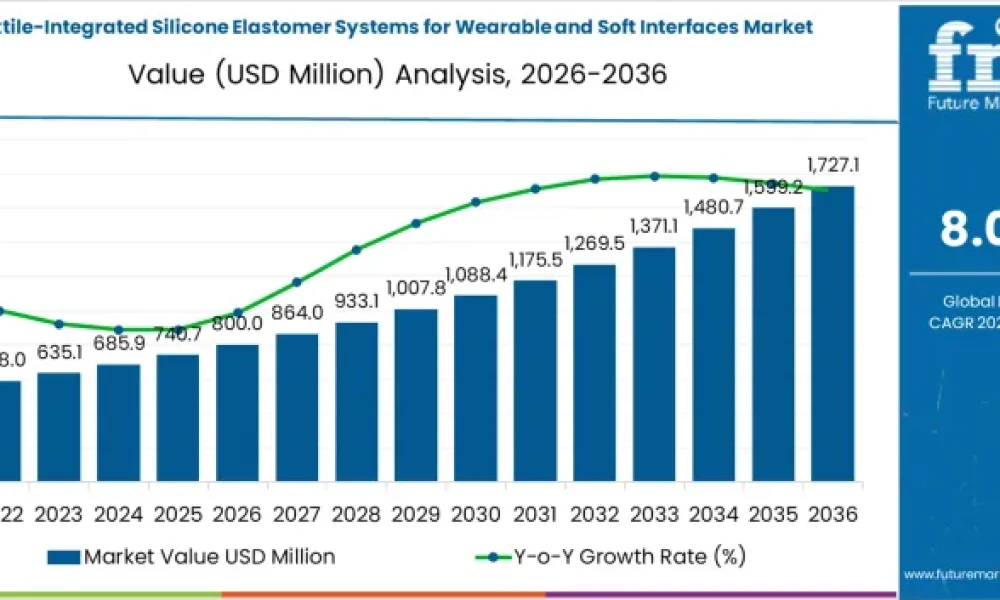
The Textile-Integrated Silicone Elastomer Systems for Wearable and Soft Interfaces Market is rapidly evolving into a cornerstone of tomorrow’s wearable technology ecosystem, with the global market estimated to hit USD 800 million in 2026 and projected to surge to USD 1,727.1 million by 2036, based on robust demand across health monitoring, smart textiles, and flexible consumer electronics industries with an expected 8 % compound annual growth rate (CAGR) over the next decade. This growth underscores the rising imperative for advanced materials that deliver comfort, durability, and seamless textile integration in next-generation wearables.
Key Market Insights at a Glance
The dynamic textile-integrated silicone elastomer systems market is anchored by technological innovations that make wearables more adaptive and user-centric. Liquid Silicone Rubber (LSR) leads with approximately 40 % market share due to its superior stretchability, biocompatibility, and skin-friendly performance. Health & fitness wearables remain the dominant application, commanding roughly 55 % of the market as consumers increasingly demand fashionable yet functional devices that monitor wellness and activity in real time.
Emerging use cases span smart garments with embedded sensors, soft interfaces in augmented reality applications, and medical and rehabilitation textiles that enhance patient care. The rise of textile-embedded electronics is reshaping user expectations for comfort without compromise on performance, as manufacturers focus on hybrid materials that seamlessly integrate silicone elastomers into fabric substrates.
Segment Overview
The market is segmented by elastomer type and application. Liquid Silicone Rubber (LSR) stands out as the most widely used material, accounting for a significant portion of revenues due to its unmatched elasticity and resistance to moisture and heat. Other elastomer categories include room-temperature vulcanized (RTV) and high-temperature vulcanized (HTV) silicones, along with advanced silicone composites and hybrid materials that expand functional versatility across sectors.
On the application front, health and fitness wearables continue to dominate, driven by a global surge in preventive health awareness and the proliferation of connected wearable gadgets. Smart textiles, medical garments, and performance-oriented textiles are also gaining traction, reflecting a broader shift toward personalized and responsive fabric technologies in both consumer and clinical environments.
To access the complete data tables and in-depth insights — Request Your Sample Report Now
Regional Overview
Growth across major regions underscores a worldwide embrace of textile-integrated silicone elastomer technologies. Asia Pacific leads with the highest projected CAGR—particularly in China, where wearable tech adoption and smart textile innovations are flourishing. North America follows closely, driven by entrenched innovation ecosystems in the United States and Canada that support wearable computing and health-tech integration. Europe exhibits steady expansion, underpinned by strong research & development capabilities and rising investments in medical and industrial wearable applications. Markets in South Korea, Japan, and Germany are also contributing healthy growth, propelled by advanced electronics manufacturing and consumer electronics demand.
Competitive Landscape
The competitive arena is shaped by global specialty chemical and material science leaders advancing silicone-textile integration solutions. Notable key players include Dow Inc., Wacker Chemie AG, Shin-Etsu Chemical Co., Ltd., Momentive Performance Materials, Elkem ASA, and Specialty Silicone Products, Inc., which collectively push the boundaries of material performance, textile compatibility, and processing efficiency. These companies are actively expanding product portfolios to include customizable elastomer formulations suited for diverse wearable and soft interface applications.
Competition is intensified by R&D initiatives aimed at enhancing mechanical resilience, elasticity, and tactile comfort, while maintaining consistency in large-scale manufacturing environments. Strategic collaborations between elastomer manufacturers, textile producers, and electronics OEMs are shaping multi-disciplinary frameworks that foster innovation across product lifecycles.
Market Outlook: Powering the Next Decade
Analysts expect the textile-integrated silicone elastomer systems market to dramatically influence how wearables are designed, produced, and experienced over the next decade. With a projected near-doubling in market value by 2036, the industry is poised for significant reinvention in how fabrics and flexible materials interact with embedded technology. Adoption of sustainable and high-performance elastomers will be critical as wearable demand spans health, entertainment, sports, and enterprise sectors.
Growth will be further propelled by consumer preference for comfortable, adaptive wearables that seamlessly blend into daily life. Additionally, advancements in elastomer chemistry and textile processing technologies will continue to reduce integration costs and enhance product reliability, making soft interfaces ubiquitous in connected devices.
Key Players of Sustainable Label Industry
Leading organizations are increasingly prioritizing sustainability—both in material selection and scalable manufacturing practices. Companies like Dow Inc. and Wacker Chemie AG are championing low-impact production methods and recyclable silicone systems to align with global sustainability goals. Meanwhile, specialty suppliers are collaborating with textile innovators to reduce waste and extend product lifespans through eco-friendly elastomer solutions.
Recent Strategic Developments
Recent strategic developments in the sector include intensified R&D investments to create next-generation silicone elastomers with enhanced sensory capabilities and eco-conscious attributes. Industry alliances are emerging to support innovation incubators, pilot programs, and cross-continental manufacturing partnerships that accelerate adoption of flexible textile technologies. These initiatives signal a unified push toward integrating advanced material science with user-centric wearable design.
Have a specific Requirements and Need Assistant on Report Pricing or Limited Budget please contact us – [email protected]
About Future Market Insights (FMI)
Future Market Insights, Inc. (FMI) is an ESOMAR-certified, ISO 9001:2015 market research and consulting organization, trusted by Fortune 500 clients and global enterprises. With operations in the U.S., UK, India, and Dubai, FMI provides data-backed insights and strategic intelligence across 30+ industries and 1200 markets worldwide.
Why Choose FMI: https://www.futuremarketinsights.com/why-fmi



