Textile Dyes Market 2025: Sustainable Innovations & Growth Trends to Watch
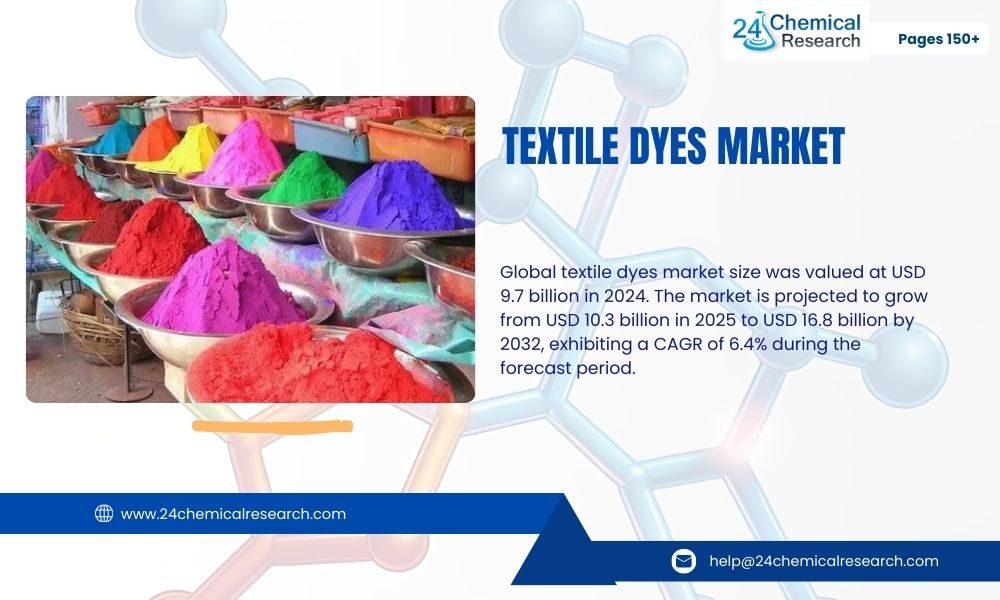
The global textile dyes market continues to demonstrate robust expansion, with its valuation reaching USD 9.7 billion in 2024. According to comprehensive industry analysis, the market is projected to grow at a CAGR of 6.4%, reaching approximately USD 16.8 billion by 2032. This sustained growth trajectory reflects increasing textile production worldwide and the rising adoption of advanced dyeing technologies that cater to evolving environmental and performance requirements.
Textile dyes are specialized chemical formulations that bond permanently with fabrics through complex molecular interactions. These coloring agents are classified into several categories including reactive, disperse, acid, and vat dyes – each engineered for specific fiber types and application conditions. The dyeing process has evolved significantly, incorporating innovations that enhance color fastness while reducing environmental impact across the textile value chain.
Download FREE Sample Report: https://www.24chemicalresearch.com/download-sample/215886/global-textile-dyes-market
Market Overview & Regional Analysis
Asia-Pacific stands as the undisputed leader in textile dye consumption, accounting for over 60% of global demand. The region’s dominance stems from its extensive textile manufacturing base across China, India, Bangladesh, and Vietnam. This concentration of production facilities creates a continuous need for high-performance dyes, particularly reactive varieties for cotton and disperse dyes for polyester fabrics. The region also benefits from lower production costs and improving technical capabilities in specialty dye formulations.
Europe maintains a strong position in premium dye technologies, with Germany, Italy, and Turkey serving as innovation hubs for sustainable dye solutions. Strict environmental regulations like REACH have pushed European manufacturers to develop advanced formulations with reduced ecological impact. North America’s market is characterized by specialized demand, particularly for dyes used in high-performance textiles for military, medical, and outdoor applications where durability and safety standards are paramount.
Key Innovations & Product Launches
- Eco‑Friendly Reactive Dyes with Reduced Resource Use
- Shree Pushkar Chemicals & Fertilisers Ltd. (India) introduced the Dyecol ESR series of reactive dyes which use tri‑functional reactivity to bond more efficiently with cotton fibre. These reduce water and energy usage by up to ~50%, and reduce salt usage by about 20%.
- Also, Shree Pushkar launched salt‑free reactive dyes under their DYECOL SS and DYECOL DR series, offering high strength dyes that require less auxiliary (chemicals) usage.
- Digital Printing & Water‑less / Low‑Water Dyeing Technologies
- The market is seeing rising adoption of digital textile printing, which promises faster turnaround, lower dye waste, and substantial water reductions compared to traditional dye baths.
- Eco‑innovations include waterless or low‑liquor ratio dyeing processes; some reactive dyes now formulated for low‑liquor ratio, enabling much smaller volumes of dye bath liquid per kg of fabric.
- Regulatory Pressure & Sustainability Push
- Companies are being pushed (by consumers, brands, governments) to use more biodegradable dyes, less toxic auxiliaries, and reduce wastewater pollution.
- There is a growing shift in the dye product mix: more investment in dyes that comply with stricter environmental standards, and expansion of eco‑certifications.
- New Launches for Bold Colour + Efficiency
- Archroma in March 2025 launched the AVITERA® RASPBERRY SE dye, delivering deeper red tones while slashing water + energy consumption by up to ~50%.
- Huntsman Textile Effects expanded its AVITERA SE range, with similar aims: better dye uptake / fixation, lower resource usage.
Market Trends & Drivers
- Strong Growth in Eco‑Friendly Dye Segment
The market for eco‑friendly textile dyes is growing at higher CAGRs (often in double digits) compared to conventional dyes. - Asia‑Pacific Leading in Manufacturing & Demand
The region remains dominant in textile dye consumption and production, particularly in countries like China, India, Bangladesh. Many innovations and new plant investments are being made in APAC. - Consumer & Regulatory Pressure
Consumers want sustainable, non‑toxic, traceable dyes. Regulations in many regions are tightening around wastewater discharge, banned substances (e.g. heavy metals), PFAS / fluorinated compounds, etc. These are pushing the industry to shift product lines. - Functional & Specialty Applications
Activewear, medical textiles, home furnishing, and technical textiles are demanding dyes with higher performance (wash fastness, light fastness, UV stability), as well as eco credentials. Hybrid dyes, dyes for blends (synthetic / natural), digital printing‑compatible dyes are growing.
Challenges & Risks
- Cost / Investment for New Dye Technologies
While sustainable dyes often offer lower water, chemical or energy use, switching manufacturing lines, handling new auxiliaries, or certifying processes involves cost. Adoption may be slower in regions with tight margins. - Matching Colour / Fastness vs Eco‑Performance
Getting eco‑friendly dyes to match the colour vibrancy, wash/light fastness, and stability of conventional dyes is a technical challenge. Sometimes greener dyes trade off a little on performance, so R&D is ongoing to close that gap. - Supply Chain / Raw Materials
Feedstock for natural dyes or bio‑based components can be variable. Also, many synthetic dyes rely on petrochemical inputs; fluctuating costs of raw chemicals impact pricing. - Regulation Complexity & Compliance
Different countries have different rules on what’s allowed in dye chemicals, what wastewater treatment must achieve, etc. Manufacturers in one country exporting to another may need to satisfy multiple regulatory frameworks.
Key Market Drivers and Opportunities
The textile dyes market is propelled by several fundamental growth factors. The global expansion of fast fashion, coupled with rising disposable incomes in emerging economies, continues to drive demand for colorful apparel. Simultaneously, the growth of technical textiles – used in automotive, healthcare, and protective gear applications – requires specialized dyes with enhanced performance characteristics. Digital textile printing presents a particularly promising opportunity, as this emerging technology demands concentrated, highly pure dyes that command premium pricing.
Sustainability initiatives represent another major opportunity area, with brands increasingly prioritizing eco-friendly dyeing processes. Waterless dyeing technologies, natural dye alternatives, and advanced effluent treatment solutions are gaining traction as the industry works to reduce its environmental footprint. This shift aligns with changing consumer preferences and tightening regulatory requirements worldwide.
Challenges & Restraints
Despite strong growth prospects, the textile dyes market faces several significant challenges. Environmental regulations, while driving innovation, also increase compliance costs and operational complexity. The development of new eco-friendly formulations can require investments upwards of $500,000 per dye, creating barriers for smaller manufacturers. Raw material price volatility – particularly for petrochemical derivatives used in synthetic dyes – presents another persistent challenge, making cost management increasingly difficult.
Alternative coloring technologies, such as solution-dyed fibers, threaten to displace traditional dyeing methods in certain applications. While currently limited in scope, these innovations could capture market share in technical textile segments where performance outweighs design flexibility. Wastewater treatment requirements also remain a substantial operational challenge, particularly in developing markets where infrastructure limitations exist.
Market Segmentation by Type
- Reactive Dyes
- Disperse Dyes
- Acid Dyes
- Vat Dyes
- Direct Dyes
Market Segmentation by Application
- Apparel
- Home Textiles
- Technical Textiles
- Automotive Textiles
- Others
Market Segmentation and Key Players
- Archroma
- Huntsman Corporation
- Kiri Industries
- Nippon Kayaku
- CHT Switzerland
- Kyung-In Synthetic Corporation
- Jay Chemicals
- Everlight Chemical
- Bodal Chemicals
- Atul Ltd
- Sumitomo Chemical
- Aarti Industries
- Hubei Chuyuan Group
- Runtu
- Jihua Group
Report Scope
This report presents a comprehensive analysis of the global and regional markets for textile dyes, covering the period from 2024 to 2032. It includes detailed insights into the current market status and outlook across various regions and countries, with specific focus on:
- Sales, sales volume, and revenue forecasts
- Detailed segmentation by type and application
In addition, the report offers in-depth profiles of key industry players, including:
- Company profiles
- Product specifications
- Production capacity and sales
- Revenue, pricing, gross margins
- Sales performance
It further examines the competitive landscape, highlighting the major vendors and identifying the critical factors expected to challenge market growth.
As part of this research, we surveyed textile dyes companies and industry experts across the value chain. Primary research covered:
- Current market dynamics and emerging trends
- Technological advancements in dye formulations
- Regulatory developments impacting production
- Regional demand patterns and growth opportunities
Get Full Report Here: https://www.24chemicalresearch.com/reports/215886/global-textile-dyes-market
FREQUENTLY ASKED QUESTIONS:
What is the current market size of the Global Textile Dyes Market?
→ The global textile dyes market was valued at USD 9.7 billion in 2024 and is projected to reach USD 16.8 billion by 2032.
What growth rate is expected for the textile dyes market?
→ The market is anticipated to grow at a CAGR of 6.4% from 2024 to 2032.
Which region dominates the textile dyes market?
→ Asia-Pacific accounts for over 60% of global demand, led by textile manufacturing hubs in China, India, and Bangladesh.
What are the key types of textile dyes?
→ Major categories include reactive dyes, disperse dyes, acid dyes, vat dyes, and direct dyes.
Who are the leading companies in this market?
→ Key players include Archroma, Huntsman, Kiri Industries, Nippon Kayaku, and CHT Switzerland.
Founded in 2015, 24chemicalresearch has rapidly established itself as a leader in chemical market intelligence, serving clients including over 30 Fortune 500 companies. We provide data-driven insights through rigorous research methodologies, addressing key industry factors such as government policy, emerging technologies, and competitive landscapes.
- Plant-level capacity tracking
- Real-time price monitoring
- Techno-economic feasibility studies
With a dedicated team of researchers possessing over a decade of experience, we focus on delivering actionable, timely, and high-quality reports to help clients achieve their strategic goals. Our mission is to be the most trusted resource for market insights in the chemical and materials industries.
International: +1(332) 2424 294 | Asia: +91 9169162030
Website: https://www.24chemicalresearch.com/




