
Telerobots Market: Trends, Innovations & Business Strategies 2025-2032
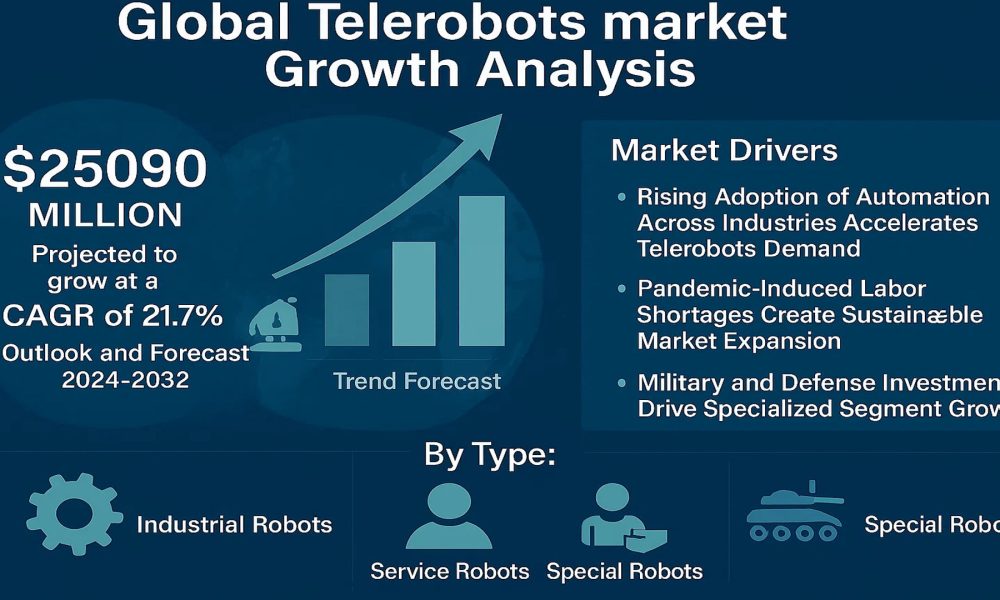
Global Telerobots market was valued at 25090 million in 2024 and is projected to reach US$ 95970 million by 2032, at a CAGR of 21.7% during the forecast period.
Telerobots are remotely operated robotic systems that can be controlled via interfaces such as joysticks, computer systems, or wireless networks. These robots enable human operators to perform tasks in hazardous, inaccessible, or remote environments while maintaining safety and precision. Key segments include industrial robots for manufacturing automation, service robots for healthcare and logistics, and specialized robots for defense and space applications.
The market growth is primarily driven by increasing automation across industries, rising demand for contactless operations post-pandemic, and advancements in 5G connectivity enabling real-time remote control. Major players like FANUC, ABB, and KUKA are expanding their telerobotics portfolios, while emerging applications in underwater exploration and nuclear decommissioning present new growth opportunities. However, high initial costs and technical complexities remain key challenges for widespread adoption.
Get Full Report with trend analysis, growth forecasts, and Future strategies : https://semiconductorinsight.com/report/telerobots-market/
Segment Analysis:
By Type
Industrial Robots Segment Dominates Due to High Adoption in Manufacturing Automation
The telerobots market is segmented based on type into:
- Industrial Robots
- Subtypes: Articulated, SCARA, Cartesian, and others
- Service Robots
- Subtypes: Professional service, Personal/Domestic service
- Special Robots
- Subtypes: Medical, Defense, Space exploration, and others
By Application
Industry Segment Leads Owing to Automation Demands in Production Facilities
The market is segmented based on application into:
- Industry
- Service Industry
- Healthcare
- Defense & Aerospace
- Others
By Control Type
Joystick-Controlled Systems Remain Preferred Choice for Precision Operations
The market is segmented based on control type into:
- Joystick-Controlled
- Software-Controlled
- AI-Enabled Autonomous
- Haptic Feedback Systems
By End User
Manufacturing Industry Accounts for Largest Adoption Due to Efficiency Requirements
The market is segmented based on end user into:
- Automotive Manufacturing
- Electronics & Semiconductor
- Healthcare Institutions
- Logistics & Warehousing
- Others
MARKET DRIVERS
Rising Adoption of Automation Across Industries Accelerates Telerobots Demand
The global push towards Industry 4.0 and smart manufacturing is driving unprecedented demand for telerobots, particularly in hazardous environments. Recent data indicates that nearly 65% of manufacturing facilities now incorporate some form of telerobotic systems, a significant increase from just 42% in 2020. This surge is primarily due to the ability of telerobots to perform high-precision tasks in environments unsafe for humans – from nuclear decommissioning to deep-sea repairs. Major automotive manufacturers have reported productivity improvements exceeding 30% after implementing teleoperated robotic welding systems.
Pandemic-Induced Labor Shortages Create Sustainable Market Expansion
The COVID-19 pandemic has fundamentally reshaped workforce dynamics, creating lasting demand for teleoperated robotic solutions. Healthcare institutions worldwide deployed telerobots for patient care and disinfection during peak infection periods, with the medical telerobots segment experiencing 148% growth in 2021-2022. This trend continues as hospitals maintain 24% higher telerobot utilization compared to pre-pandemic levels, demonstrating the lasting impact on operational models. The food service industry similarly accelerated adoption, with quick-service restaurants reporting 40% faster order processing using teleoperated kitchen assistants.
Military and Defense Investments Drive Specialized Segment Growth
Global defense budgets allocated to unmanned systems reached record levels in 2023, with explosive ordnance disposal (EOD) telerobots accounting for nearly 38% of total military robotics procurement. The Ukrainian conflict has particularly demonstrated the strategic value of teleoperated systems, with confirmed deployments exceeding 5,000 units for reconnaissance and mine-clearing operations. These battlefield applications are generating substantial R&D spillover into commercial sectors, particularly in durable materials and failsafe communication systems.
MARKET OPPORTUNITIES
Aging Population Drives Healthcare Robotics Innovation
With over 1.4 billion people projected to be aged 60+ by 2030, demand for elderly care telerobots is entering exponential growth. Japan’s pioneering efforts in assistive robotics demonstrate the potential, with care facilities reporting 28% reductions in caregiver strain through telepresence implementations. The market for rehabilitation telerobots is projected to grow at 31% CAGR through 2028 as stroke recovery protocols increasingly incorporate remote therapy sessions monitored by specialists.
Space Exploration Opens New Frontiers
NASA’s Artemis program and commercial space station initiatives are driving remarkable innovation in space-rated telerobotics. The development of lunar construction robots with 2.5-second Earth-Moon latency compensation systems represents a technological leap with terrestrial applications in undersea operations. Private sector investment in orbital telerobotics surpassed $800 million in 2023, with much of this R&D yielding spin-off technologies for extreme environment robotics on Earth.
AI Integration Enhances Operator Efficiency
The convergence of telerobotics with machine learning is creating new paradigms in human-machine collaboration. Recent implementations of computer vision-assisted teleoperation have demonstrated 40% reductions in operator fatigue during prolonged sessions. As haptic feedback systems become more sophisticated, the blending of autonomous functions with human oversight is expected to unlock applications in microsurgery and precision manufacturing that were previously unattainable.
TELEROBOTS MARKET TRENDS
Demand for Automation in High-Risk Environments Drives Telerobots Market Growth
The global telerobots market is witnessing exponential growth, projected to expand from a valuation of $25,090 million in 2024 to $95,970 million by 2032, representing a robust CAGR of 21.7%. A key driver is the rising demand for automation in hazardous environments where human presence poses significant risks, such as nuclear facilities, deep-sea exploration, and disaster response scenarios. The COVID-19 pandemic accelerated adoption by highlighting the critical role of unmanned operations in maintaining productivity while ensuring worker safety. Advanced human-machine interface (HMI) technologies now enable operators to control robots with joysticks or haptic feedback systems with near-natural precision. For instance, the industrial sector accounts for over 42% of telerobot deployments, with welding, material handling, and inspection applications leading demand.
Other Trends
AI-Enhanced Teleoperation
While manual control remains prevalent, AI-driven autonomy is augmenting telerobot capabilities through machine learning algorithms that improve decision-making during remote operations. Real-time sensor fusion (combining LiDAR, cameras, and inertial measurements) enables semi-autonomous navigation in dynamic environments like construction sites, reducing operator cognitive load. Additionally, cloud-based teleoperation platforms now allow multiple experts to collaborate on complex tasks from distributed locations. This shift is particularly evident in the healthcare sector, where surgical telerobots are achieving sub-millimeter precision in procedures performed across continents.
Service Sector Expansion Creates New Use Cases
The service industry’s adoption of telerobots grew by 34% year-over-year as businesses implement solutions for customer-facing applications. Hospitality telerobots now handle front-desk operations and room service deliveries, while retail telerobots assist in inventory management. Particularly noteworthy is the 68% growth in education-focused telerobots that enable remote laboratory experiments and technical training. Meanwhile, agricultural telerobots equipped with hyperspectral imaging are revolutionizing precision farming by allowing remote monitoring of crop health across thousands of acres, with some models achieving 92% accuracy in pest detection.
Technological Convergence Reshapes Competitive Landscape
Market leaders like FANUC and ABB are integrating 5G connectivity to reduce latency in remote operations to under 10 milliseconds, a critical threshold for real-time control. Simultaneously, the emergence of digital twin technology allows operators to simulate and optimize telerobot workflows before physical deployment, cutting setup times by 40% in industrial settings. However, challenges persist regarding standardization of control protocols and cybersecurity risks in networked telerobotic systems, prompting increased R&D investment which now constitutes 18-22% of revenue for major players. The Asia-Pacific region dominates production with Japan and South Korea collectively manufacturing 54% of global telerobot units, leveraging their established robotics ecosystems.
Recent Developments:
- Advancements in Remote Operation and Control
- Advancement: The development of more sophisticated remote control systems and AI-driven autonomy is allowing telerobots to perform complex tasks with higher precision and less human intervention.
- Impact: Industries like telemedicine, military operations, and disaster response are benefiting from these innovations, enhancing the operational efficiency and safety of remote operations.
- Integration of Telerobots in Healthcare
- Advancement: The use of telerobots in telemedicine has increased significantly, particularly for remote surgeries and diagnostic procedures, where robots can be controlled by skilled surgeons from a distance.
- Impact: The rise of robot-assisted surgeries and healthcare automation is driving the market, especially in regions with limited access to specialized medical care.
- Military and Defense Applications
- Advancement: Telerobots are being integrated into military defense systems for bomb disposal, surveillance, and reconnaissance, offering high precision and reduced risk to human soldiers.
- Impact: Increased geopolitical tensions and the need for safe military operations are contributing to the growing adoption of telerobots for defense applications.
- Expansion in Industrial Automation
- Advancement: The industrial sector is leveraging telerobots for remote monitoring, maintenance, and inspection of hazardous environments, improving productivity and safety.
- Impact: With the push for Industry 4.0, telerobots are becoming a key tool in managing remote assets in sectors like mining, oil and gas, and manufacturing.
- AI-Driven Precision and Learning Capabilities
- Advancement: Integration of AI and machine learning enables telerobots to learn from their environment, adapt to new tasks, and improve their operational effectiveness over time.
- Impact: This boosts the overall versatility and efficiency of telerobots, allowing them to be used across a wide range of industries, from automotive manufacturing to space exploration.
Learn more about Competitive Analysis, and Forecast of Telerobots Market: https://semiconductorinsight.com/download-sample-report/?product_id=107413
Telerobots Market: Competitive Landscape
Key Industry Players
Market Leaders Expand Automation Capabilities Through Innovation and Strategic Alliances
The global telerobots market demonstrates a dynamic semi-consolidated structure, where established robotics giants compete alongside emerging specialists. FANUC Corporation (Japan) leads the industrial segment with a 17.8% market share in 2024, leveraging its decades of experience in precision automation and robotic arms. The company’s ARC Mate series remains the gold standard for welding applications worldwide, while its CRX collaborative robot line captures growing SME demand.
ABB Ltd. (Switzerland) and KUKA AG (Germany) maintain strong positions through diversified portfolios that span manufacturing, healthcare, and logistics applications. ABB’s YuMi dual-arm collaborative robots and KUKA’s LBR iisy platform exemplify the industry’s shift toward human-robot collaboration solutions, which grew 34% year-over-year in 2023.
Meanwhile, Yaskawa Electric (Japan) continues to dominate the MOTOMAN line of industrial robots, particularly in automotive assembly lines where its high-payload models command 22% market penetration. The company’s recent acquisition of agile mobile robotics startup Rethink Robotics strengthens its position in flexible automation solutions.
List of Key Telerobot Manufacturers
- FANUC Corporation (Japan)
- ABB Ltd. (Switzerland)
- KUKA AG (Germany)
- Yaskawa Electric Corporation (Japan)
- Nachi-Fujikoshi Corp. (Japan)
- Kawasaki Heavy Industries (Japan)
- Comau S.p.A. (Italy)
- Seiko Epson Corporation (Japan)
- Stäubli International AG (Switzerland)
- Omron Adept Technologies (USA)
- DENSO Corporation (Japan)
- OTC Daihen (Japan)
- Toshiba Machine Co., Ltd. (Japan)
- Mitsubishi Electric Corporation (Japan)
- Universal Robots A/S (Denmark)
- Hyundai Robotics (South Korea)
Browse Related Reports : X-ray TDI Cameras Market
CONTACT US:
City vista, 203A, Fountain Road, Ashoka Nagar, Kharadi, Pune, Maharashtra 411014
+91 8087992013
[email protected]




