
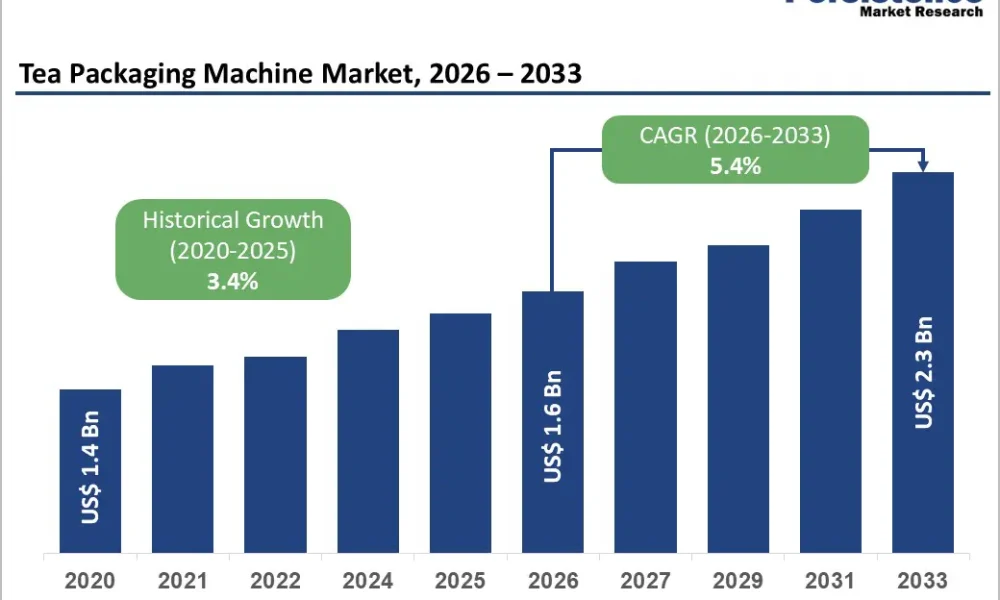
The tea packaging machine market is experiencing steady growth as rising global tea consumption and the increasing demand for convenience-oriented packaging solutions drive investments in automated machinery. Tea packaging machines are designed to efficiently package loose leaf tea, tea bags, pyramid bags, and single-serve sachets while ensuring product hygiene, consistency, and shelf appeal. According to market projections, the global tea packaging machine market is likely to be valued at US$1.6 billion in 2026 and is expected to reach US$2.3 billion by 2033, growing at a CAGR of 5.4% during the forecast period from 2026 to 2033. This growth reflects structural trends in Asia-Pacific, where rising disposable incomes, urbanization, and expanding tea consumption are fueling demand for packaged tea products.
Among the market segments, automatic and semi-automatic packaging machines dominate due to their speed, efficiency, and precision in producing large volumes of packaged tea. Asia-Pacific leads in revenue due to its position as the largest consumer and producer of tea, with countries like China, India, and Vietnam driving demand for modern packaging solutions. Meanwhile, Europe and North America are witnessing a rise in demand for premium, specialty, and herbal teas, which requires flexible and precise packaging machinery capable of handling small-batch and high-value products. The shift toward convenience formats such as pouches, pyramid bags, and single-serve tea packs further strengthens market expansion globally.
Key Highlights from the Report
• The global tea packaging machine market is projected to reach US$2.3 billion by 2033.
• Rising tea consumption in Asia-Pacific is the primary growth driver.
• Adoption of automated packaging lines is accelerating market demand.
• Machines supporting pouches, pyramid bags, and single-serve packs are increasingly preferred.
• Sustainability mandates and material innovations are shaping machine specifications toward eco-friendly packaging.
• Premiumization of tea and small-batch specialty blends is driving demand for high-precision, flexible packaging solutions.
𝐆𝐞𝐭 𝐚 𝐒𝐧𝐞𝐚𝐤 𝐏𝐞𝐞𝐤, 𝐒𝐚𝐦𝐩𝐥𝐞 𝐏𝐃𝐅 𝐈𝐧𝐬𝐢𝐝𝐞: https://www.persistencemarketresearch.com/samples/36067
Market Segmentation
The tea packaging machine market can be segmented based on machine type, packaging format, automation level, and end-user industry. By machine type, the market includes tea bag machines, pouch packaging machines, flow pack machines, and pyramid bag machines, with tea bag machines dominating due to their widespread adoption in both mass-market and premium tea production. Pouch and flow pack machines are gaining traction due to convenience-oriented packaging trends and increasing demand for single-serve tea products.
In terms of automation, fully automatic machines dominate in high-volume production facilities, offering higher efficiency, precision, and integration with upstream and downstream processing lines. Semi-automatic machines are preferred by small-scale producers and specialty tea brands seeking flexibility for limited production runs.
Packaging format segmentation includes tea bags, pyramid bags, loose leaf pouches, and single-serve sachets, with tea bags remaining the leading format due to their mass-market acceptance and ease of use. Single-serve sachets and premium pyramid bags are growing rapidly, particularly in Europe and North America, where consumers favor high-quality, convenient, and visually appealing packaging.
End-users include tea manufacturers, private label brands, specialty tea producers, and contract packers, with large-scale tea manufacturers driving demand for automated, high-capacity lines. Specialty and herbal tea producers, on the other hand, increasingly require machines capable of handling delicate tea leaves, blending multiple ingredients, and producing small-batch or premium packages.
Regional Insights
Asia-Pacific leads the global tea packaging machine market, driven by high consumption and production of tea in countries such as China, India, and Vietnam. Rising urbanization, growth in modern retail, and increasing awareness of hygiene and convenience have accelerated adoption of automated tea packaging solutions in the region.
Europe shows strong demand for specialty and premium teas, requiring advanced machines capable of producing pyramid bags and high-precision small-batch packages. Sustainability and eco-friendly packaging trends are also influencing machine design, with a focus on recyclable materials and reduced film usage.
North America is witnessing a rise in demand for herbal, wellness, and flavored teas, creating opportunities for flexible packaging formats and innovative machinery. Meanwhile, Latin America and the Middle East & Africa are emerging markets, benefiting from rising tea consumption, retail modernization, and increased investment in food processing infrastructure.
𝐆𝐞𝐭 𝐚 𝐂𝐮𝐬𝐭𝐨𝐦𝐢𝐳𝐞𝐝 𝐌𝐚𝐫𝐤𝐞𝐭 𝐕𝐢𝐞𝐰 𝐢𝐧 𝐎𝐧𝐞 𝐂𝐥𝐢𝐜𝐤 : https://www.persistencemarketresearch.com/request-customization/36067
Market Drivers
The tea packaging machine market is driven primarily by structurally rising tea consumption in Asia-Pacific, which has created strong demand for high-volume automated packaging lines. Growth in convenience-oriented packaging formats such as pouches, single-serve sachets, and pyramid bags has accelerated the adoption of machines capable of producing precise, hygienic, and attractive packages.
The premiumization of tea, including specialty blends, herbal teas, and organic varieties, further drives demand for high-precision packaging machinery. In addition, sustainability mandates and innovations in packaging materials are encouraging manufacturers to invest in machines compatible with recyclable materials and optimized for reduced film consumption, improving both environmental performance and operational efficiency.
Market Restraints
Despite strong growth prospects, the market faces challenges such as high capital investment required for fully automated tea packaging lines, which can limit adoption among small-scale producers. The complexity of machines capable of handling delicate tea leaves or small-batch production may also require skilled operators and maintenance, increasing operational costs.
Additionally, raw material price volatility for films, biodegradable plastics, and tea-grade paper can affect production costs and profit margins. Limited awareness of advanced packaging technologies in emerging markets may also slow adoption, particularly among local or traditional tea producers.
Market Opportunities
The tea packaging machine market presents opportunities in innovation, flexibility, and sustainability. Manufacturers can capitalize on growing demand for premium and specialty teas by offering machines that support small-batch production, multi-component filling, and high-precision packaging.
There is also an opportunity to integrate smart technology and IoT-enabled machinery to monitor production lines, improve operational efficiency, and reduce downtime. The increasing global focus on eco-friendly packaging, recyclable films, and biodegradable materials provides opportunities to develop machines compatible with sustainable solutions. Expansion into emerging markets such as Latin America, Africa, and Southeast Asia, where tea consumption is rising, also represents a significant growth avenue.
𝐁𝐮𝐲 𝐍𝐨𝐰 𝐭𝐡𝐞 𝐃𝐞𝐭𝐚𝐢𝐥𝐞𝐝 𝐑𝐞𝐩𝐨𝐫𝐭: https://www.persistencemarketresearch.com/checkout/36067
Company Insights
Key players operating in the tea packaging machine market include:
• Bosch Packaging Technology
• Ishida Co., Ltd.
• TNA Solutions Pty Ltd.
• Bosch Thermotechnology
• Multivac Sepp Haggenmüller SE & Co. KG
• GEA Group AG
• Mitsubishi Heavy Industries Packaging Solutions
• Ilapak S.A.
• Mespack S.A.
• R.A Jones Packaging Machinery
Recent developments include the launch of automated pyramid bag machines with integrated filling and sealing for specialty teas, enhancing precision and hygiene. Additionally, several companies have introduced eco-friendly packaging machines compatible with recyclable films, responding to sustainability trends and regulatory requirements.
Conclusion
The tea packaging machine market is set for significant growth, with a projected market size of US$2.3 billion by 2033 at a CAGR of 5.4%. Growth is driven by rising tea consumption in Asia-Pacific, accelerated adoption of automated packaging lines, and increasing demand for convenience-oriented formats such as pouches, pyramid bags, and single-serve packs. Sustainability mandates, material innovation, and premiumization of tea are reshaping machine specifications, with a focus on recyclable materials and high-precision packaging. Developed and emerging markets alike are embracing these trends, positioning the tea packaging machine market for long-term expansion across global food and beverage processing industries.




