
The global stucco market is projected to increase from USD 4.34 billion in 2026 to USD 6.07 billion by 2036, expanding at a compound annual growth rate (CAGR) of 3.4%, according to Fact.MR. The market was valued at USD 4.20 billion in 2025. The forecast represents an additional USD 1.73 billion in market value between 2026 and 2036, based on the published figures.
Construction activity, facade renovation and demand for energy-efficient building envelopes are shaping purchasing decisions across residential and commercial projects. The product mix is also changing. Traditional cement-based stucco remains the largest category because of its lower material cost, while acrylic and polymer-modified systems appeal to contractors seeking greater flexibility, crack resistance and colour retention.
Get detailed market forecasts, competitive benchmarking, and pricing trends: https://www.factmr.com/connectus/sample?flag=S&rep_id=8828
Building energy requirements influence facade specifications
Exterior insulation and finish systems (EIFS) provide an important application for acrylic stucco, which serves as the decorative and weather-resistant outer layer over continuous insulation. Building energy-efficiency requirements cited in the source include ASHRAE 90.1 and the 2024 International Energy Conservation Code (IECC 2024).
In Europe, building renovation and energy-performance improvements provide another source of demand. The source identifies the European Union’s Energy Performance of Buildings Directive (EPBD) as a driver of exterior insulation and facade renovation.
Contractors must weigh these requirements against material and labour costs. Fact.MR’s supplied analysis describes one-coat polymer-modified systems as an alternative to traditional three-coat cement stucco. It reports that application time can fall from three to five days to one to two days per wall section. The source also cites a 20% to 30% material-cost premium for these systems, with labour savings potentially making the trade-off attractive where skilled plasterer rates exceed USD 60 per hour. These figures should be verified against the original report before publication.
Where growth is fastest
- India — 5.0% CAGR through 2036. Construction expansion, government-backed building programmes and wider adoption of advanced coating systems support the country’s leading growth rate. The source also identifies the Smart Cities Mission as a policy initiative supporting construction modernisation.
- China — 4.0% CAGR. Construction modernisation and large-scale building initiatives underpin projected growth.
- Mexico — 3.0% CAGR. Urban construction activity and building development programmes support demand for specialised construction materials.
- Germany — 2.8% CAGR. Building renovation and energy-performance requirements support demand for facade improvement and coating systems.
- United States — 2.5% CAGR. Construction activity and the modernisation of existing buildings contribute to market demand.
- South Korea — 2.3% CAGR. Construction technology development and changing building requirements support growth.
- Japan — 2.0% CAGR. A mature construction market and established building practices shape demand for stucco products.
India has the highest projected growth rate among the countries profiled. Germany provides a European reference point, with growth supported by renovation activity and energy-efficiency considerations.
What leads the market
- Cement-based stucco — 60% share. The source identifies cement-based products as the leading type, supported by lower material costs and established construction practices. The detailed segment analysis reports this share for 2025, while the summary lists 60.0% for 2026; the reference year requires confirmation.
- Exterior applications — 55% share. Exterior use is the largest application category because stucco is widely used as a weather-resistant facade finish. The detailed segment analysis reports a 2025 share, while the summary lists 55.0% for 2026.
- Residential construction — 50% share. Housing is the largest end-use category in the supplied analysis, reflecting the contribution of residential building and renovation projects.
The remaining type categories are acrylic/polymer stucco, with a reported 25% share, and silicone stucco, with 15%. By application, interior uses account for 30% and decorative uses for 15%. By end use, commercial construction represents 35%, while infrastructure accounts for 15%. These figures are reported in the detailed segment analysis; the original report should be checked to confirm their applicable reference year.
The hurdle: balancing performance with installed cost
The main purchasing challenge is the trade-off between upfront material expense and the labour and performance requirements of a project. Cement-based stucco remains attractive where initial cost is the main consideration. Polymer-modified and acrylic systems may offer faster installation and greater flexibility, but their higher material costs can affect project budgets.
The source also identifies construction labour availability, raw-material pricing and technical training as constraints. Portland cement prices and acrylic polymer costs can influence material budgets, while specialised application requirements may limit adoption among smaller contractors with less access to training and technical support.
For manufacturers, product positioning therefore depends on more than the finish itself. Contractors and specifiers need to assess substrate compatibility, installation time, local building requirements and total installed cost when comparing systems.
Industry investment: product development and renovation demand
The supplied analysis points to several areas of commercial opportunity:
- Polymer-modified formulations: Faster installation, crack resistance and colour retention are identified as reasons contractors may choose acrylic and polymer-modified products for selected projects.
- Energy-efficient facade systems: EIFS and exterior insulation upgrades create opportunities for stucco products used as finish layers over insulation.
- Regional market development: India’s 5.0% projected CAGR and China’s 4.0% CAGR indicate stronger forecast growth than the other countries profiled, while Germany’s renovation and energy-efficiency requirements provide a distinct European demand context.
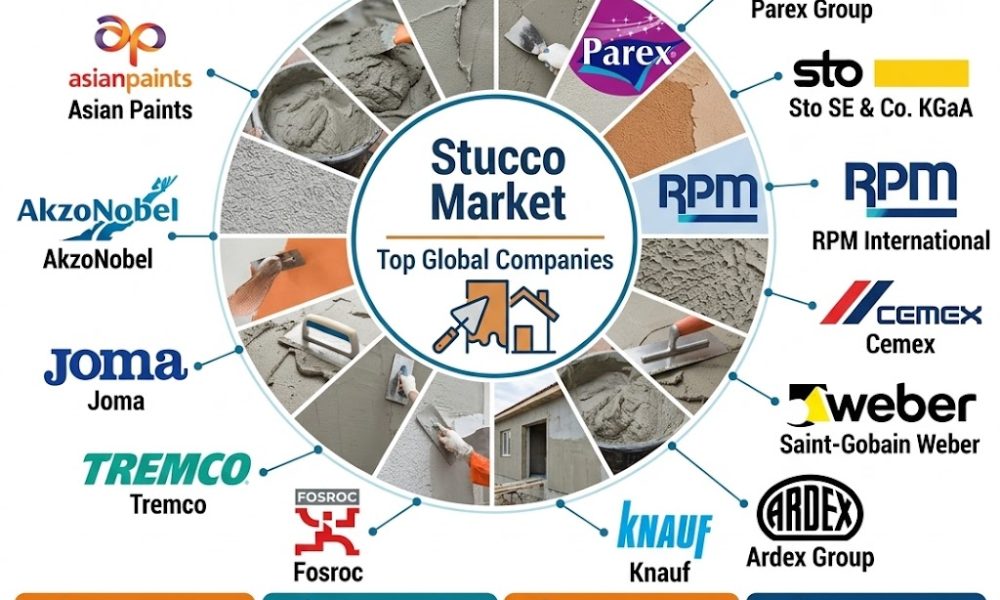
The supplied material does not identify dated company announcements or provide a verifiable list of profiled companies. Company-specific developments and named competitors are therefore omitted pending confirmation from the original Fact.MR report.
Analyst perspective
Fact.MR’s published analysis describes a shift in product mix from traditional cement stucco toward polymer-modified and acrylic systems, while cement-based products retain the largest share because of their lower material cost.
Publication note: The supplied source does not provide a complete, verbatim analyst quotation with an analyst’s name and title. The preceding sentence is a paraphrase of the supplied analysis, not a direct quote, and should not be placed in quotation marks or attributed to an individual analyst.
What this means for construction buyers
- Compare total installed cost, not material price alone. Evaluate the material premium for polymer-modified products against expected labour requirements, application time and project-specific performance needs. Savings should be validated with contractor estimates rather than assumed across every project.
- Match product specifications to building requirements. For facade renovation and EIFS projects, review the applicable energy code, substrate conditions, insulation assembly and finish-system specifications before selecting a product. Confirm local requirements with the project’s architect or building professional.
- Plan sourcing around regional growth and supply risks. Buyers serving faster-growing markets such as India and China should assess supplier capacity, delivery lead times and raw-material exposure. Multi-year supply agreements may be useful where demand visibility and contractual terms justify them, but should retain appropriate flexibility for project schedules and price changes.
Gain Full Access to Market Forecasts and Key Drivers:https://www.factmr.com/report/stucco-market
Our Other Language Reports:
https://www.factmr.com/ko-reports.xml
https://www.factmr.com/ja-reports.xml
Report coverage
Fact.MR’s stucco market analysis covers market size and forecasts, product types, applications, end-use categories, regional demand and country-level growth projections through 2036.



