
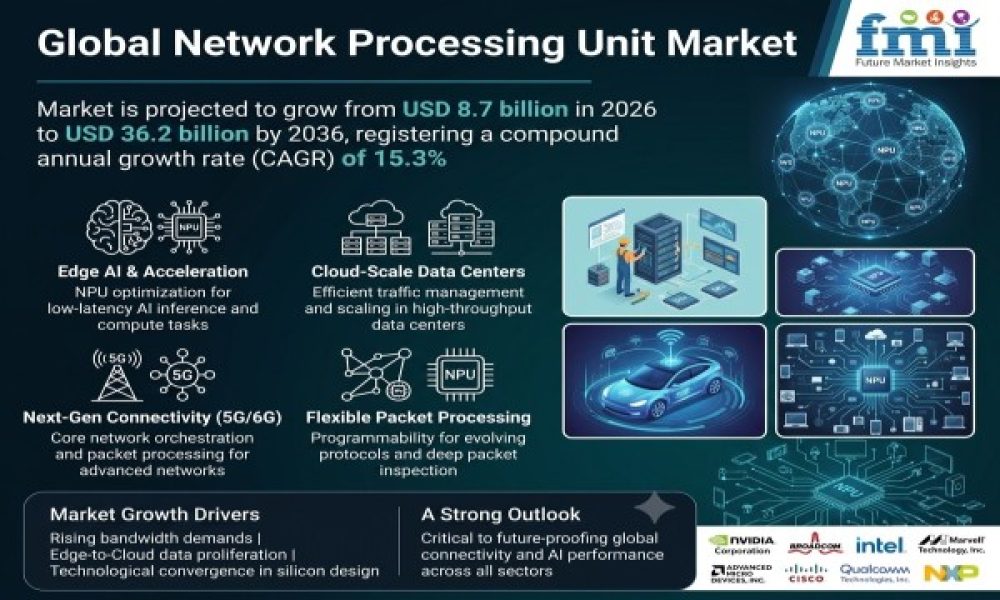
NEWARK, Del., October 13, 2026. The global Network Processing Unit Market is projected to grow from USD 8.7 billion in 2026 to USD 36.2 billion by 2036, registering a compound annual growth rate (CAGR) of 15.3%, according to Future Market Insights (FMI). The market is expected to add USD 27.5 billion over the forecast period as cloud providers, telecom operators and enterprise network teams invest in dedicated processors for packet handling, virtual switching and encryption.
Network processing units (NPUs) offload selected networking tasks from host central processing units (CPUs). This allows computing resources to remain available for applications and accelerated workloads. As AI clusters expand, buyers are assessing processor performance alongside power consumption, software compatibility, latency and the cost of integrating new hardware into existing infrastructure.
AI infrastructure puts network efficiency under scrutiny
Network traffic management is becoming an important consideration in data center capacity planning. The International Energy Agency projected global data center electricity consumption could reach approximately 945 terawatt-hours (TWh) by 2030 in a report published in April 2025. The projection provides context for operators evaluating the power and computing costs associated with growing digital infrastructure.
Dedicated packet processing can help reduce the workload placed on host CPUs, but the benefits depend on how well the processor integrates with the surrounding network stack. Differences in software development kits, compilers, telemetry and orchestration tools can require substantial testing before a new platform is approved for production.
Industry specifications are also shaping system development. The Ultra Ethernet Consortium published Specification 1.0.3 in July 2026 as an implementation reference for the networking stack. Separately, the P4 Language Consortium published P4_16 version 1.2.5 in October 2024 for programming network-device data planes. These technical specifications provide reference points for interoperability and programmable networking; they are not government regulations.
Access the Sample Report — Explore Key Insights Today!
https://www.futuremarketinsights.com/reports/sample/rep-gb-34462
Where growth is fastest
FMI forecasts expansion across all five profiled countries. South Korea leads the group, while the United States and two European markets also record double-digit growth.
- South Korea — 16.4% CAGR: Government-backed AI computing expansion and a domestic semiconductor ecosystem support processor development and testing. In February 2025, the Ministry of Science and ICT stated that the country aimed to secure 18,000 advanced GPUs by the first half of 2026. Power availability and software integration remain relevant deployment constraints.
- United States — 15.7% CAGR: Hyperscale cloud infrastructure and domestic semiconductor engineering capabilities support demand. In September 2025, AWS made R8gn instances generally available in Northern Virginia and Oregon, featuring sixth-generation Nitro Cards supporting 600 Gbps network bandwidth.
- United Kingdom — 15.2% CAGR: Planned AI infrastructure and established cloud operations support the outlook. In June 2025, the Department for Science, Innovation and Technology required AI Growth Zone applicants to demonstrate at least 500 MW of power capacity by 2030.
- Germany — 14.9% CAGR: Distributed computing programmes, industrial networks and semiconductor expertise support demand. The European Commission estimated 1,948 German edge nodes during 2025 in its June 2026 Digital Decade country report.
- Japan — 14.5% CAGR: Domestic engineering capabilities and long equipment-support cycles contribute to the outlook. In June 2025, Japan’s Ministry of Economy, Trade and Industry published its Watt-Bit Collaboration report to align power infrastructure with telecommunications development.
These figures represent forecast growth rates, not market-share rankings. Actual purchasing decisions will depend on infrastructure readiness, software support, power availability and qualification requirements in each country.
What leads the market
FMI’s 2026 estimates show demand concentrated in standalone processors, data center deployments, routing and switching applications, and programmable architectures.
- Standalone NPUs — 46.0%: This product category leads as independent processors allow engineering teams to qualify packet-handling functions across multiple server and network platform generations.
- Data centers — 39.0%: Dense cloud and AI computing environments require repeated network services across large numbers of server interfaces.
- Routing and switching — 33.0%: Continuous packet forwarding across core routers, Ethernet switches and other network tiers supports demand for dedicated processing.
- Programmable architecture — 44.0%: Programmability allows network teams to revise packet parsing, match-action logic and telemetry as protocols and security policies evolve.
These shares relate to different segmentation categories and should not be added together. For buyers, they indicate where demand is concentrated and which product characteristics deserve closer evaluation during supplier selection.
The hurdle: software migration and thermal design
Hardware throughput alone does not determine whether a network processor is suitable for production. Software migration can introduce lengthy integration work when development kits, telemetry systems and orchestration interfaces differ between processor families.
Thermal constraints create another challenge. Higher processing demands can require board redesign, changes to cooling arrangements or adjustments to system architecture. These changes may increase deployment costs and delay production approval even when the replacement processor offers better throughput.
FMI identifies shared programming interfaces as an opportunity to reduce these barriers. Common interfaces can help engineering teams validate packet behaviour across compatible hardware platforms and limit repeated integration work. Buyers still need to test performance under realistic congestion, latency and security conditions before committing to large-scale deployment.
Recent developments and industry investment
Recent announcements demonstrate continued investment in AI networking, data center interconnects and dedicated infrastructure processing.
- February 2026: Cisco introduced Silicon One G300 and related systems for programmable 102.4 Tbps networking across large AI data center clusters.
- January 2026: NVIDIA announced BlueField-4 for AI-native storage infrastructure designed to share context securely across accelerated computing clusters.
- September 2025: AMD joined IBM in deploying Pensando Pollara AI NICs and Ortano DPUs within a dedicated Zyphra training cluster on IBM Cloud.
These developments illustrate activity across network processors, data processing units (DPUs), network interface cards and switching infrastructure. They should not be interpreted as evidence that every product is a standalone NPU or that these announcements establish market share.
FMI profiles eight companies in the market: NVIDIA Corporation, Broadcom Inc., Intel Corporation, Marvell Technology, Inc., Advanced Micro Devices, Inc., Cisco Systems, Inc., Qualcomm Technologies, Inc. and NXP Semiconductors N.V.
Their activities span programmable packet processing, infrastructure offload, cloud networking, telecom systems and embedded connectivity. Competition depends on more than silicon performance. Software portability, integration support, power efficiency and the ability to qualify a processor across multiple deployment environments also influence purchasing decisions.
Analyst perspective
“Network processing units secure repeat design wins through software that exposes packet behavior as clearly as the silicon delivers line-rate throughput. Portable pipelines and congestion-tested latency deserve equal weight as migration costs can erase the compute savings promised by faster offload hardware.”
— Sudip saha, Principal Consultant, Future Market Insights
What this means for data center and telecom buyers
Procurement teams should evaluate network processors against measurable operating requirements rather than relying on peak throughput specifications alone.
- Test performance using representative traffic. Assess sustained packet rates, latency under congestion and power consumption using workloads that reflect the intended environment. Confirm that the processor can meet requirements when routing, encryption and other network functions operate concurrently.
- Calculate the full migration cost. Include software porting, driver integration, telemetry changes, cooling requirements, validation and ongoing maintenance in the business case. Compare the expected computing capacity recovered through offload with the total cost of deployment.
- Prioritise software portability and long-term support. Ask suppliers how their programming interfaces, compilers and orchestration tools support future hardware generations. Where multiple processor vendors are under consideration, define common acceptance tests for packet behaviour, security functions and congestion control before selecting a platform.
These steps can help buyers reduce integration risk, compare suppliers on consistent technical criteria and determine whether a processor upgrade delivers measurable benefits within their existing infrastructure.
Report coverage
Future Market Insights’ Network Processing Unit Market report examines market size and forecasts through 2036, product types, deployment categories, applications, end users, architectures, regional and country growth rates, competitive activity, adoption drivers, restraints and opportunities.
Explore More Related Reports –
Noise Monitoring Devices Market – https://www.futuremarketinsights.com/reports/noise-monitoring-devices-market
Solar-Powered Asset Tracking Market – https://www.futuremarketinsights.com/reports/solar-powered-asset-tracking-market
About Future Market Insights
Future Market Insights, Inc. (FMI) is an ESOMAR-certified market research and consulting firm headquartered in Delaware, USA, with offices in the United Kingdom, the United Arab Emirates and India. FMI delivers syndicated and custom research across food and beverage, healthcare, chemicals, technology, packaging, consumer goods and industrial sectors.
Media contact
Future Market Insights, Inc.
Email: [email protected]
Phone: +1-347-918-3531



