
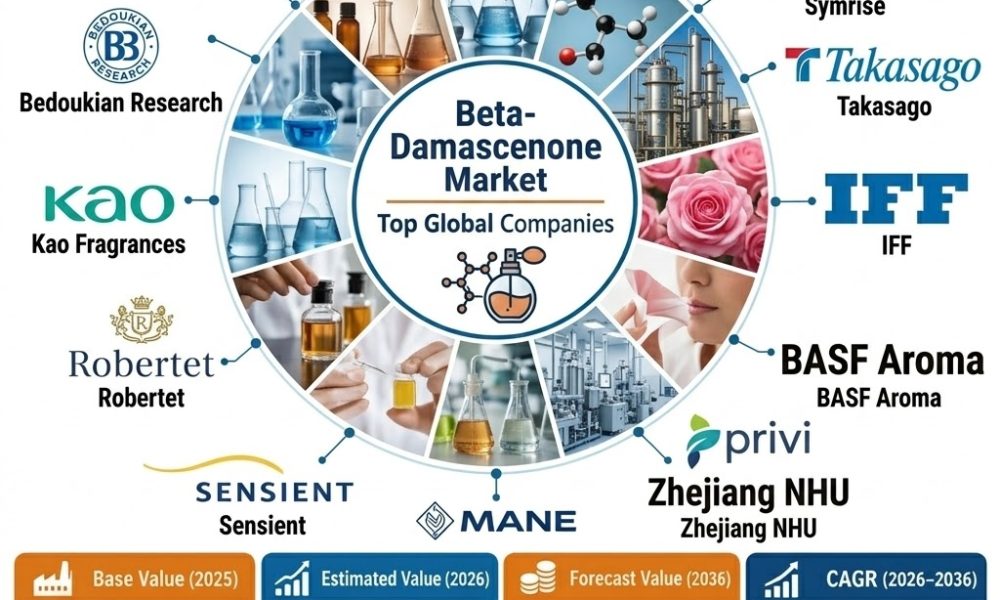
Demand for specialised fragrance ingredients and cost-efficient synthetic production is expected to support steady market expansion through 2036, according to the supplied market analysis.
The global beta-damascenone market is projected to increase from USD 186.66 million in 2026 to USD 268.43 million by 2036, expanding at a compound annual growth rate (CAGR) of 3.7%, according to the supplied Fact.MR market analysis. The market was valued at USD 180.00 million in 2025. The forecast represents an additional USD 81.77 million in market value between 2026 and 2036.
Beta-damascenone is a highly potent aroma compound used in fine fragrances and flavour formulations. Its distinctive rose, fruity and honey-like notes make it relevant to perfume compositions and selected food and beverage flavour applications. Manufacturers can obtain the compound through natural extraction or chemical synthesis, with synthetic production offering a cost advantage for applications requiring consistent supply.
Get detailed market forecasts, competitive benchmarking, and pricing trends:https://www.factmr.com/connectus/sample?flag=S&rep_id=8806
The market’s growth outlook reflects continued demand from fragrance formulators, interest in natural-origin ingredients and the need to balance product performance with sourcing costs. However, regulatory requirements for fragrance ingredients and the cost of developing and qualifying production processes remain important considerations for suppliers and buyers.
Where growth is fastest
India and China are projected to record the highest growth rates among the countries profiled in the supplied analysis. Their respective forecasts point to stronger expansion in Asian fragrance markets than in the more mature European markets covered.
- India: A 4.5% CAGR through 2036, the highest among the countries listed. The source identifies fragrance-sector expansion and increasing adoption of specialised aroma ingredients as supporting factors.
- China: A 4.0% CAGR. Demand is associated with the development of domestic fragrance production and perfumery applications.
- United States: A 3.3% CAGR, supported by demand from established fragrance manufacturers and specialised applications.
- South Korea: A 3.1% CAGR, reflecting continued interest in fragrance innovation and formulation technologies.
- Germany: A 2.9% CAGR, supported by its established fragrance manufacturing base and emphasis on product requirements.
- Japan: A 2.7% CAGR, reflecting demand for specialised fragrance ingredients.
- France: A 2.5% CAGR, with established luxury perfumery and premium fragrance applications contributing to market demand.
These country-level growth rates indicate different expansion opportunities for ingredient suppliers. India and China offer comparatively faster projected growth, while Germany and France remain relevant to suppliers serving established European fragrance markets.
What leads the market
Synthetic production, fragrance applications and liquid formulations account for the largest reported shares across the market’s main segments.
- By source — Synthetic: The synthetic segment accounts for approximately 60% of the market in the detailed segment analysis. Chemical synthesis supports consistent production and lower costs compared with natural extraction. Natural ingredients retain a role in premium formulations.
- By application — Fragrance: Fragrance applications account for approximately 70% of the market. The segment benefits from the compound’s use in rose, fruit and other fragrance accords.
- By form — Liquid: Liquid formulations account for approximately 85% of the market. Diluted liquid solutions support handling and dosing during fragrance compounding.
Flavour applications represent another area of demand, particularly in apple, grape, berry and tropical fruit formulations. The supplied analysis assigns this segment a 20% share, with other applications accounting for the remaining 10%.
The reported segment shares suggest that suppliers focused on synthetic production and liquid fragrance ingredients are positioned to serve the largest established areas of demand. Natural-origin products continue to provide an alternative for buyers whose formulations prioritise botanical sourcing.
The hurdle: Cost, qualification and regulatory requirements
The market’s principal challenges include research and development expenditure, production qualification and regulatory compliance. Developing aroma compounds and maintaining consistent product specifications require technical expertise and investment, potentially limiting participation by smaller manufacturers.
Fragrance ingredient buyers must also evaluate applicable industry requirements and documentation when selecting suppliers. The supplied source refers to International Fragrance Association (IFRA) allergen restrictions affecting related terpenoid compounds, but it does not identify a specific standard, amendment number or effective date. No particular regulatory deadline can therefore be confirmed from the available material.
For procurement teams, the practical challenge is to secure dependable supply while ensuring that ingredients meet the specifications and requirements applicable to each formulation and destination market.
Industry investment and competitive positioning
Competition is shaped by the ability to produce beta-damascenone consistently, supply fragrance formulators and support different application requirements. The supplied analysis identifies three leading suppliers:
- Firmenich
- Givaudan
- Symrise
These companies are profiled as established participants in the fragrance ingredient sector. The source associates synthetic production with cost advantages and consistent supply, but it does not provide dated company announcements or verifiable details of specific investments, partnerships or product launches.
As a result, the available information supports a discussion of competitive positioning rather than a timeline of recent corporate developments.
Analyst perspective
The supplied source contains a section titled “Analyst Opinion at Fact.MR,” which states that synthetic production holds a 60% share, fragrance applications account for 70% and liquid formulations represent 85% of the market. However, it does not provide a named analyst, professional title or a clearly attributed verbatim quotation.
A publishable analyst quotation should be obtained and approved before this section is added. No quotation has been invented for this draft.
What this means for fragrance manufacturers and procurement teams
- Review supply agreements against projected demand. With the market forecast to add USD 81.77 million in value between 2026 and 2036, buyers should assess supplier capacity, lead times, qualification requirements and the availability of suitable alternatives. Multi-year agreements may be appropriate where demand visibility and supplier terms support them.
- Match sourcing decisions to formulation requirements. Synthetic ingredients account for the largest reported source segment, while natural products retain a role in selected premium applications. Procurement and product development teams should compare cost, consistency, sourcing requirements and formulation performance before choosing a supply route.
- Evaluate regional expansion selectively. India’s projected 4.5% CAGR and China’s 4.0% CAGR exceed the rates reported for Germany and France. Suppliers considering expansion should combine these forecasts with local customer demand, distribution capabilities, regulatory requirements and the cost of qualifying ingredients for intended applications.
Report coverage
The beta-damascenone market analysis covers market size and forecasts, source, application, form, regional growth, country-level CAGRs, demand drivers, restraints and competitive positioning through 2036.
Top Trending Reports:
Water Leakage Detector Systems Market
About Fact MR
Fact MR is an ESOMAR-certified market research and consulting firm headquartered in Delaware, USA, with offices in the United Kingdom, the United Arab Emirates and India. Fact MR delivers syndicated and custom research across food and beverage, healthcare, chemicals, technology, packaging, consumer goods and industrial sectors.



