
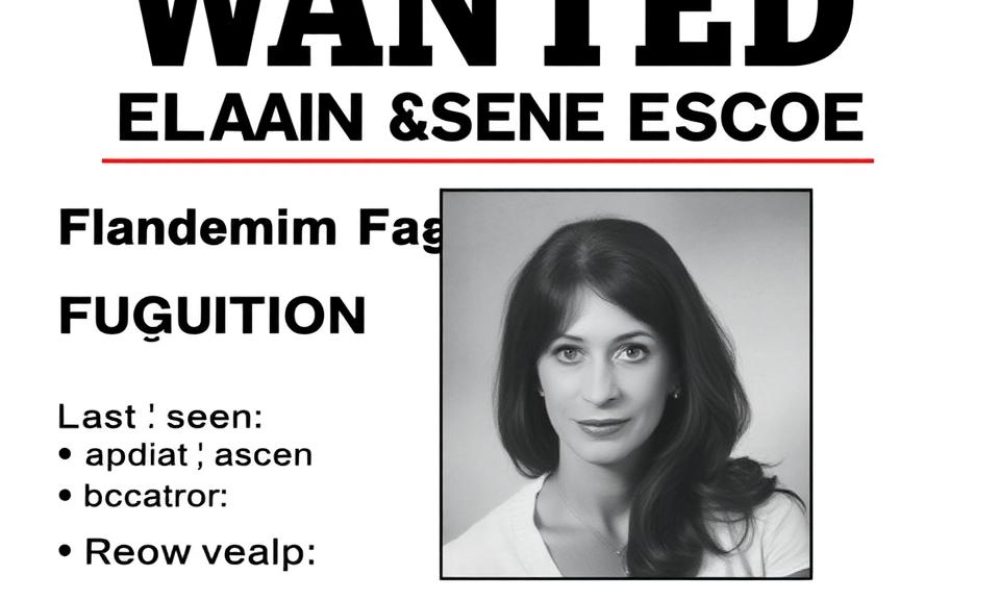
Federal authorities allege that Elaine Angene Escoe and five co-defendants used false employee counts, fabricated payroll expenses, and invented business revenues to obtain millions of dollars from emergency programs created for legitimate companies struggling during the COVID-19 crisis.
WASHINGTON, DC, July 11, 2026 — Federal prosecutors allege that Elaine Angene Escoe helped build an elaborate pandemic relief fraud operation centered on companies that appeared active on paper, while applications allegedly relied on inflated staffing levels, fictitious payroll obligations, and fabricated revenues to secure government funds.
The Business Records Allegedly Did Not Match Reality
The FBI’s official fugitive profile for Elaine Angene Escoe states that Escoe and five co-defendants allegedly submitted more than ninety fraudulent applications between May 2020 and November 2021, targeting multiple federal relief programs with false information about employees, payroll expenses, and business revenues.
Federal authorities do not publicly describe every applicant company as completely fictitious or entirely nonoperational, so the most accurate account is that prosecutors allege the applications materially misrepresented business activity, staffing levels, payroll obligations, and revenue figures to obtain funds to which the applicants were not entitled.
That distinction matters because a company can legally exist on a state registry while lacking meaningful employees, genuine payroll, substantial revenue, or the operating history represented in a federal application, making documentary legitimacy very different from commercial reality.
Ghost Employees Increased the Apparent Need for Relief
Employee counts were crucial during the pandemic because several relief programs calculated eligibility or funding levels by examining how many workers a business supported, what those workers earned, and whether payroll obligations had been disrupted by COVID-19 restrictions.
Prosecutors allege that applications connected to Escoe’s group included false employee numbers, allowing businesses to appear responsible for more jobs than authentic payroll records, tax filings, bank activity, or state employment data would have supported.
By presenting nonexistent or exaggerated workforces, applicants could allegedly increase the amount of assistance requested while invoking the Paycheck Protection Program’s central humanitarian purpose, which was created to prevent layoffs and preserve employment during a national emergency.
The alleged use of ghost employees was particularly damaging because the program’s political and economic justification rested on protecting real workers whose wages, health insurance, housing stability, and family finances depended upon employers receiving emergency support.
Fake Payrolls Became the Engine of the Scheme
Payroll expenses were equally important because Paycheck Protection Program loan calculations generally depended upon documented payroll costs, meaning inflated wages, invented compensation, or fabricated tax materials could produce larger loan requests than genuine business records justified.
Federal investigators can test those figures against payroll processor reports, quarterly employment tax returns, state workforce submissions, wage deposits, insurance records, bank statements, and employee testimony, creating multiple independent ways to determine whether claimed payroll obligations actually existed.
When applications repeatedly claim substantial payroll while business accounts show little ordinary wage activity, investigators may argue that the discrepancy reflects deliberate deception rather than a bookkeeping mistake, particularly when similar patterns appear across numerous related companies.
The alleged payroll fabrication, therefore, became more than a technical falsehood; it transformed emergency formulas designed to protect workers into a mechanism for maximizing government disbursements by inventing financial obligations.
Fabricated Revenues Opened Access to Additional Programs
Business revenues became especially important for the Restaurant Revitalization Fund and Shuttered Venue Operators Grant program, where applicants generally needed to demonstrate qualifying operations, historical receipts, pandemic-related losses, or substantial declines connected to public health restrictions.
Federal authorities allege that Escoe’s group submitted false revenue information to make companies appear eligible for assistance, potentially allowing businesses with limited activity, inadequate history, or insufficient losses to resemble genuine restaurants, venues, or operating enterprises harmed by the pandemic.
Revenue fabrication could involve overstating pre-pandemic sales, inventing operating histories, altering bank statements, or misrepresenting gross receipts, although the public FBI summary does not identify the precise document used in every application attributed to the alleged conspiracy.
That caution is necessary because prosecutors must prove individual false statements and connect them to specific defendants, while responsible reporting should avoid declaring every company nonexistent unless charging documents or trial evidence expressly establish that conclusion.
More Than Ninety Applications Created Scale
The alleged conspiracy involved more than 90 applications, a volume that suggests prosecutors are describing a sustained application system rather than a single false filing submitted in a moment of confusion or economic desperation.
A portfolio of that size would require repeated preparation of business narratives, payroll figures, employee counts, revenue statements, ownership information, banking details, and certifications tailored to the requirements of several federal programs.
Investigators can identify coordination by comparing addresses, telephone numbers, email accounts, bank accounts, payroll templates, document formatting, preparer information, ownership links, and the timing of submissions across companies presented as independent applicants.
Patterns that seem insignificant in one file can become powerful evidence when dozens of applications reuse the same unusual figures, contact details, statements, or supporting documents, allowing prosecutors to build a conspiracy theory from interconnected records.
Three Programs Lost Approximately $34.1 Million
Federal authorities say the alleged conspiracy resulted in approximately $29.1 million in wrongful Paycheck Protection Program disbursements, approximately $3.8 million through the Shuttered Venue Operators Grants, and approximately $1.2 million from the Restaurant Revitalization Fund.
Those figures total approximately $34.1 million, making the case one of the most significant publicly described South Florida pandemic-relief fraud prosecutions and helping explain why Escoe was later placed on the FBI’s Most Wanted Fraudsters list.
The government separately says the defendants sought more than $32 million, a discrepancy that may reflect how applications, approvals, disbursements, overlapping requests, and accounting categories were calculated across the broader investigation.
Accurate reporting should preserve those distinctions because requested money, approved money, disbursed money, and alleged loss can represent different legal and financial measurements within a complex federal prosecution.
The Companies Created a Paper Shield
Fraud schemes involving business relief frequently rely upon legally registered entities because incorporation documents, tax identification numbers, bank accounts, websites, and commercial addresses can create the outward appearance of a genuine enterprise.
A state registration certificate proves that an entity was formed, but it does not prove that the company maintained employees, generated authentic revenue, operated a restaurant, hosted public events, or incurred the payroll expenses described in federal applications.
That gap between legal existence and economic substance can become a paper shield, allowing applicants to present ordinary formation records while concealing that the company’s real operations were minimal, dormant, newly created, or materially different from the narrative submitted to the government.
The Escoe allegations illustrate why investigators examine substance rather than labels, comparing claimed business activity against deposits, vendor payments, leases, payroll transfers, tax history, insurance coverage, customer receipts, and employee testimony.
Pandemic Urgency Made Verification Difficult
Congress and federal agencies designed relief programs for speed because thousands of businesses were collapsing, millions of workers faced unemployment, and ordinary underwriting timelines were incompatible with the extraordinary economic emergency created by shutdowns and public health restrictions.
That urgency forced lenders and administrators to process enormous volumes of applications while relying heavily on applicant certifications, uploaded records, automated checks, and documentation that could not always be independently verified before funds were released.
Fraud networks allegedly exploited those conditions by producing internally consistent paperwork that appeared legitimate long enough to satisfy initial review, even when deeper comparisons with tax, banking, or employment records would later expose discrepancies.
The lesson is not that emergency programs were unnecessary, but that rapid distribution systems require stronger data matching, cross-agency coordination, beneficial ownership verification, and post-disbursement auditing to identify applicants who weaponize administrative speed.
Money Allegedly Moved After the Awards
Federal authorities allege that participants directed payments to one another and to businesses they controlled after the relief money arrived, while also withdrawing large amounts of cash and using blank, signed checks to conceal the origin or nature of proceeds.
Those allegations are important because they shift the case from false applications into money-laundering territory, where prosecutors examine whether subsequent transactions were designed to spend, distribute, transfer, or conceal money derived from alleged fraud.
Large cash withdrawals can reduce the visibility of subsequent spending, while blank-signed checks can allow another person to choose the payee, date, and amount after obtaining access to the account holder’s authorization.
Investigators can nevertheless reconstruct those movements through bank surveillance, check images, deposit records, text messages, email communications, handwriting evidence, accounting data, and testimony from people who handled documents or received payments.
Every Co-Defendant Has Faced Resolution
The FBI states that all five co-defendants charged alongside Escoe have either pleaded guilty or been found guilty at trial, leaving Escoe as the principal unresolved defendant in the broader pandemic relief prosecution.
Those outcomes do not establish Escoe’s guilt, because every defendant is entitled to an individual determination based on admissible evidence, and she remains presumed innocent unless proven guilty beyond a reasonable doubt.
However, completed cases can produce extensive evidence, including cooperating testimony, plea agreements, trial exhibits, bank records, business files, electronic communications, and sentencing materials that prosecutors may use if Escoe is located and returned to court.
The resolved cases also narrow the public focus, because the government’s substantial reward and national wanted designation now center on the only charged participant who has not yet faced final adjudication.
The Disappearance Interrupted the Case
A federal warrant was issued for Escoe on May 22, 2025, and authorities say she was last seen in Palm Beach County on June 3, two days before a scheduled federal court appearance she allegedly failed to attend.
Her disappearance transformed a financial prosecution into a fugitive investigation requiring agents to examine housing, travel, communications, financial access, aliases, family contacts, business relationships, and any support network capable of helping her remain outside custody.
The FBI now offers up to $150,000 for information leading to her arrest and conviction, while public records identify the aliases Annie and Annie Palmer, her Jamaican birthplace, physical description, and multiple tattoos.
Recent South Florida coverage of Escoe’s addition to the FBI’s national fraudster list has renewed attention on the allegations, reward, aliases, and unresolved effort to bring her before a federal judge.
The Human Cost Behind Ghost Payrolls
The alleged ghost employees were more than fake numbers; every invented worker helped justify money that Congress intended for real people whose jobs, health coverage, rent payments, food security, and family stability were threatened by the pandemic.
Legitimate small businesses often waited anxiously for relief while facing payroll deadlines, commercial rent, equipment costs, insurance obligations, and uncertain reopening rules, allowing fraudulent applications to compete with employers confronting genuine economic collapse.
Restaurants and venues suffered especially severe losses because their business models depended on gatherings, foot traffic, tourism, performances, and in-person service, leaving many operators unable to replace lost revenue with remote work or online sales.
When funds were diverted through deception, the damage extended beyond taxpayers to workers, owners, neighborhoods, suppliers, and cultural institutions that depended upon emergency programs to survive an unprecedented disruption.
Compliance Lessons for Lenders and Advisers
Lenders, accountants, payroll providers, tax preparers, and business consultants should verify that employee counts, payroll expenses, revenues, ownership information, and operating histories align across tax records, bank statements, payroll reports, and corporate documents.
Shared contact details, repeated payroll templates, unexplained companies, newly opened accounts, rapid cash withdrawals, and inconsistent business histories should prompt an enhanced review rather than routine processing, especially when multiple applicants appear to be connected.
Professionals should refuse requests to manufacture documents, alter financial histories, or certify unsupported figures, because emergency conditions do not suspend fraud laws or eliminate personal exposure for knowingly false submissions.
Internal reporting systems, document preservation, independent verification, and escalation to compliance personnel can help institutions identify suspicious applications before funds leave government programs and become harder to recover.
Lawful International Planning Versus Concealment
International residence, offshore companies, second citizenship, and cross-border banking can be lawful when established through truthful applications, documented funds, transparent ownership, tax compliance, and legitimate government procedures.
In professional advisory work, Amicus International Consulting emphasizes that lawful international planning must be supported by verifiable records, transparent compliance, and purposes that do not obstruct courts, regulators, creditors, or criminal investigators.
Professional second-citizenship and relocation planning cannot lawfully be used to hide proceeds of fraud, evade arrest warrants, fabricate identities, or shield defendants from accountability for alleged federal crimes.
The Escoe case demonstrates that companies, accounts, and international movement can complicate an investigation, but electronic applications, bank records, payroll data, and business filings can preserve evidence long after emergency funds have been distributed.
Final Analysis
Federal authorities allege that the Escoe conspiracy relied upon false employee counts, fabricated payroll obligations, and invented business revenues to transform paper companies or misrepresented enterprises into apparently qualified applicants for emergency government assistance.
The public record does not establish that every company was entirely fictitious, but it clearly alleges that the business information submitted in more than 90 applications was materially false and intended to obtain funds to which the applicants were not entitled.
Escoe remains charged and presumed innocent, yet the convictions or guilty pleas of every co-defendant and the scale of the documentary record mean prosecutors could have substantial evidence if she is eventually arrested.
For taxpayers, workers, and legitimate business owners, the enduring warning is that ghost employees and fake payrolls do not merely distort forms; they also redirect scarce public money away from real people facing genuine economic harm.




