
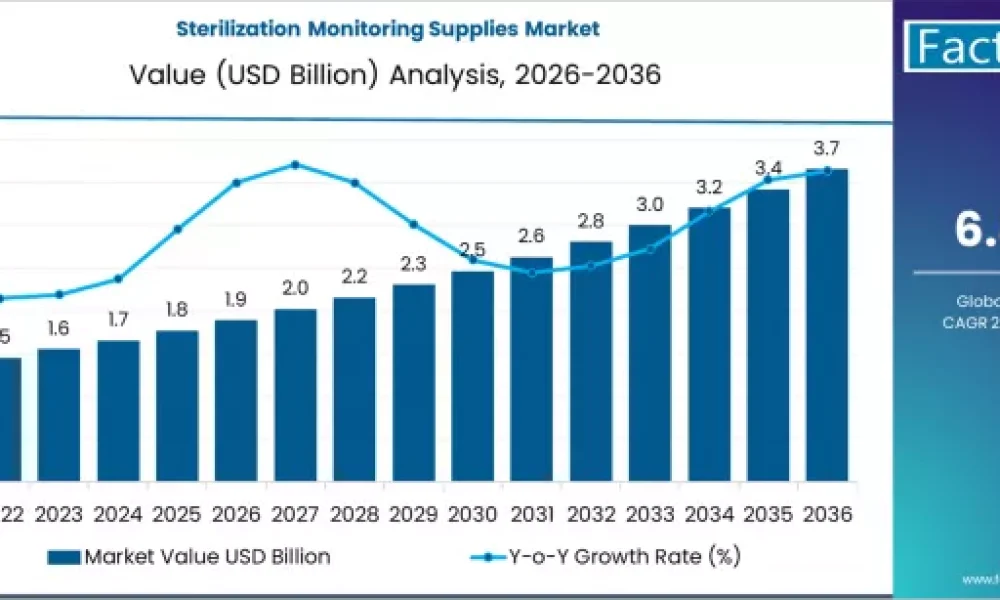
The global sterilization monitoring supplies market is entering a phase of high-stakes expansion, with its valuation projected to grow from USD 810 million in 2026 to USD 1.5 billion by 2036. According to a specialized industry analysis, the market is set to expand at a compound annual growth rate (CAGR) of 6.4%, driven by the rising complexity of surgical procedures and stringent regulatory mandates for patient safety.
As the global healthcare landscape shifts toward value-based care, the cost of a single Surgical Site Infection (SSI) can devastate a hospital’s operational margin. This has transformed sterilization monitoring—the process of verifying that medical instruments are truly sterile—from a routine task into a data-driven clinical priority. High-sensitivity biological indicators and rapid-response chemical monitors are now essential for ensuring “lethality” in every sterilization cycle.
Summary Table: Sterilization Monitoring Supplies Outlook
| Metric | Details |
| Market Value (2026E) | USD 810 Million |
| Forecast Value (2036F) | USD 1.5 Billion |
| Projected CAGR (2026-2036) | 6.4% |
| Leading Product | Biological Indicators (38.5% Share) |
| Primary End-User | Hospitals & CSSD Units (55%+ Share) |
| Highest Growth Market | India (8.2% CAGR) |
Request for Sample Report | Customize Report | Purchase Full Report – https://www.factmr.com/connectus/sample?flag=S&rep_id=13604
Core Market Dynamics: Answering the Strategic ‘How’ and ‘Why’
Sterilization monitoring supplies include biological indicators (containing resistant spores), chemical indicators (color-changing strips), and physical monitors used to validate steam, gas, and radiation sterilization processes.
Who is leading the sector? Industry pioneers including 3M Company, STERIS, Getinge AB, Cantel Medical (STERIS), and Cardinal Health are at the forefront, developing rapid-readout systems that provide results in minutes rather than days.
What is the dominant product type? Biological Indicators command a leading 38.5% market share. These remain the gold standard because they provide the only direct proof of microbial kill, though the market is rapidly shifting toward “rapid” versions that use fluorescence to detect enzyme activity.
Where is growth most accelerated? India is emerging as a global growth leader with an 8.2% CAGR, fueled by a massive boom in accredited surgical centers. China and Brazil follow closely as healthcare infrastructure modernizers seeking to meet international sterilization standards.
Why is the technology shifting? The market is moving toward Electronic Monitoring and Documentation. There is a notable surge in demand for integrated systems that automatically record sterilization results into a patient’s electronic health record (EHR), providing a digital “birth-to-death” audit trail for every instrument.
Sector Insights: Hospitals and CSSD Units Drive Market Volume
The Hospitals and Central Sterile Supply Departments (CSSD) segment remains the primary end-user, projected to hold over 55% of the market share by 2026. However, the Ambulatory Surgical Centers (ASCs) segment is seeing the fastest adoption of tabletop rapid-monitoring kits as more complex orthopaedic and cardiac surgeries move to outpatient settings.
“Sterilization is an ‘invisible’ science until it fails,” the analysis states. “We are seeing a major trend where hospitals are moving from ‘lot control’ to ‘every-load monitoring.’ By using rapid biological indicators in every single cycle, facilities can release instruments for surgery immediately with 100% confidence, effectively eliminating the risk of unsterile instrument recalls.”
Key Market Trends and Strategic Outlook
1. Optimization through Rapid-Readout Technology
The most significant absolute dollar opportunity lies in 20-minute Biological Indicators. Historically, validating a load took 24 to 48 hours; modern monitoring systems provide a definitive “pass/fail” in under half an hour, drastically increasing instrument throughput and reducing the need for massive surgical inventories.
2. The Rise of “Chemical-Free” and Eco-Friendly Indicators
Innovation is currently focused on reducing the chemical waste associated with traditional monitoring. Lead-free chemical indicators and reusable electronic test packs (Electronic Bowie-Dick tests) are gaining traction in the United States (5.5% CAGR) and Germany (5.1% CAGR) as healthcare systems pursue sustainability goals.
3. Regulatory Tailwinds and CSSD Centralization
In regions with aging populations, the sheer volume of surgeries is forcing the centralization of CSSDs. This is driving the demand for “High-Throughput Monitoring Solutions”—bulk-packaged indicators and automated incubation systems that can handle hundreds of test packs daily without human error.
Investment Perspective: A Recession-Proof Healthcare Staple
The sterilization monitoring supplies market represents a robust, recurring revenue opportunity for medical device and diagnostic firms. As the number of global surgeries continues to climb and “Zero-Infection” mandates become the global norm, the demand for high-reliability monitoring consumables is expected to remain a primary growth engine through 2036.
Have specific requirements or need assistance on report pricing or have a limited budget? Please contact [email protected]
About Fact.MR:
Fact.MR is a global market research and consulting firm, trusted by Fortune 500 companies and emerging businesses for reliable insights and strategic intelligence. With a presence across the U.S., UK, India, and Dubai, we deliver data-driven research and tailored consulting solutions across 30+ industries and 1,000+ markets. Backed by deep expertise and advanced analytics, Fact.MR helps organizations uncover opportunities, reduce risks, and make informed decisions for sustainable growth



