
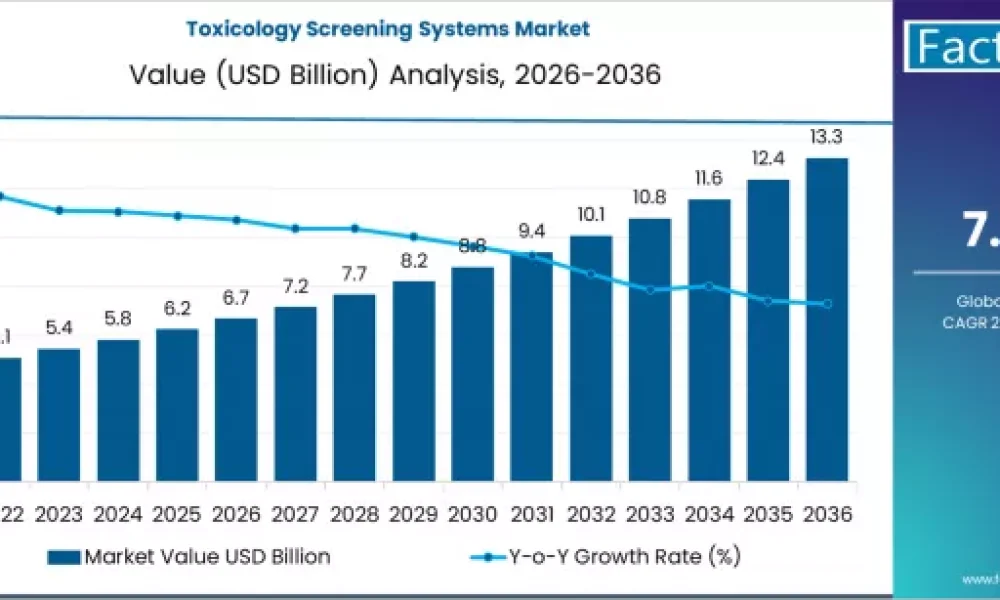
The global toxicology screening systems market is poised for significant expansion, with its valuation projected to rise from USD 6.68 billion in 2026 to USD 13.25 billion by 2036. According to a specialized industry analysis, the market is set to expand at a compound annual growth rate (CAGR) of 7.1%, fueled by an escalating global need for rapid substance detection in clinical, forensic, and corporate environments.
As healthcare systems grapple with the ongoing opioid epidemic and rising polysubstance abuse, the clinical necessity for high-throughput screening has reached an all-time high. Modern toxicology systems are no longer merely diagnostic tools; they have become essential infrastructure for emergency departments and workplace safety programs worldwide.
Summary Table: Toxicology Screening Systems Market Outlook
| Metric | Details |
| Market Value (2026E) | USD 6.68 Billion |
| Forecast Value (2036F) | USD 13.25 Billion |
| Projected CAGR (2026-2036) | 7.1% |
| Leading Technology | Immunoassay Analyzers (23.1% Share) |
| Primary Application | Workplace Drug Testing (29.4% Share) |
| Highest Growth Market | India (9.1% CAGR) |
Request for Sample Report | Customize Report | Purchase Full Report – https://www.factmr.com/connectus/sample?flag=S&rep_id=13609
Core Market Dynamics: Answering the Strategic ‘Who,’ ‘What,’ and ‘Why’
Toxicology screening systems utilize advanced analytical techniques—ranging from rapid immunoassays to high-precision Mass Spectrometry—to identify illicit drugs, prescription medications, and environmental toxins in biological samples.
Who is leading the sector? The market is dominated by global diagnostic and life science leaders, including Thermo Fisher Scientific, Danaher Corporation, Agilent Technologies, Bio-Rad Laboratories, and Waters Corporation. These players are increasingly focusing on integrated solutions that combine automated sample prep with AI-driven data management.
What is the dominant technology? Immunoassay Analyzers command a leading 23.1% market share. Their dominance is rooted in their role as the frontline screening tool for high-volume environments like workplace testing and hospital ERs, offering the rapid turnaround times necessary to guide immediate clinical or administrative action.
Where is growth most accelerated? India is emerging as a high-growth frontier, with a projected 9.1% CAGR, driven by expanding laboratory infrastructure. In North America, the United States maintains the largest industry share (projected at 72.8% of the regional market by 2034) due to stringent occupational health regulations.
Why is the technology shifting? The primary driver is Technological Convergence. The market is rapidly moving away from standalone units toward platforms that integrate Liquid Chromatography with Tandem Mass Spectrometry (LC-MS/MS) for immediate confirmation of initial positive screens, effectively shortening the “chain of custody” window.
Sector Insights: Workplace Safety and Clinical Diagnostics Lead Demand
The Workplace Drug Testing segment represents the largest application area, accounting for 29.4% of the market. Mandated safety regulations in the transportation, aviation, and manufacturing sectors generate a consistent, high-volume flow of samples that remains relatively insulated from broader economic fluctuations.
“Toxicology screening has moved from the ‘back-office’ lab to the clinical frontline,” the analysis states. “We are seeing a major trend where ‘Point-of-Care’ (POC) devices are capturing significant attention. Employers and law enforcement now demand the ability to conduct non-invasive, instant oral fluid or urine screens that provide laboratory-grade accuracy at the site of collection.”
Key Market Trends and Strategic Outlook
1. The Rise of “Multi-Analyte” Panels
With the diversification of synthetic drugs (such as Fentanyl analogs and “designer” benzodiazepines), there is a massive absolute dollar opportunity in multi-drug screening panels. Systems that can detect 12 or more substance classes simultaneously from a single sample are becoming the new baseline for forensic and pain management clinics.
2. Integration of AI and Machine Learning
Leading manufacturers are deploying AI algorithms to automate the interpretation of complex chromatograms. This reduces the risk of human error and allows laboratories to handle the increasing volume of samples triggered by new “Drug-Free Workplace” mandates across emerging economies.
3. Shift Toward Non-Invasive Sampling
There is a notable transition toward Oral Fluid (Saliva) and Hair testing. These methods are gaining favor in corporate and roadside settings because they are harder to “cheat” than traditional urine tests and offer a more dignified collection process, supporting a projected 13.7% growth in hair-based testing segments in specific regions.
Investment Perspective: A High-Utility Diagnostic Pillar
The toxicology screening systems market represents a robust, recurring revenue opportunity for medical device and analytical instrument firms. As global regulatory frameworks tighten and the societal cost of substance abuse continues to climb, the demand for scalable, high-accuracy screening solutions—capable of delivering definitive results in minutes—is expected to remain a primary growth engine through 2036.
Have specific requirements or need assistance on report pricing or have a limited budget? Please contact [email protected]
About Fact.MR:
Fact.MR is a global market research and consulting firm, trusted by Fortune 500 companies and emerging businesses for reliable insights and strategic intelligence. With a presence across the U.S., UK, India, and Dubai, we deliver data-driven research and tailored consulting solutions across 30+ industries and 1,000+ markets. Backed by deep expertise and advanced analytics, Fact.MR helps organizations uncover opportunities, reduce risks, and make informed decisions for sustainable growth



