
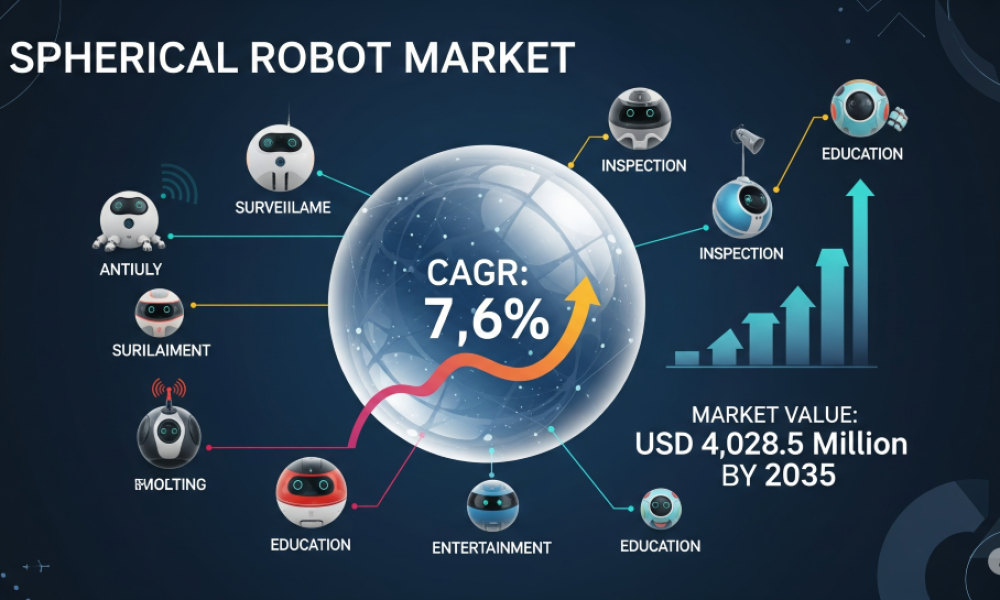
The global spherical robot market is expected to grow from USD 1,936.5 million in 2025 to USD 4,028.5 million by 2035, registering a CAGR of 7.6% during the forecast period. Growth is driven by increasing demand for autonomous, mobile robotic solutions across various industries.
Spherical robots, also known as ball robots, are valued for their omnidirectional movement, compact design, and ability to navigate confined or hazardous environments, making them suitable for diverse applications.
Market Overview
Equipped with a spherical outer shell, these robots achieve smooth and agile movement across a variety of terrains. Their versatility has led to significant adoption in industrial inspection, surveillance, and maintenance tasks, particularly in sectors such as defense, oil & gas, automotive, and logistics.
Beyond industrial uses, spherical robots are increasingly employed in medical, educational, and consumer electronics applications. The rise of entertainment robots, educational kits, and personal assistant devices is also contributing to steady growth in the consumer segment, expanding the market’s reach across professional and personal domains.
Drivers of the Spherical Robot Market
The spherical robot market is fueled by growing demand for autonomous and mobile robotic systems across industries. Valued for their omnidirectional mobility and compact design, these robots are increasingly adopted in industrial automation, logistics, defense, healthcare, and education.
Their ability to operate in confined or hazardous environments—such as pipelines, disaster zones, or narrow warehouse aisles—makes them ideal for inspection, surveillance, and material handling tasks. As industries focus on automation to enhance safety, efficiency, and productivity, the adoption of spherical robots is expected to grow steadily.
Market Segmentation
By Application
- Industrial: Used for inspection, maintenance, and monitoring in hazardous areas.
- Defense & Security: Adopted for surveillance, reconnaissance, and bomb disposal.
- Healthcare & Education: Employed for rehabilitation therapy, training, and STEM education.
- Consumer Electronics: Includes robotic toys, entertainment robots, and smart assistants.
By Component
- Hardware: Sensors, actuators, batteries, and control units.
- Software: AI-driven navigation, automation algorithms, and user-interface platforms.
- Services: Maintenance, repair, and customization support.
By Region
- North America: Strong adoption in defense, research labs, and industrial automation.
- Europe: Growth driven by robotics research, smart manufacturing, and healthcare innovations.
- Asia-Pacific: Fastest-growing region due to industrialization in China, Japan, and South Korea, coupled with rising consumer robotics adoption.
- Middle East & Africa: Emerging applications in oilfield monitoring, security, and military.
Full Market Report available for delivery. For purchase or customization, please request here –
https://www.factmr.com/connectus/sample?flag=S&rep_id=8286
Competitive Landscape
The spherical robot market is moderately consolidated, with companies focusing on AI integration, IoT connectivity, and advanced material design to improve efficiency and durability. Leading players are investing in R&D collaborations with universities, defense organizations, and tech startups to expand application areas.
Key Players
- Sphero Inc.
- QTRON Robotics
- Vstone Co., Ltd.
- KUKA AG
- Boeing (defense robotics division)
- Zhiwei Robotics Corp.
- Simbotics
These companies are focusing on miniaturization, ruggedization, and AI-enhanced navigation, enabling spherical robots to tackle complex industrial and military challenges while appealing to consumer and educational markets.
Recent Developments
- In July 2025, Sphero Inc. launched a new AI-powered educational robot, designed to help schools integrate coding and robotics into STEM curricula.
- In May 2025, QTRON Robotics introduced a spherical inspection robot capable of operating in toxic and explosive environments, targeted at oil & gas and mining applications.
- In February 2025, KUKA AG partnered with a German defense agency to develop autonomous spherical surveillance robots for battlefield reconnaissance.
- In October 2024, Vstone Co., Ltd. expanded its product line with entertainment-oriented spherical robots, blending AI interaction with consumer usability.
Future Outlook
The future of the spherical robot market is promising, as industries increasingly prioritize automation, miniaturization, and autonomous mobility. With the rise of Industry 4.0 and IoT-enabled ecosystems, spherical robots are expected to play a crucial role in remote inspections, hazardous environment operations, and intelligent surveillance.
Advancements in battery efficiency, AI-driven navigation, and rugged materials will further expand adoption across defense, logistics, and healthcare sectors. On the consumer front, robotic toys and educational kits are forecasted to see steady growth, driven by the increasing emphasis on STEM learning.
By 2035, spherical robots are likely to become a mainstream automation tool across both industrial and consumer markets, delivering value through mobility, versatility, and adaptability in challenging environments.
Contact:
US Sales Office
11140 Rockville Pike
Suite 400
Rockville, MD 20852
United States
Tel: +1 (628) 251-1583, +353-1-4434-232
Email: [email protected]



