Overview of the Market
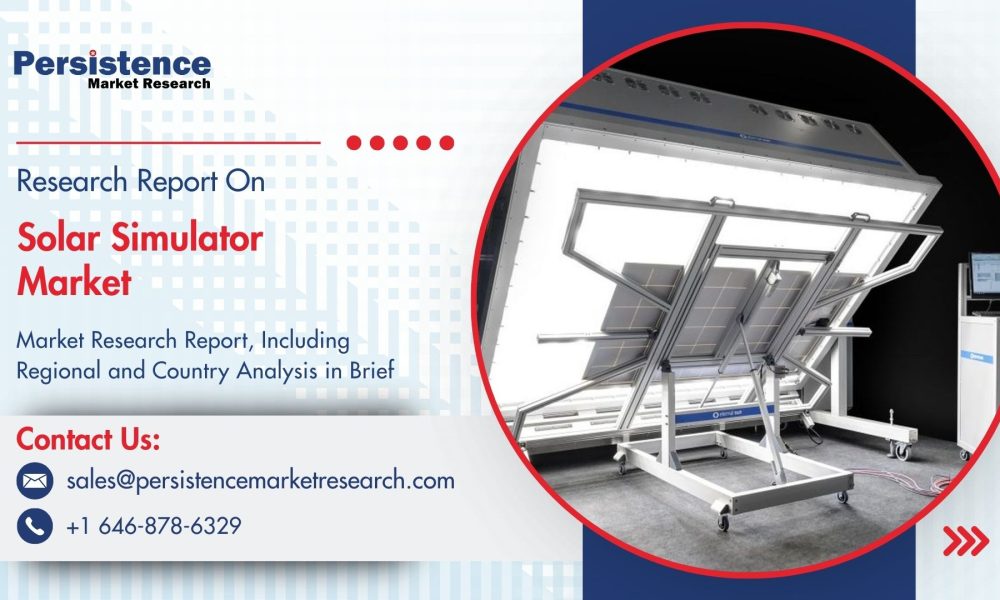
The global solar simulator market is witnessing steady expansion, driven by the growing demand for renewable energy testing, photovoltaic research, and product reliability assessments across industries. Solar simulators are specialized devices that replicate natural sunlight, enabling controlled testing of solar panels, materials, and other products requiring solar exposure. The increasing adoption of solar energy systems and the emphasis on efficient photovoltaic module testing have positioned solar simulators as a vital tool in the renewable energy value chain.
According to the latest study by Persistence Market Research, the global solar simulator market size is projected to increase from US$ 478.2 Mn in 2025 to US$ 772.9 Mn by 2032, expanding at a CAGR of 7.1%. Among the key growth drivers, rising investments in renewable energy projects, technological advancements in simulation technologies, and stringent regulations on product quality and safety are fueling market adoption. The class AAA solar simulators dominate the segment, owing to their superior spectral match, spatial uniformity, and temporal stability. Regionally, North America leads the market, backed by large-scale solar energy projects, strong R&D funding, and the presence of leading manufacturers. Europe and Asia Pacific are also witnessing strong growth, particularly due to government incentives for solar technology adoption.
Get a Sample PDF Brochure of the Report (Use Corporate Email ID for a Quick Response): https://www.persistencemarketresearch.com/samples/33597
Key Market Insights
- The solar simulator market is projected to grow at a CAGR of 7.1% between 2025 and 2032.
- Class AAA solar simulators are the dominant segment due to their precision in solar radiation simulation.
- North America remains the largest regional market, supported by robust solar R&D infrastructure.
- The increasing focus on photovoltaic module testing and certification is a major growth driver.
- Growing demand from electronics, automotive, and material testing sectors is expanding the application base.
What are solar simulators used for in the renewable energy sector?
Solar simulators are used in the renewable energy sector to replicate natural sunlight for testing and evaluating solar energy systems, particularly photovoltaic (PV) modules. These simulators provide standardized and repeatable conditions to assess solar cell efficiency, durability, and performance under varying environmental conditions. Beyond PV testing, they are also applied in material science, automotive, and aerospace industries to test products exposed to sunlight during their lifecycle. By ensuring quality control and compliance with international standards, solar simulators help manufacturers improve product reliability and accelerate the adoption of renewable energy solutions.
Market Dynamics
Drivers: The growing global shift toward renewable energy and decarbonization is a primary driver of the solar simulator market. Increasing investments in photovoltaic research, combined with the need for high-precision testing of solar modules, are pushing demand higher. Furthermore, technological advances in simulator design, such as multi-source light systems and LED-based models, enhance performance and efficiency.
Restraints: High installation and maintenance costs of advanced solar simulators remain a major restraint. Additionally, limited adoption in developing economies due to budget constraints and lack of technical expertise slows market penetration.
Opportunities: The integration of LED-based solar simulators presents a significant growth opportunity, offering longer lifespan, energy efficiency, and superior performance. Emerging economies investing heavily in solar energy infrastructure also present untapped opportunities for market players to expand their reach.
Market Segmentation
The solar simulator market can be segmented by class, application, and light source. By class, the market is divided into class AAA, class ABA, and class ABB simulators. Class AAA holds the dominant market share due to its ability to provide highly accurate and stable light output for advanced solar cell and photovoltaic testing. Class ABA and ABB simulators, while more cost-effective, are used for research applications where slightly lower precision is acceptable. The growing preference for class AAA models highlights the increasing importance of standardized and precise solar testing.
By application, the market is segmented into photovoltaic testing, material testing, automotive, aerospace, and others. The photovoltaic testing segment dominates the market, owing to the rising demand for renewable energy and strict performance certification requirements for solar panels. Automotive and aerospace applications are also gaining traction, particularly for testing components such as coatings, interiors, and electronic devices exposed to sunlight. Material testing, including polymers and construction materials, represents another important application area, ensuring product durability against UV exposure.
For Customized Insights on Segments, Regions, or Competitors, Request Personalized Purchase Options @ https://www.persistencemarketresearch.com/request-customization/33597
Regional Insights
North America leads the global solar simulator market, attributed to its well-established renewable energy infrastructure, significant R&D investments, and the presence of key industry players. The U.S. is the largest contributor in the region, supported by strong government policies promoting solar energy adoption. Europe is another major market, driven by environmental regulations, technological innovation, and widespread solar deployment in countries like Germany, France, and the U.K. Asia Pacific is emerging as a high-growth region, led by China, Japan, and India, where solar investments and manufacturing activities are surging. Meanwhile, Latin America and the Middle East & Africa show steady growth potential, particularly in large-scale solar projects and emerging renewable energy programs.
Competitive Landscape
The solar simulator market is moderately consolidated, with global players focusing on innovation, product expansion, and regional partnerships. Investments in LED-based simulators and AI-driven monitoring systems are becoming a priority to strengthen market positions.
Company Insights
✦ Newport Corporation
✦ Abet Technologies, Inc.
✦ Class Oriel Instruments
✦ Sciencetech Inc.
✦ Wacom Electric Co., Ltd.
✦ Solar Light Company, LLC
✦ Spectrolab, Inc. (a Boeing Company)
✦ IEC Solar, Inc.
✦ Gsolar Power Co., Ltd.
✦ Nisshinbo Holdings Inc.
Key Industry Developments
One of the notable industry developments is the rising adoption of LED-based solar simulators, which provide greater energy efficiency, longer service life, and enhanced performance in testing conditions. Several manufacturers are replacing traditional xenon-based systems with LED systems to reduce operational costs and improve output accuracy.
Another key trend is the increasing focus on integration of IoT and AI-based monitoring technologies in solar simulators. This allows real-time monitoring of solar cell testing, improving reliability and offering predictive maintenance capabilities. Industry collaborations between research institutes and private companies are further driving product advancements and enhancing simulation accuracy.
Innovation and Future Trends
Future trends in the solar simulator market revolve around technological innovation and diversification of applications. The use of multi-spectral and hybrid light sources is expected to gain popularity, enabling more precise simulation of natural sunlight across various wavelengths. This will help in advancing research in photovoltaic efficiency and material testing.
Moreover, the market is likely to witness expansion into emerging applications, such as wearable electronics, smart materials, and advanced aerospace components. As industries move toward sustainability, solar simulators will play a critical role in accelerating product development cycles. With continuous R&D investments, the solar simulator market is set to evolve into a more advanced, efficient, and indispensable segment of the renewable energy ecosystem.
Explore the Latest Trending Research Reports:
About Persistence Market Research:
At Persistence Market Research, we specialize in creating research studies that serve as strategic tools for driving business growth. Established as a proprietary firm in 2012, we have evolved into a registered company in England and Wales in 2023 under the name Persistence Research & Consultancy Services Ltd. With a solid foundation, we have completed over 3600 custom and syndicate market research projects, and delivered more than 2700 projects for other leading market research companies’ clients.
Our approach combines traditional market research methods with modern tools to offer comprehensive research solutions. With a decade of experience, we pride ourselves on deriving actionable insights from data to help businesses stay ahead of the competition. Our client base spans multinational corporations, leading consulting firms, investment funds, and government departments. A significant portion of our sales comes from repeat clients, a testament to the value and trust we’ve built over the years.
Contact Us:
Persistence Market Research
G04 Golden Mile House, Clayponds Lane
Brentford, London, TW8 0GU UK
USA Phone: +1 646-878-6329
UK Phone: +44 203-837-5656
Email: [email protected]
Web: https://www.persistencemarketresearch.com