
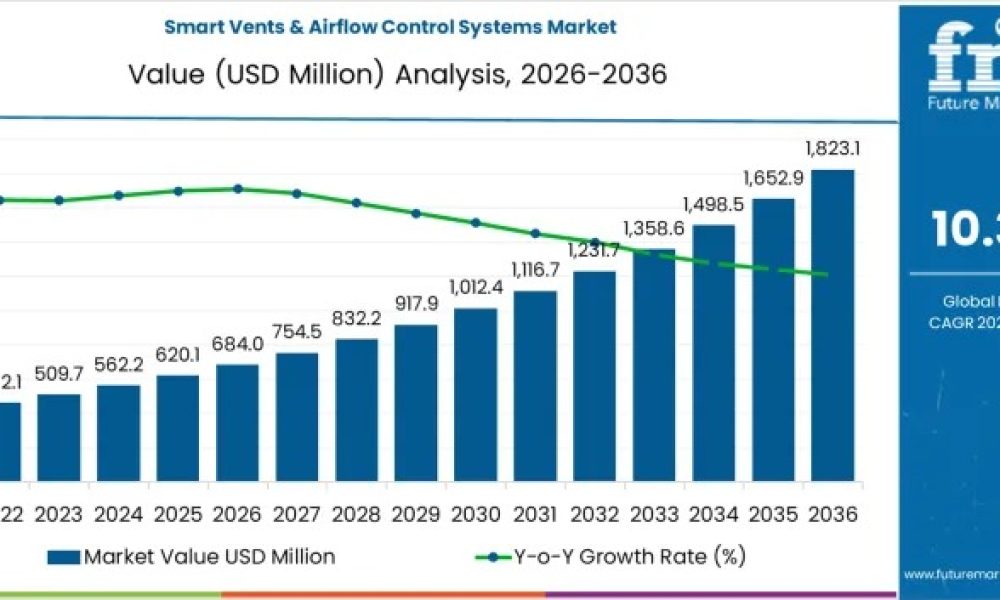
The global smart vents and airflow control systems market is entering a decisive growth phase as building and mobility sectors prioritize precision airflow management over incremental expansion of heating and cooling capacity. Valued at USD 684.0 million in 2026, the market is projected to reach approximately USD 1.86 billion by 2036, expanding at a robust compound annual growth rate (CAGR) of 10.3%. This acceleration reflects a fundamental shift in value formation toward airflow modulation technologies—motorized vents, embedded sensors, and intelligent control software—integrated directly into HVAC system design.
Rather than increasing core HVAC output, organizations are allocating capital toward systems that optimize how conditioned air is distributed within spaces. Smart airflow control improves thermal balance, enhances occupant comfort, and delivers measurable gains in energy efficiency without proportional increases in energy consumption. As efficiency mandates tighten globally, these systems are becoming an essential layer within modern HVAC architectures.
Value Concentration Driven by Modular Integration and Digital Control
Market growth is underpinned by cost structures that favor add-on modules capable of leveraging existing HVAC assemblies. Smart vents enable zone-level actuation and digital control without requiring full system replacement, making them attractive for both new construction and targeted retrofits. Spending is increasingly concentrated in applications where airflow precision directly influences performance metrics such as energy intensity, temperature uniformity, and indoor environmental quality.
Revenue concentration remains strongest in environments with centralized control capability—commercial buildings, multi-family residential complexes, institutional facilities, and advanced mobility platforms—where airflow optimization delivers quantifiable operational benefits. Software-defined airflow control, embedded at the system design stage, is emerging as a long-term value driver as building operators seek continuous optimization rather than static configuration.
Get access to comprehensive data tables and detailed market insights — request your sample report today!
Scalability Hinges on Interoperability and System Balance
Despite strong growth momentum, scalability in the smart vents and airflow control systems market remains conditioned by interoperability, pressure management, and disciplined installation practices. Introducing active airflow modulation adds layers of calibration, commissioning, and control coordination across HVAC equipment, sensors, and software platforms. Value realization depends on maintaining system balance without inducing excess noise, accelerated wear, or reduced equipment lifespan.
Cost sensitivity persists in retrofit scenarios, where duct compatibility, physical access constraints, and legacy HVAC configurations can increase installation complexity. Reliability considerations also shape purchasing decisions, with attention focused on actuator duty cycles, sensor accuracy, and connectivity stability. Regulatory ventilation standards further constrain aggressive airflow modulation strategies, reinforcing demand for solutions that operate within defined compliance frameworks.
Market Segmentation Highlights Clear Technology Preferences
Motorized smart vents represent the largest share of global demand, accounting for 44.0% of the market by actuation type. Electric motors provide precise, repeatable airflow positioning and support frequent adjustment cycles, making them well suited for dynamic environments. Integration with electronic controllers enables real-time response to temperature, pressure, and occupancy data, reinforcing their dominance across both building and mobility applications.
From a control architecture perspective, zonal HVAC control holds the largest share at 34.0%. Zonal control allows independent airflow regulation across rooms or seating positions, improving comfort differentiation while reducing unnecessary conditioning of unoccupied areas. This capability aligns directly with energy optimization goals, particularly in buildings with uneven thermal loads or variable usage patterns.
Integration type also plays a decisive role in adoption. HVAC module–integrated systems account for 52.0% of demand, reflecting a preference for streamlined architectures that simplify wiring, control logic, and packaging. Factory-integrated solutions support standardization, manufacturing efficiency, and scalability across high-volume deployments, while distributed or aftermarket systems serve more specialized or retrofit-driven needs.
Global Growth Accelerates Across Key Markets
Demand for smart vents and airflow control systems is expanding globally as HVAC architectures transition toward zone-based efficiency and digital management. China leads growth with a CAGR of 12.3%, driven by large-scale deployment of intelligent HVAC infrastructure in high-density residential and commercial buildings. Integration with smart building platforms and expanding applications in electric vehicle and rail cabins further amplify demand.
Brazil follows closely at 12.1%, where high ambient temperatures and rising cooling loads make targeted airflow optimization a priority. Commercial buildings and electric transit fleets increasingly adopt smart airflow systems to reduce operating costs and energy consumption, with retrofit activity playing a significant role.
The United States market grows at 9.7%, supported by widespread adoption of smart thermostats, home automation platforms, and data-driven HVAC upgrades. Zone-based comfort control in residential settings and energy performance requirements in commercial facilities continue to drive demand. South Korea, expanding at 9.5%, benefits from high penetration of smart building technologies and dense urban construction that favors fine-grained airflow control. Germany’s steady growth at 9.4% reflects regulatory emphasis on energy efficiency, integration with heat pump systems, and retrofit-driven performance improvements.
Competitive Landscape Anchored in Integration and Reliability
Competition in the smart vents and airflow control systems market is shaped by control precision, durability, sensor accuracy, and integration depth. Leading suppliers such as Valeo, Hanon Systems, Denso, Bosch, Continental, Marelli, Hyundai Mobis, MAHLE, Eberspächer, and Gentherm differentiate through OEM-qualified designs, scalable platforms, and global engineering support.
Integrated smart vent modules aligned with broader HVAC and thermal management architectures are gaining preference, particularly in automotive and advanced building applications. As electrification, connectivity, and efficiency standards converge, suppliers capable of delivering reliable, software-coordinated airflow solutions are strengthening their competitive positioning.
Outlook
With the market set to nearly triple in value by 2036, smart vents and airflow control systems are becoming a strategic component of energy-efficient HVAC and climate control design. Long-term value concentration will favor software-defined airflow control embedded within standardized architectures that support compliance, optimization, and lifecycle performance. As adoption accelerates across regions and applications, detailed market intelligence will be critical for understanding where value is forming and how technology, regulation, and system integration are reshaping this high-growth market.
Why Choose FMI: Empowering Decisions that Drive Real-World Outcomes: https://www.futuremarketinsights.com/why-fmi
About Future Market Insights (FMI)
Future Market Insights, Inc. (FMI) is an ESOMAR-certified, ISO 9001:2015 market research and consulting organization, trusted by Fortune 500 clients and global enterprises. With operations in the U.S., UK, India, and Dubai, FMI provides data-backed insights and strategic intelligence across 30+ industries and 1200 markets worldwide.



