
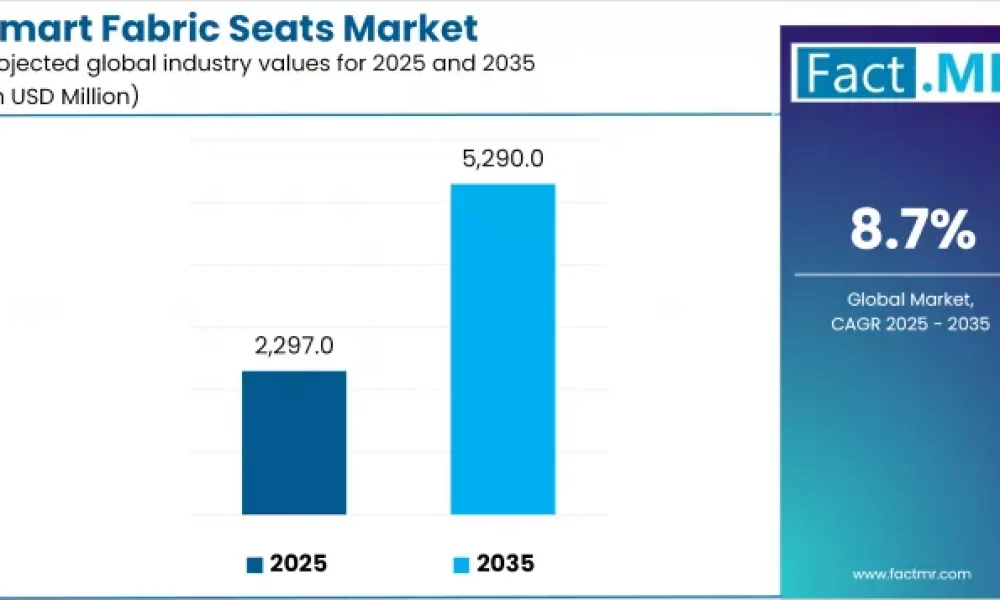
The global smart fabric seats market is projected to rise from USD 2,297 million in 2025 to approximately USD 5,290 million by 2035, marking a compound annual growth rate (CAGR) of around 8.7% over the forecast period. The strong growth trajectory reflects accelerating demand for high-tech seating systems in mobility, driven by premium comfort, sensor-enabled wellness features and connected interior experiences across automotive and other transport applications.
Consumers now expect far more than conventional upholstery: smart fabric seats offer temperature regulation, pressure sensing, moisture/ humidity resilience, posture control and even biometric tracking. These capabilities are becoming differentiators for vehicle manufacturers, especially in electric, luxury and autonomous vehicle segments.
Key Market Insights at a Glance
Market Value (2025): USD 2,297 million
Forecast Value (2035): USD 5,290 million
CAGR (2025–2035): ~8.7%
Leading Technology Segment (2025): Temperature-regulating smart fabrics (~36.5% share)
Fastest-Growing Country (2025–2035): India (~11.3% CAGR)
Key Players: Adient; FORVIA; Gentherm; Hyundai Transys; Lear Corporation; Magna International
To Access the Complete Data Tables & in-depth Insights, Request a Discount on this report: https://www.factmr.com/connectus/sample?flag=S&rep_id=10942
Market Drivers / Growth Overview
The smart fabric seats market is gaining critical momentum for several reasons. First, automotive OEMs and consumers alike are elevating seating from a support feature to a central wellness and comfort module. As cabin time increases and journeys diversify (ride-share, work-from-car, autonomous vehicle environments), seats become a pivotal interface for thermal comfort, fatigue detection and ergonomic support.
Second, the proliferation of electric vehicles (EVs) and autonomous mobility systems is intensifying demand for advanced interior materials. Smart fabric seats integrate seamlessly with connected vehicle systems and support new business models (subscription comfort upgrades, health-monitoring seats, shared mobility fleet comfort). Third, technological advancements in textile electronics, conductive threads, sensor-embedded upholstery and printed heating/cooling elements are enhancing manufacturability and cost-effectiveness, making smart seats more broadly viable.
Finally, emerging markets are showing strong potential: increasing middle-class incomes, rising vehicle ownership, expansion of urban mobility and premium interior expectations in Asia-Pacific, India and Latin America are contributing to incremental demand for smart seating solutions.
Nevertheless, certain challenges remain. Cost-premium of smart fabric modules compared to conventional seats, durability and reliability of embedded electronics in harsh automotive environments, and sustainability concerns (recyclability of smart textiles) must be addressed to support mass adoption.
Segmentation & Key Drivers
By Technology:
Temperature-Regulating Fabrics: Largest share in 2025 (~36.5%) driven by in-vehicle climate comfort needs.
Pressure-Sensing Fabrics: Growing adoption for posture control, occupant monitoring and wear detection.
Moisture & Humidity-Sensitive Fabrics: Emerging category for premium seats in high-warm/humid markets.
Self-Healing / Conductive Fabrics: Niche but expanding as sensor complexity grows.
By Fabric Type:
Woven Smart Fabrics: Established base due to durability and familiarity.
Knitted Smart Fabrics: Gains traction for lightweight, flexible seats in EVs.
Hybrid/Composite Smart Fabrics: Fastest growth for premium segments where sensors and structure integrate.
By End-Use Industry:
Automotive OEMs: Primary market with smart fabric seats increasingly embedded in new vehicle platforms.
Aerospace & Aviation: Growing interest in premium cabin seating and smart textiles for health/comfort.
Defense & Military Transport: Niche but high value, especially for monitoring and comfort in heavy duty seats.
Healthcare Mobility & Premium Seating: Expansion opportunity as transport reimagines occupant wellness.
Regional & Country Insights
North America: Strong demand thanks to premium vehicle segment, EV penetration and early technology adoption.
Europe: High quality and sustainability mandates drive adoption; luxury OEM seats lead innovation.
Asia-Pacific: Fastest growth region; India forecast at ~11.3% CAGR from 2025-2035, driven by rising vehicle volumes and premiumisation.
Latin America, Middle East & Africa: Emerging markets, premium and luxury mobility segments lead early adoption; broad growth potential as affordability expands.
Competitive Landscape
The smart fabric seats market features leading automotive component suppliers and textile innovators. Companies such as Adient, FORVIA, Gentherm, Hyundai Transys, Lear Corporation and Magna International are intensifying R&D investment into sensor-embedded upholstery, thermal control fabrics and connected seat systems. Strategic initiatives include partnerships with OEMs, integration of smart textiles into modular seat architectures, deployment of lightweight/eco-friendly materials and regional manufacturing expansions to meet demand.
Recent Developments
Launch of temperature-controlled smart seat modules that reduce heating/cooling time by up to 40%, enhancing occupant comfort and lowering component count in premium models.
OEMs incorporating posture-sensing fabric technologies and occupant fatigue monitoring into next-generation electric and autonomous vehicles.
Expansion of smart textile manufacturing footprint in India and China to serve growing demand in Asia-Pacific and localise cost.
Introduction of hybrid smart fabrics that embed conductive sensors in woven seat materials, offering advanced features with recycled or sustainable materials.
Market Outlook & Strategic Insights
Looking ahead through 2035, the smart fabric seats market is set to evolve from premium niche to more mainstream adoption as cost structures improve, materials mature and consumer expectations elevate. Strategic priorities for companies in this space include:
Reducing cost of smart fabric modules to enable scalability into mid-segment vehicles.
Enhancing durability and reliability of embedded sensors and electronics in seat systems.
Collaborating with OEMs early to integrate smart fabrics into seat architecture and new vehicle platforms.
Offering modular upgrade packages (comfort upgrades, health monitoring) for mobility-as-a-service and shared fleets.
Developing sustainable and recyclable smart textile solutions to align with tightening automotive materials regulation.
Organizations that execute on these strategic imperatives—to deliver high-value, reliable, smart fabric seating solutions while managing cost, sustainability and service network—will be best positioned to capture significant share of the projected USD 5.29 billion global market by 2035.
Purchase Full Report for Detailed Insights
For access to full forecasts, regional breakouts, company share analysis, and emerging trend assessments, you can purchase the complete report: https://www.factmr.com/checkout/10942
Have specific requirements or need assistance on report pricing or have a limited budget? Please contact [email protected]
Contact:
US Sales Office
11140 Rockville Pike
Suite 400
Rockville, MD 20852
United States
Tel: +1 (628) 251-1583, +353-1-4434-232
Email: [email protected]
About Fact.MR:
Fact.MR is a global market research and consulting firm, trusted by Fortune 500 companies and emerging businesses for reliable insights and strategic intelligence. With a presence across the U.S., UK, India, and Dubai, we deliver data-driven research and tailored consulting solutions across 30+ industries and 1,000+ markets. Backed by deep expertise and advanced analytics, Fact.MR helps organizations uncover opportunities, reduce risks, and make informed decisions for sustainable growth.



