
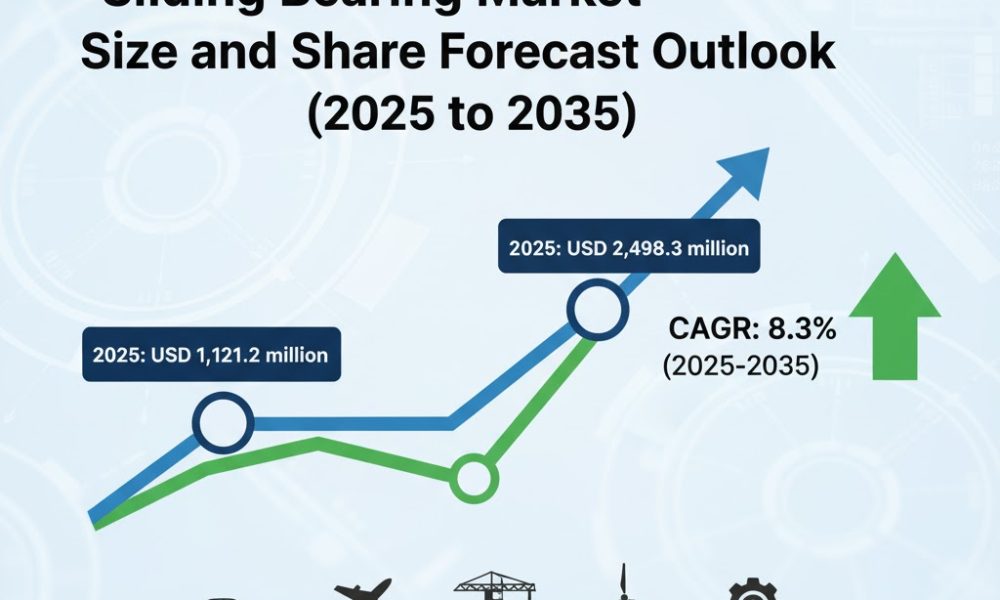
The global Sliding Bearing Market is projected to witness robust growth over the next decade, expanding from an estimated USD 1,121.2 million in 2025 to approximately USD 2,498.3 million by 2035, reflecting a CAGR of 8.3% between 2025 and 2035. The market’s acceleration is driven by increasing industrial automation, the rise of electric vehicles (EVs), and intensifying demand from renewable energy infrastructure and aerospace sectors.
Market Summary
Sliding bearings—essential components that minimize friction and support heavy loads in automotive, aerospace, and industrial machinery—are undergoing a technological transformation. Enhanced material science, advanced coatings, and integration with smart manufacturing technologies are creating a new generation of low-maintenance, self-lubricating bearings optimized for high-performance environments.
Access the comprehensive market report for detailed regional insights, competitive benchmarking, and technological advancements! Request Sample Report
Market Drivers
- Industrial Automation and Industry 4.0: The automation of manufacturing and robotics applications has accelerated the use of precision sliding bearings capable of supporting high dynamic loads with minimal maintenance.
- EV Expansion: The transition toward electric mobility is fueling demand for lightweight, noise-free, and energy-efficient bearings used in EV drivetrains and battery systems.
- Renewable Energy Investments: Sliding bearings play a critical role in wind turbines and solar tracking systems, enabling smoother motion, energy efficiency, and longer equipment lifespans.
- Focus on Sustainability: Global mandates for eco-friendly and lead-free materials are encouraging innovation in recyclable composites and lubrication-free designs.
Market Challenges
Despite the promising outlook, the industry faces constraints from raw material price volatility (steel, bronze, and composites) and intense price competition from regional manufacturers. Moreover, design complexity and high R&D costs continue to challenge smaller market entrants.
Key Trends
- Smart Bearings with Sensors: Integration of IoT and condition-monitoring capabilities is enabling predictive maintenance.
- Nanocoating and Composite Materials: These advancements enhance thermal stability, reduce wear, and extend lifespan.
- 3D Printing and Custom Design: Additive manufacturing is driving cost-effective production of application-specific bearings.
Segmental Insights
- By Application: The automotive sector remains the dominant revenue contributor, driven by rising EV production and lightweight component demand.
- By Product Type: Radial sliding bearings account for a major share due to their versatility in high-speed and heavy-load applications.
- By End-Use Industry: The industrial machinery segment benefits significantly from automation trends in manufacturing, mining, and construction.
Regional Insights
- North America: The U.S. market is bolstered by manufacturing modernization, renewable energy projects, and defense sector investments, growing at a 4.5% CAGR.
- Europe: With sustainability targets and EV adoption, the region—particularly Germany, the UK, and Italy—shows steady growth at a 4.7% CAGR.
- Asia-Pacific: Expected to be the fastest-growing region, led by China, India, Japan, and South Korea, as industrialization and infrastructure expansion drive demand.
- Japan and South Korea: Growth of precision engineering, robotics, and shipbuilding strengthens regional competitiveness.
Purchase the full market report for comprehensive forecasts, regional analysis, competitive intelligence, and emerging trend evaluations! Buy Full Report
Competitive Landscape
The sliding bearing industry features both global leaders and regional innovators:
- SKF Group (18–20% share) – Leading in self-lubricating materials and low-friction coatings.
- NSK Ltd. (15–17%) – Specializing in energy-efficient, high-durability designs for automotive and rail applications.
- Schaeffler AG (12–14%) – Advancing composite-based solutions for EVs and industrial equipment.
- RBC Bearings Inc. (8–10%) – Focused on aerospace and defense-grade bearing technologies.
- GGB Bearing Technology (5–7%) – Pioneering eco-friendly, maintenance-free bearing solutions.
Market Outlook
From 2025 to 2035, the sliding bearing market will continue to evolve toward sustainability, digitalization, and performance efficiency. The introduction of smart bearings, eco-composites, and predictive maintenance technologies will shape the future competitive edge. The sector’s alignment with green energy and automation initiatives positions it as a critical enabler of global industrial modernization.
About Future Market Insights (FMI)
Future Market Insights, Inc. (FMI) is an ESOMAR-certified, ISO 9001:2015 market research and consulting organization, trusted by Fortune 500 clients and global enterprises. With operations in the U.S., UK, India, and Dubai, FMI provides data-backed insights and strategic intelligence across 30+ industries and 1200 markets worldwide.
Why Choose FMI: Empowering Decisions that Drive Real-World Outcomes: https://www.futuremarketinsights.com/why-fmi



