
The sleep testing services market has emerged as a critical component of the global healthcare ecosystem as sleep disorders increasingly gain recognition as serious medical conditions with wide-ranging physical, mental, and economic consequences. Sleep testing services involve structured clinical evaluations that monitor physiological parameters during sleep to diagnose disorders such as obstructive sleep apnea (OSA), insomnia, restless leg syndrome (RLS), circadian rhythm disorders, narcolepsy, and parasomnias. These services are delivered through both in-laboratory polysomnography and technologically advanced home sleep testing solutions, allowing clinicians to assess sleep quality, breathing irregularities, oxygen saturation, brain activity, and cardiovascular responses.
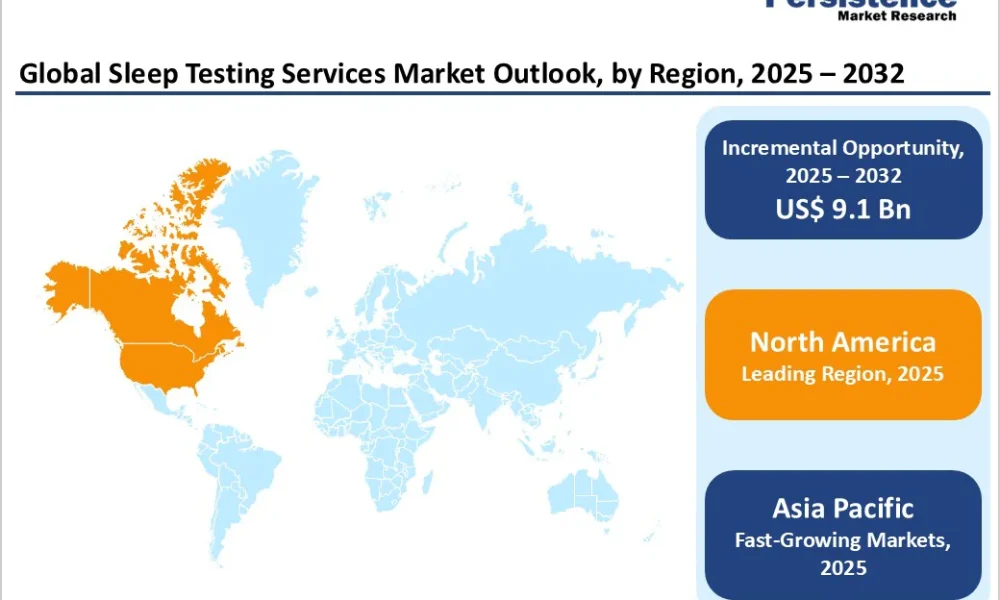
The global sleep testing services market is estimated to be valued at US$ 7.6 billion in 2025 and is projected to reach US$ 16.7 billion by 2032, expanding at a robust compound annual growth rate (CAGR) of 11.9% during the forecast period from 2025 to 2032. This strong growth trajectory is fueled by rising prevalence of sleep disorders, changing lifestyles, increased digital screen exposure, growing obesity rates, and heightened awareness of the link between sleep health and chronic diseases. Among service types, in-lab sleep testing continues to dominate due to its diagnostic precision and ability to manage complex cases, while North America leads geographically owing to its advanced healthcare infrastructure, high diagnostic penetration, and strong reimbursement frameworks.
Download Your Free Sample & Explore Key Insights: https://www.persistencemarketresearch.com/samples/35429
Key Highlights from the Report
• The global sleep testing services market is projected to more than double in value between 2025 and 2032 due to rising diagnosis rates of sleep disorders.
• North America remains the leading region driven by advanced sleep labs, high OSA prevalence, and early technology adoption.
• Asia Pacific is the fastest-growing market supported by expanding healthcare access, telehealth adoption, and home sleep testing availability.
• In-lab sleep testing dominates the diagnostic service segment due to gold-standard accuracy and comprehensive monitoring.
• Obstructive sleep apnea represents the leading indication segment because of its high global prevalence and standardized diagnostic pathways.
• Technology-driven home sleep testing and subscription-based sleep health models are reshaping long-term market dynamics.
Market Overview and Growth Dynamics
The sleep testing services market is experiencing sustained expansion as sleep is increasingly recognized as a foundational pillar of preventive healthcare. Modern lifestyles characterized by irregular work schedules, shift work, extended screen exposure, psychological stress, and sedentary habits have significantly disrupted natural circadian rhythms. As a result, sleep disorders are no longer viewed as isolated lifestyle concerns but as chronic medical conditions closely linked to cardiovascular disease, diabetes, obesity, depression, and neurocognitive decline. This paradigm shift has driven both patients and healthcare systems to prioritize early diagnosis and ongoing sleep monitoring.
From a statistical perspective, obstructive sleep apnea alone affects nearly 936 million adults globally, with a significant proportion remaining undiagnosed. Historical market growth between 2019 and 2024 stood at a CAGR of 8.6%, reflecting steady adoption of diagnostic services even before the accelerated digital health expansion seen in recent years. The post-pandemic era has further amplified demand, as healthcare systems increasingly integrate telemedicine, wearable technologies, and AI-enabled diagnostics into sleep testing workflows. In this environment, sleep testing services have evolved from episodic diagnostic procedures into continuous care solutions, strengthening their role across preventive, diagnostic, and therapeutic pathways.
Market Segmentation Analysis
The sleep testing services market can be broadly segmented based on diagnostic service type, indication, and care delivery model, each contributing uniquely to overall market expansion. By diagnostic service, the market is divided into in-lab sleep testing and home sleep testing (HST). In-lab testing, including polysomnography, holds the largest revenue share, accounting for over 65% of the market in 2025. These services are considered the clinical gold standard as they provide comprehensive, multi-parameter data capturing brain activity, respiratory events, muscle tone, oxygen levels, and cardiac rhythms. Their dominance is particularly strong in complex cases requiring differential diagnosis or assessment of multiple coexisting sleep disorders.
Home sleep testing represents the fastest-growing segment, supported by rising patient preference for convenience, reduced costs, and technological improvements that enhance diagnostic reliability. Advances in wearable sensors, cloud-based data transmission, and AI-driven interpretation have significantly improved the clinical acceptance of HSTs, especially for moderate to severe OSA screening. As reimbursement frameworks continue to evolve, HST adoption is expected to accelerate across both developed and emerging markets.
By indication, obstructive sleep apnea leads the market, capturing approximately 44.8% of global market share in 2025. The dominance of OSA is driven by its high prevalence, well-established diagnostic criteria, and clearly defined treatment protocols such as CPAP therapy and oral appliances. Other indications, including insomnia, restless leg syndrome, circadian rhythm disorders, narcolepsy, and REM sleep behavior disorder, contribute steadily to market demand, particularly as awareness and clinical education improve. Together, these segmentation dynamics highlight a market that balances clinical rigor with technological innovation to meet diverse patient needs.
Regional Insights and Trends
Regional performance within the sleep testing services market varies significantly based on healthcare infrastructure, awareness levels, and technology adoption. North America is projected to account for approximately 36.6% of global market share in 2025, driven by high prevalence of sleep disorders, strong insurance coverage, and widespread availability of accredited sleep labs. The United States alone sees tens of millions of individuals affected by chronic sleep conditions annually, prompting continuous investment in advanced diagnostic technologies and AI-driven sleep analytics. Collaborations between medical device manufacturers, academic institutions, and digital health companies further reinforce the region’s leadership position.
Europe represents a substantial share of the global market, supported by national sleep societies, government-backed awareness campaigns, and integration of sleep health into broader non-communicable disease strategies. Countries such as Germany, the United Kingdom, and France are witnessing increased diagnostic rates due to public education initiatives and policy-level recognition of the economic burden posed by untreated sleep disorders. The region also benefits from strong research ecosystems that foster innovation in sleep medicine and diagnostic methodologies.
The Asia Pacific region is the fastest-growing market, expanding at a CAGR of approximately 13.8% during the forecast period. Rapid urbanization, rising middle-class populations, increasing healthcare investments, and growing prevalence of chronic diseases are driving demand for sleep testing services. Countries such as China, India, South Korea, and Japan are actively expanding diagnostic infrastructure, including specialized sleep labs and at-home testing solutions. The region is also at the forefront of adopting mobile health technologies and wearable-based diagnostics, significantly improving access to sleep testing in both urban and semi-urban areas.
Get Custom Insights Designed for Your Business: https://www.persistencemarketresearch.com/request-customization/35429
Market Drivers
The primary driver of growth in the sleep testing services market is the rising prevalence of sleep disorders fueled by lifestyle changes and circadian rhythm disruptions. Increased stress levels, extended work hours, digital overstimulation, and irregular sleep-wake cycles have collectively contributed to widespread sleep deprivation and chronic sleep conditions. As clinical evidence increasingly links poor sleep to cardiovascular disease, metabolic disorders, mental health issues, and reduced productivity, both patients and healthcare providers are prioritizing early diagnosis and intervention. Growing public awareness campaigns and expanding insurance coverage have further encouraged individuals to seek professional sleep evaluations, directly boosting demand for sleep testing services.
Market Restraints
Despite strong growth potential, the market faces notable restraints related to underdiagnosis and workforce shortages. Many sleep disorders present with symptoms that overlap with conditions such as depression, anxiety, or hormonal imbalances, leading to misdiagnosis or delayed referrals. Limited training in sleep medicine among primary care physicians exacerbates this issue, resulting in a significant proportion of affected individuals remaining undiagnosed. Additionally, the shortage of certified sleep technologists and sleep medicine specialists constrains diagnostic capacity, particularly in high-demand regions. Long waiting times for in-lab testing and fragmented care pathways further limit market scalability and patient access.
Market Opportunities
The evolution of technology-enabled care models presents substantial opportunities for the sleep testing services market. Home sleep testing, supported by AI-driven analytics, real-time data transmission, and telemedicine integration, is transforming traditional diagnostic pathways into scalable and patient-centric solutions. Subscription-based sleep health services that combine wearable monitoring, virtual consultations, and longitudinal data analysis are gaining traction, particularly among health-conscious consumers and employers seeking preventive care solutions. These innovations not only improve early detection and adherence to treatment but also align with value-based care models, creating sustainable growth opportunities for providers, payers, and technology innovators alike.
Checkout Now & Download Complete Market Report: https://www.persistencemarketresearch.com/checkout/35429
Company Insights
The global sleep testing services market is characterized by intense competition and continuous innovation, with companies focusing on advanced diagnostics, strategic partnerships, and geographic expansion. Key players operating in the market include:
• Circle Health Group
• Cleveland Clinic
• Competence Center of Sleep Medicine
• Imperial College Healthcare NHS Trust
• Interdisciplinary Center of Sleep Medicine
• International Institute of Sleep
• Koninklijke Philips N.V.
• Korea University Medicine
• London Sleep Centre
• MedStar Health
• Millennium Sleep Lab
• OmniSleep Sleep Health
• PM Sleep Lab
• ResMed
• Singapore Neurology & Sleep Centre
• Singular Sleep, LLC
• Sleep Management Institute
• Sleep Dynamics
• Sleep Management Services
• Somnique Sleep Health
• Surrey Sleep Research Centre
• University of Kentucky
• USA Sleep Diagnostic
Recent developments in the market include the launch of cloud-based diagnostic ecosystems and FDA-cleared home sleep testing devices that deliver near-polysomnography accuracy, as well as strategic collaborations between technology firms and healthcare providers to expand access to AI-enabled sleep diagnostics. These developments underscore the industry’s shift toward integrated, technology-driven care models.
Conclusion
The sleep testing services market is undergoing a transformative phase marked by rising awareness of sleep health, rapid technological innovation, and expanding access to diagnostic services worldwide. With strong growth fundamentals, increasing prevalence of sleep disorders, and a shift toward preventive and personalized care, the market is poised for sustained expansion through 2032. While challenges such as underdiagnosis and workforce shortages persist, advancements in home sleep testing, digital health platforms, and subscription-based care models are redefining the landscape. As healthcare systems increasingly recognize sleep as a cornerstone of overall well-being, sleep testing services will continue to play a vital role in improving population health outcomes and reducing the long-term burden of chronic disease.




