
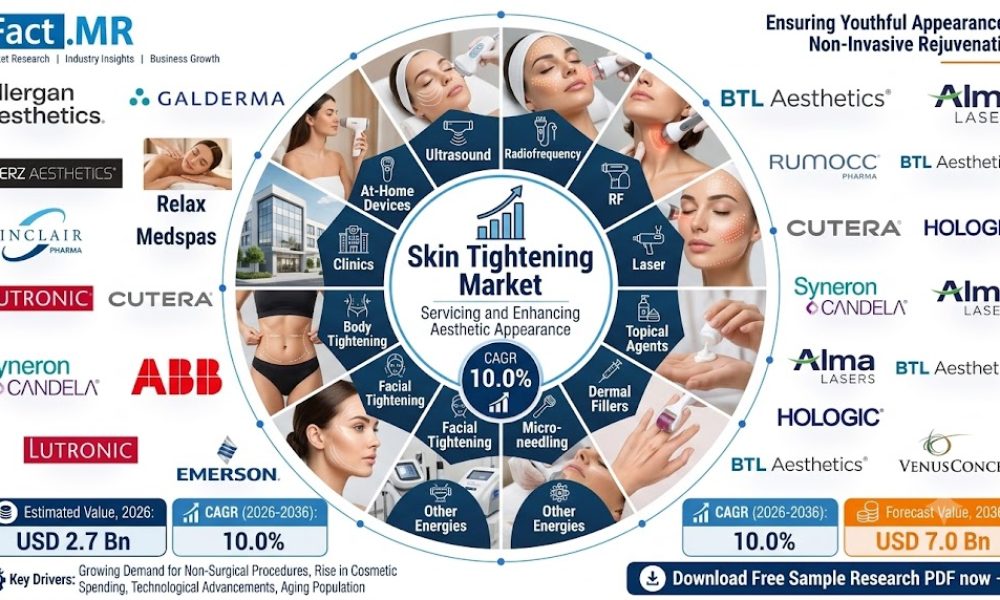
The global skin tightening market is projected to grow from USD 2.7 billion in 2026 to USD 7.0 billion by 2036, expanding at a 10.0% CAGR over the forecast period. The market was valued at USD 2.5 billion in 2025, with an absolute opportunity of approximately USD 4.3 billion through 2036.
Demand is being shaped by dermatology clinics and medspa centers investing in device-based treatment systems. Providers are looking for platforms that can address facial laxity, jawline contouring and neck rejuvenation during scheduled outpatient visits. Repeat treatment programs are also supporting equipment demand as medspa operators build structured patient packages.
Get Detailed Market Forecasts, Competitive Benchmarking, and Pricing Trends: https://www.factmr.com/connectus/sample?flag=S&rep_id=3336
Energy-Based Devices Account for 68.4% of the Market
Energy Based Skin Tightening Devices are expected to account for 68.4% of the market in 2026, making them the leading product category. RF, microneedle RF, ultrasound and laser systems remain closely connected to professional treatment outcomes and clinic workflows.
The application landscape is similarly concentrated. Facial Skin Tightening is expected to hold 74.1% share in 2026. Facial laxity around the jawline, cheeks and eye area remains a common starting point for patients considering non-surgical treatment options.
The American Society of Plastic Surgeons reported that minimally invasive treatments increased 1.5% in 2024. This supports continued attention toward facial tightening as part of professional aesthetic treatment menus.
Dermatology Clinics Remain the Core End-Use Setting
Dermatology clinics are projected to hold 62.8% share in 2026. These providers can combine device treatments with patient screening, skin assessment and follow-up visits. Energy-based procedures also require trained operators and appropriate patient selection, making clinical settings an important purchasing environment.
Energy Based Aesthetic Technology is expected to account for 51.6% share, while Device Based Treatment Systems hold 77.2%. Direct Aesthetic Device Sales are projected to represent 44.9%, reflecting the need for manufacturers and authorized teams to support demonstrations, training and technical service.
Shambhu Nath Jha, Principal Consultant at Fact.MR, states:
“Skin tightening is becoming a clinic workflow decision and a device choice. Providers are expected to judge platforms by treatment depth, patient selection, staff training and service response. Suppliers that combine clear indications, clinical education and dependable after-sales support are better placed to win repeat equipment orders.”
Procedure Demand and Aging Demographics Support Adoption
The market is benefiting from low-downtime facial tightening programs, aging populations and continued clinic interest in RF and ultrasound platforms. Dermatology and medspa providers can use these systems for scheduled outpatient treatments while building repeat-care programs.
The International Society of Aesthetic Plastic Surgery reported that aesthetic procedures reached close to 38 million in 2024, including 20.5 million non-surgical procedures.
Combination energy and body-area programs represent another opportunity. Suppliers can support treatment packages covering facial, neck, arm and abdominal tightening. Service and leasing models may also reduce the upfront equipment burden for medspa chains and other providers.
At the same time, RF microneedling safety concerns, medical device documentation and equipment maintenance costs can slow adoption. Clear patient screening, operator training and regulatory documentation remain important purchasing considerations.
Germany Leads Country Growth Through 2036
Germany is projected to record an 11.5% CAGR from 2026 to 2036. Brazil follows at 10.5%, while the USA, UK and Japan are projected to expand at 9.5%, 8.5% and 7.5%, respectively.
Germany’s growth is linked to specialist dermatology demand and demographic trends. Destatis reported 19.0 million residents aged 65 and older in 2024. Brazil’s older population also expanded, rising from 22.0 million in 2012 to 34.1 million in 2024, according to IBGE.
In the USA, the Census Bureau reported that the population aged 65 and older rose 3.1% to 61.2 million in 2024. Japan recorded 36.243 million people aged 65 and older in 2024, representing 29.3% of its population.
Competitive Landscape Focuses on Energy Delivery and Provider Support
Competition in the skin tightening market centers on energy delivery, treatment indications, clinical training and after-sales service. Key providers profiled by Fact.MR include Merz Aesthetics, Alma Lasers, Cynosure Lutronic, Candela Medical and Sofwave Medical Ltd.
Merz Aesthetics participates through Ultherapy PRIME. Alma Lasers supports energy-based aesthetic treatment through Alma Harmony. Cynosure Lutronic participates with XERF structural skin tightening and other RF-based systems. Candela Medical and Sofwave Medical also serve professional providers through RF- and ultrasound-based technologies.
Manufacturers are expected to focus on documented treatment indications, energy delivery limits, staff training and service coverage. For clinics, device selection is increasingly connected with appointment capacity, patient screening and post-treatment follow-up.
About the Skin Tightening Market Report
The Fact.MR assessment covers non-surgical and minimally invasive products, technologies and treatment systems used to tighten lax skin across facial and body applications. The scope includes energy-based, ultrasound-based and laser-based systems, along with thread lift devices.
The report analyzes facial, eye-area, neck and body applications across dermatology clinics, hospitals, medspa centers and cosmetic surgery centers. Distribution channels include direct aesthetic device sales, distributors and dealers, online sales channels, and service and leasing models.
The analysis draws on 120+ sources, 35+ company portfolios, 25+ countries and more than 20 industry interviews. Fact.MR combines primary research, desk research, market sizing, forecasting and data validation to assess adoption patterns, company activity, regulatory developments and country-level growth.
Explore More Related Studies Published by Fact.MR Research
https://www.openpr.com/news/4640482/food-grade-cellulose-whiteners-market-to-reach-usd-867-0
https://www.openpr.com/news/4640497/fast-charge-enabling-graphene-coatings-market-valued-at-usd
About Fact.MR
Fact.MR is a market research and consulting firm providing syndicated and customized research across industries. Its studies combine primary research, secondary research, market sizing, forecasting and competitive analysis to support business and strategic decisions.



