
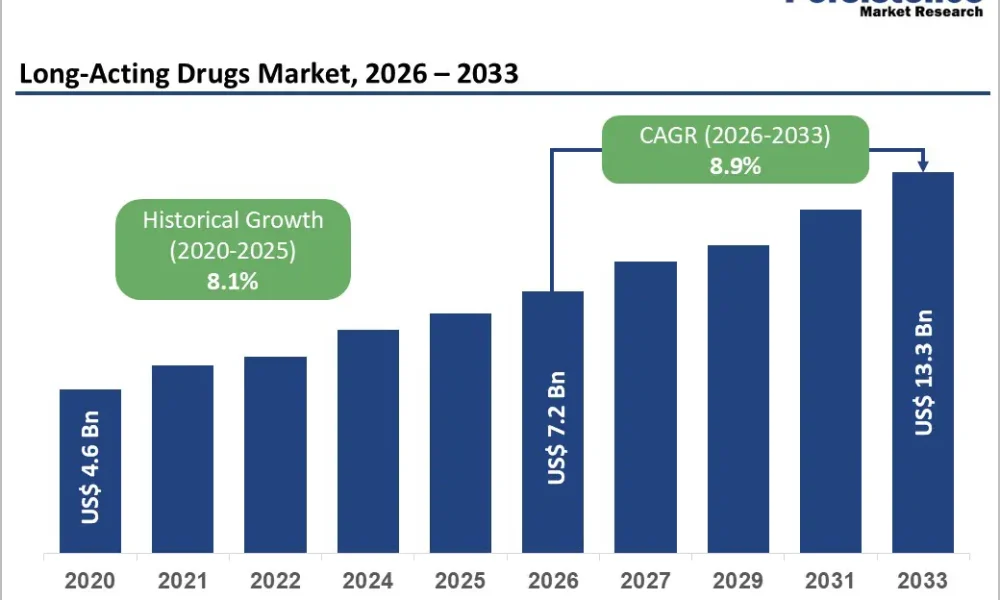
The global long-acting drugs market is entering a pivotal phase of expansion, driven by the growing burden of chronic diseases and a healthcare ecosystem increasingly focused on patient adherence and long-term therapeutic outcomes. According to current estimates, the market is projected to grow from US$ 7.2 billion in 2026 to US$ 13.3 billion by 2033, registering a strong CAGR of 8.9% during 2026–2033, compared with a historical CAGR of 8.1% between 2020 and 2025. This sustained growth trajectory reflects the structural shift from conventional daily dosing regimens to extended-release, depot-based, and injectable long-acting formulations designed to reduce treatment frequency and enhance patient convenience.
The market’s expansion is fundamentally anchored in the rising prevalence of cancer, diabetes, cardiovascular diseases, central nervous system (CNS) disorders, HIV, and hormonal conditions—ailments that require long-term therapy and are often associated with poor medication adherence. Among delivery technologies, microsphere-based systems dominate with approximately 43.5% market share, owing to their ability to provide controlled, biodegradable, and sustained drug release across multiple therapeutic areas. By therapeutic application, cancer treatment leads the market, accounting for more than 37.7% of revenue, driven by the high global incidence and need for sustained chemotherapeutic and targeted regimens. Geographically, North America holds the largest share (41.2% in 2025) due to advanced healthcare infrastructure, regulatory support, and strong pharmaceutical pipelines, while Asia Pacific is emerging as the fastest-growing region fueled by expanding healthcare access and government-backed innovation initiatives.
Download Your Free Sample & Explore Key Insights: https://www.persistencemarketresearch.com/samples/34040
Key Highlights from the Report
• The global long-acting drugs market is projected to reach US$ 13.3 billion by 2033, growing at a CAGR of 8.9%.
• North America leads the market with a 41.2% share, supported by FDA approvals and high healthcare spending.
• Microsphere-based drug delivery systems account for 43.5% of the total delivery technology share.
• Cancer represents the largest therapeutic segment, contributing over 37.7% of market revenue.
• Asia Pacific is the fastest-growing region due to rising chronic disease prevalence and expanding clinical research.
• Polymer depot technologies are significantly improving adherence in HIV and CNS disorder treatments.
Market Segmentation
The long-acting drugs market can be segmented based on delivery technology, therapeutic area, route of administration, and end-user profile. Among delivery technologies, microsphere-based systems lead the market due to their versatility and controlled-release capabilities. These biodegradable polymer particles, often composed of poly(lactic-co-glycolic acid) (PLGA), allow gradual drug diffusion over weeks or months. Their widespread application in oncology, hormonal therapies, CNS disorders, and infectious diseases has cemented their dominant position. In addition to microspheres, polymer-based depots, liposomal systems, implants, and in-situ forming gels also contribute significantly to market development, particularly for highly potent biologics and peptides.
By therapeutic area, oncology commands the largest share, reflecting the sustained need for prolonged chemotherapeutic exposure, targeted monoclonal antibodies, and supportive care medications. CNS disorders such as schizophrenia and bipolar disorder represent another major segment, as long-acting injectable antipsychotics help reduce relapse rates associated with non-adherence. Infectious diseases, especially HIV, are rapidly expanding within the market due to advancements in extended-release antivirals. End users primarily include hospitals, specialty clinics, and ambulatory surgical centers, where injectable and implantable long-acting formulations are administered under controlled conditions. Increasing adoption in outpatient and homecare settings is further broadening accessibility.
Regional Insights
North America dominates the global long-acting drugs market, accounting for 41.2% of revenue share in 2025. The United States, in particular, benefits from robust pharmaceutical R&D infrastructure, high healthcare expenditure, and a favorable regulatory environment led by the U.S. Food and Drug Administration (FDA). The region faces a substantial burden of chronic diseases, including diabetes affecting over 37 million Americans, along with increasing prevalence of schizophrenia and HIV. The widespread adoption of long-acting injectables such as aripiprazole and paliperidone demonstrates the region’s leadership in innovative drug delivery platforms. Reimbursement support and insurance coverage further facilitate patient access.
Europe holds approximately 27.5% of the market share in 2025, supported by an aging population and strong regulatory frameworks under the European Medicines Agency (EMA). Regulatory advancements such as the Clinical Trials Regulation (CTR) have streamlined approvals for innovative therapies. Europe also benefits from research funding programs like Horizon Europe, which promote cross-border collaboration in sustained-release oncology and CNS treatments. Countries including Germany, France, and the United Kingdom are at the forefront of clinical adoption.
Asia Pacific represents the fastest-growing regional market, driven by expanding healthcare infrastructure, rising disposable incomes, and a growing patient population suffering from diabetes, hypertension, and cancer. India and China are experiencing sharp increases in chronic disease incidence, prompting demand for long-term treatment solutions. Government initiatives to strengthen pharmaceutical manufacturing and innovation ecosystems are accelerating adoption. As clinical trials and biologics manufacturing capacity expand, Asia Pacific is poised to narrow the gap with Western markets over the next decade.
Get Custom Insights Designed for Your Business: https://www.persistencemarketresearch.com/request-customization/34040
Market Drivers
One of the primary drivers of the long-acting drugs market is the urgent need to improve patient adherence in chronic disease management. Conditions such as schizophrenia, bipolar disorder, HIV, and diabetes require consistent medication over extended periods, yet non-adherence remains a critical barrier to effective treatment. Long-acting injectable (LAI) formulations and polymer depot systems mitigate this issue by reducing dosing frequency from daily to monthly, bi-monthly, or even semiannual schedules. Polymer-based depots using biodegradable materials such as PLGA allow predictable release kinetics, maintaining stable plasma drug concentrations and reducing relapse risk. In HIV management, injectable cabotegravir marketed as Apretude by ViiV Healthcare provides protection with dosing every two months, significantly improving compliance compared to daily oral regimens.
Technological advancements in formulation science also serve as major growth catalysts. Innovations in microsphere encapsulation, nanoparticle engineering, liposomal delivery, and controlled-release matrices have expanded therapeutic possibilities. These technologies enhance bioavailability, reduce systemic toxicity, and enable targeted delivery to specific tissues. In oncology, long-acting formulations help sustain therapeutic drug levels while minimizing hospital visits. Additionally, favorable regulatory pathways and increased investment in R&D are accelerating pipeline development. Pharmaceutical companies are increasingly prioritizing lifecycle management strategies that convert existing oral drugs into long-acting injectables to differentiate products and extend patent protection.
Market Restraints
Despite strong growth prospects, the long-acting drugs market faces complex technical and regulatory challenges. One of the most significant restraints lies in balancing sterility assurance with suspension stability in long-acting injectable systems. Unlike conventional injectables, LAIs often contain micronized or crystalline drug particles that are susceptible to sedimentation, agglomeration, and particle size variation during storage. Terminal sterilization techniques such as gamma irradiation or steam sterilization may compromise the physicochemical integrity of sensitive molecules, leading to degradation or altered release profiles.
To mitigate these risks, manufacturers frequently rely on aseptic processing, which increases operational costs due to stringent cleanroom requirements and quality control measures. Incorporating excipients like polyethylene glycol (PEG) or polyvinylpyrrolidone (PVP) to enhance suspension stability introduces additional regulatory and scalability challenges. Lyophilized, reconstitutable powders improve stability but complicate administration procedures. This intricate interplay between formulation complexity, sterility requirements, and regulatory scrutiny can delay product approvals and increase development expenses, potentially limiting market entry for smaller companies.
Market Opportunities
The emergence of oral long-acting biologics and peptide formulations presents a transformative opportunity within the market. Traditionally, biologics such as GLP-1 receptor agonists and insulin analogs require injection due to degradation in the gastrointestinal tract. However, advances in protective coatings and permeation enhancers have enabled oral delivery breakthroughs. The approval of oral semaglutide marketed as Rybelsus demonstrated the viability of peptide absorption using enhancer technologies.
Similarly, Eli Lilly and Company has advanced orforglipron, an oral small-molecule GLP-1 receptor agonist, which showed significant weight reduction and glycemic control in Phase III trials. These innovations bridge the gap between injectable efficacy and oral convenience, unlocking new possibilities in diabetes and obesity management. As patients increasingly seek needle-free therapies with sustained action, long-acting oral and implantable biologics could redefine treatment paradigms across metabolic and autoimmune disorders. Continued advances in nanotechnology and polymer chemistry are expected to enable even longer dosing intervals and precision-targeted therapies.
Checkout Now & Download Complete Market Report: https://www.persistencemarketresearch.com/checkout/34040
Company Insights
Key players operating in the global long-acting drugs market include:
• Janssen Pharmaceutica NV
• Novartis AG
• Teva Pharmaceutical Industries Ltd
• ViiV Healthcare
• Alkermes
• Tolmar Inc.
• Pacira Pharmaceuticals Inc.
• Indivior PLC
• AstraZeneca
• Jazz Pharmaceuticals plc
• Ipsen Pharma
• Gilead Sciences Inc.
• Organon USA Inc.
• Endo Inc.
• Bristol-Myers Squibb Company
• Verity Pharmaceuticals Inc.
Recent industry developments highlight ongoing innovation and expansion. In February 2026, Novartis AG broke ground on a new global biomedical research center in San Diego to strengthen early-stage drug discovery and interdisciplinary collaboration. In July 2025, Pacira Pharmaceuticals Inc. entered a co-promotion partnership with Johnson & Johnson MedTech for ZILRETTA®, expanding patient access to extended-release corticosteroid therapies for osteoarthritis pain.
Conclusion
The long-acting drugs market stands at the intersection of pharmaceutical innovation and patient-centered care. With projected growth from US$ 7.2 billion in 2026 to US$ 13.3 billion by 2033, the sector reflects a decisive shift toward sustained-release therapies designed to improve adherence, optimize therapeutic outcomes, and reduce healthcare system burdens. Microsphere-based systems and polymer depots continue to dominate delivery technologies, while oncology and CNS disorders remain leading therapeutic segments. North America maintains its leadership position due to regulatory strength and R&D intensity, whereas Asia Pacific emerges as a dynamic growth frontier fueled by expanding healthcare infrastructure and rising chronic disease prevalence.




