
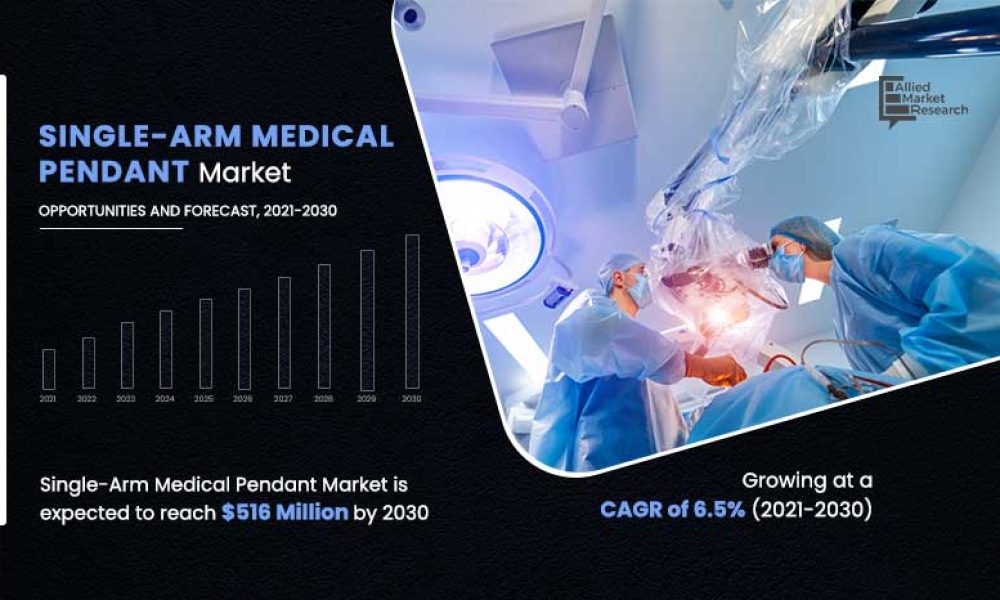
The global healthcare infrastructure is undergoing rapid transformation, with greater emphasis on advanced operating room equipment that improves efficiency and patient outcomes. Among these, single-arm medical pendants are emerging as indispensable systems. According to Allied Market Research, the global single-arm medical pendant market was valued at $278 million in 2020 and is projected to reach $516 million by 2030, growing at a CAGR of 6.5% from 2021 to 2030.
Single-arm medical pendants play a critical role in operating theaters, delivery rooms, anesthesia departments, and intensive care units (ICUs). Mounted on hospital ceilings, these devices enable the terminal transfer of oxygen, suction, compressed air, nitrogen, and other medical gases. Equipped with robust stainless-steel carcass systems and customizable configurations, single-arm medical pendants are designed to improve workflow, reduce clutter, and enhance safety in complex surgical environments.
Get a Sample Copy of this Report: https://www.alliedmarketresearch.com/request-sample/2683
Market Drivers: Growing Surgeries and Elderly Population
The rise in global surgical volumes is a primary factor fueling the demand for single-arm medical pendants. As per iData Research, approximately 15 million laparoscopic procedures are performed annually worldwide. This figure is expected to rise due to the growing adoption of minimally invasive techniques, cesarean deliveries, and procedures linked to chronic illnesses such as cancer and cardiovascular diseases.
Additionally, the global aging population is contributing significantly to market growth. Elderly patients are more susceptible to chronic diseases, which often require surgical interventions. Hospitals and clinics are investing in single-arm medical pendants to ensure efficient management of anesthesia, endoscopy, and ICU requirements for this growing patient pool.
Impact of COVID-19: Initial Setbacks and Long-term Recovery
The COVID-19 pandemic created unprecedented challenges for the single-arm medical pendant market. Lockdowns and restrictions on elective surgeries caused a sharp decline in demand during 2020 and 2021. Healthcare systems worldwide focused their resources on managing COVID-19 patients, delaying planned surgical procedures and reducing the need for pendant systems.
In addition, manufacturers faced hurdles such as disrupted supply chains, reduced production capacities, and cancellation of in-person product demonstrations. Lockdowns in key manufacturing regions, including China and India, led to delays in shipments, further hampering market performance.
However, the long-term impact is expected to be positive. As healthcare systems rebound and surgical backlogs are cleared, the demand for operating room modernization—including single-arm medical pendants—will grow steadily. Hospitals are also prioritizing investments in ICU and surgical infrastructure to prepare for future health emergencies, ensuring a healthy growth trajectory for the market.
Segment Insights
The single-arm medical pendant market is segmented by application, type, end user, and region.
By Application
Surgery held the dominant share in 2020 and is expected to maintain its lead through 2030.
This dominance is attributed to the rise in minimally invasive procedures, increase in chronic disease prevalence, and higher adoption of advanced surgical infrastructure.
Endoscopy and anesthesia applications are also witnessing growth, as pendants streamline medical gas delivery and reduce risks associated with manual handling in sensitive environments.
By Type
Flexible medical pendants accounted for the largest share in 2020. Their versatility and ability to meet ICU and operating theater needs have made them the preferred choice.
The lifting medical pendant segment is projected to grow steadily, especially in large hospitals that perform complex surgeries requiring advanced positioning and load-bearing capacity.
By End User
Hospitals were the largest end users in 2020, driven by a large patient base, higher surgical volumes, and greater healthcare investments.
Clinics and smaller healthcare centers are also adopting these systems, particularly in emerging markets where demand for specialized surgical care is growing.
By Region
North America dominated the global market in 2020, supported by strong R&D initiatives, robust healthcare infrastructure, and presence of key market players.
Asia-Pacific is expected to witness the fastest CAGR of 7.6% from 2021 to 2030, fueled by rapid hospital infrastructure development, rising healthcare expenditure, and increasing adoption of pendant systems. For instance, Shanghai Amcaremed Technology Co., Ltd. has been actively installing ICU pendant systems across the region, underscoring Asia-Pacific’s growth potential.
Europe and LAMEA are also expected to contribute steadily to global growth, supported by advancements in surgical care and expansion of healthcare facilities.
Market Challenges
While growth prospects remain strong, the industry faces notable challenges:
High costs of medical pendant systems, which may limit adoption in cost-sensitive markets.
Shortage of skilled technicians to operate and maintain these devices, particularly in developing countries.
Dependence on global supply chains, which can be vulnerable to disruptions, as highlighted during the COVID-19 pandemic.
Addressing these barriers through training programs, cost-efficient product designs, and localized manufacturing will be key to sustaining market momentum.
Key Market Players
The competitive landscape of the single-arm medical pendant market is shaped by both global and regional players. Leading companies include:
Elektra Hellas S.A.
Starkstrom Ltd.
HIPAC
Brandon Medical Company Ltd.
Unicorn Medicals
Ondal Medical Systems
BeaconMedaes
Megasan Medika
Shanghai Pax Medical Instrument Co., Ltd.
Tedisel Medical S.L.
These companies are focusing on product innovation, strategic partnerships, and geographic expansion to strengthen their positions. Collaborations with hospitals and healthcare providers are also key to tailoring products to specific surgical needs.
Future Outlook
The global single-arm medical pendant market is on a trajectory of sustained growth. Rising surgical volumes, technological advancements, and hospital modernization efforts are creating fertile ground for market expansion. Emerging economies, particularly in Asia-Pacific and LAMEA, are expected to offer lucrative opportunities as healthcare systems invest in critical care and surgical infrastructure.
Despite challenges such as high costs and workforce limitations, the market outlook remains optimistic. Companies that prioritize affordability, innovation, and training solutions will be well-positioned to capture market share and contribute to the future of safe and efficient surgical care.




