
The global silicon capacitors market is witnessing steady growth as industries increasingly demand compact, high-performance electronic components capable of operating under extreme conditions. With rapid advancements in 5G infrastructure, electric vehicles (EVs), and Internet of Things (IoT) devices, silicon capacitors are emerging as a preferred solution due to their superior electrical characteristics and reliability.
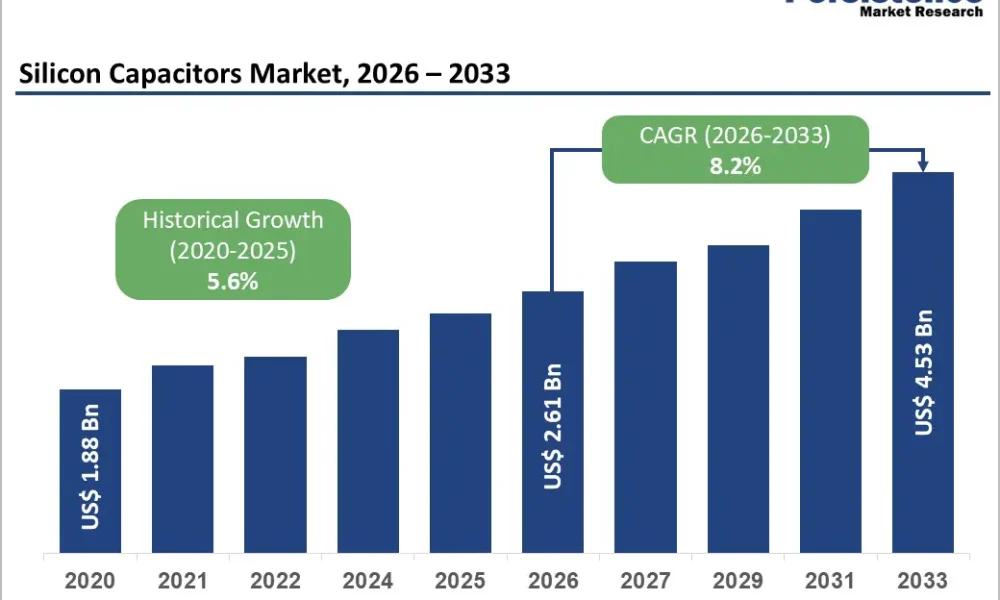
According to recent estimates, the silicon capacitors market is expected to grow from US$ 2.6 billion in 2026 to US$ 4.5 billion by 2033, registering a CAGR of 8.2% during the forecast period. This growth builds on a historical CAGR of 5.6% between 2020 and 2025, indicating a consistent upward trajectory driven by technological innovation and expanding application areas.
Market Overview
Silicon capacitors are advanced passive electronic components fabricated using semiconductor processes. Unlike traditional capacitors, they offer:
- High capacitance density
- Low equivalent series resistance (ESR)
- Excellent thermal stability
- Superior performance at high frequencies
These advantages make them ideal for modern electronics where miniaturization, efficiency, and reliability are critical.
The market is gaining traction across sectors such as automotive electronics, telecommunications, consumer devices, aerospace, and renewable energy systems.
Key Market Highlights
- Asia Pacific leads with over 45% market share due to strong electronics manufacturing
- North America is the fastest-growing region, supported by semiconductor investments
- Deep-trench technology dominates with ~42% share
- Automotive electronics is the fastest-growing segment, driven by EV adoption
- Aerospace and defense present strong opportunities due to extreme reliability requirements
Market Dynamics
Growth Drivers
- Expansion of 5G Networks and High-Frequency Applications
The global rollout of 5G networks is significantly boosting demand for silicon capacitors. These components are essential for high-frequency applications due to their low signal loss and stable performance across temperature ranges.
With billions of 5G connections expected globally, telecom infrastructure such as base stations and network equipment requires highly reliable capacitors. Silicon capacitors outperform traditional alternatives in these demanding environments, making them a key enabler of next-generation connectivity.
Additionally, the rapid growth of IoT devices—expected to reach tens of billions of connected units—further drives demand for compact and efficient capacitors.
- Rise of Electric Vehicles and Automotive Electronics
The transition toward electric mobility is a major growth driver for the silicon capacitors market. EVs require advanced electronic systems for:
- Battery management
- Power conversion
- Charging systems
- Regenerative braking
Silicon capacitors offer excellent voltage handling, thermal resilience, and long operational life, making them ideal for automotive applications.
Modern vehicles, especially EVs, incorporate thousands of electronic components, with capacitors playing a critical role in ensuring system stability and performance. The increasing deployment of Advanced Driver Assistance Systems (ADAS) further boosts demand.
Elevate your business strategy with comprehensive market data. Request a sample report now: https://www.persistencemarketresearch.com/samples/32798
Market Restraints
- High Manufacturing Costs
One of the primary challenges facing the silicon capacitors market is the high cost of production. Manufacturing these components involves complex semiconductor processes, including:
- Deep-trench etching
- Multi-layer deposition
- Cleanroom fabrication
These processes require significant capital investment—often exceeding US$ 50 million—creating barriers for new entrants and limiting adoption in cost-sensitive applications.
- Competition from Ceramic Capacitors
Multilayer ceramic capacitors (MLCCs) remain a strong competitor due to their:
- Established manufacturing processes
- Lower costs
- Widespread availability
Despite technological advancements, silicon capacitors must demonstrate clear performance advantages to replace ceramic capacitors in mainstream applications.
Emerging Opportunities
- Renewable Energy and Power Management Systems
The shift toward renewable energy sources is creating new opportunities for silicon capacitors. These components are widely used in:
- Solar inverters
- DC/DC converters
- Energy storage systems
- Uninterruptible power supplies (UPS)
Their long lifespan and minimal degradation make them suitable for energy applications requiring durability and efficiency.
- Aerospace and Defense Applications
Silicon capacitors are highly suited for aerospace and defense applications due to their ability to operate under extreme conditions, including:
- High radiation environments
- Wide temperature ranges
- Mechanical stress and vibration
With increasing investments in satellite systems, space exploration, and defense modernization, demand for high-reliability components is expected to rise significantly.
Category-wise Insights
Technology Analysis
Deep-trench technology leads the market, accounting for approximately 42% of total share. This technology enables high capacitance density by utilizing three-dimensional structures within silicon substrates.
It is widely used in:
- RF and microwave applications
- High-performance computing systems
- Advanced communication devices
Other technologies, such as Metal-Insulator-Metal (MIM) capacitors, also play a vital role in precision applications.
Capacitance Range Analysis
The high-capacitance segment (µF and above) dominates the market with around 43% share. This is driven by applications in:
- Automotive electronics
- Power management systems
- Data centers and telecom infrastructure
Medium and low capacitance ranges are used in signal processing, filtering, and timing circuits.
End-User Analysis
The automotive sector holds the largest market share, driven by electrification and automation trends.
Key applications include:
- Battery management systems
- Powertrain electronics
- ADAS and safety systems
Consumer electronics and telecommunications also represent significant demand segments due to ongoing miniaturization and connectivity trends.
Regional Insights
Asia Pacific
Asia Pacific dominates the silicon capacitors market, accounting for over 45% of global revenue. The region benefits from:
- Strong semiconductor manufacturing ecosystems
- High electronics production in China, Japan, South Korea, and Taiwan
- Rapid 5G deployment and industrial automation
Emerging economies like India are also contributing to growth through government initiatives supporting electronics manufacturing.
North America
North America is the fastest-growing region, driven by:
- Government support for semiconductor manufacturing
- Strong presence of technology companies
- High demand from aerospace and defense sectors
Innovation and R&D activities in the region continue to push the boundaries of silicon capacitor technology.
Europe
Europe is experiencing steady growth, supported by:
- Automotive electrification policies
- Renewable energy initiatives
- Strong aerospace and industrial sectors
Regulatory frameworks also influence component design and adoption, ensuring high standards for safety and sustainability.
Competitive Landscape
The silicon capacitors market is moderately consolidated, with leading players focusing on innovation and vertical integration.
Key competitive strategies include:
- Development of high-density capacitor technologies
- Expansion of manufacturing capabilities
- Strategic partnerships and collaborations
- Customization for specific applications
Companies are increasingly offering integrated solutions that combine capacitors with advanced semiconductor technologies.
Key Market Developments
Recent developments highlight ongoing innovation and competition:
- Advancements in miniaturization and high-capacitance designs
- Strategic partnerships for next-generation semiconductor technologies
- Introduction of automotive-grade and high-voltage capacitors
- Expansion into renewable energy and EV applications
These developments are strengthening the role of silicon capacitors in next-generation electronics.
Future Outlook
The silicon capacitors market is poised for steady growth, supported by several long-term trends:
- Expansion of 5G and IoT ecosystems
- Rapid adoption of electric vehicles
- Growth in renewable energy infrastructure
- Increasing demand for miniaturized electronics
As industries continue to prioritize performance, reliability, and efficiency, silicon capacitors will play a crucial role in enabling advanced electronic systems.
Conclusion
The global silicon capacitors market is evolving as a critical segment within the broader electronics industry. With a projected market value of US$ 4.5 billion by 2033, the sector is set to benefit from ongoing technological advancements and expanding application areas.
While challenges such as high manufacturing costs and competition from traditional capacitors persist, the unique advantages of silicon capacitors—particularly in high-performance and mission-critical applications—position them for sustained growth.
As the world moves toward a more connected, electrified, and energy-efficient future, silicon capacitors will remain at the forefront of innovation, powering the next generation of electronic devices and systems.
Related Reports:




