
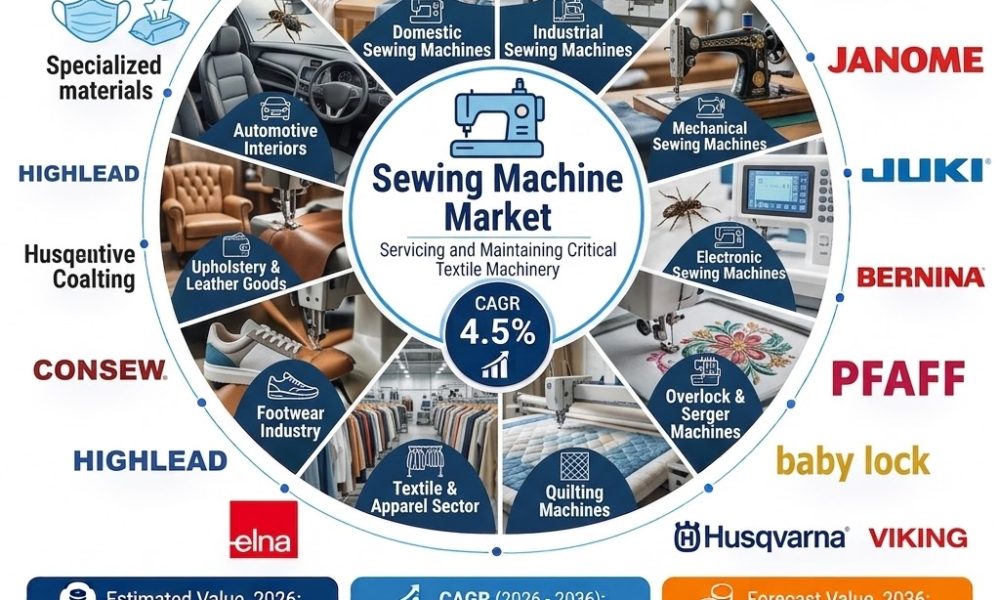
The global sewing machine market is projected to increase from USD 5.6 billion in 2026 to USD 8.7 billion by 2036, expanding at a 4.5% CAGR during the forecast period. The market was valued at USD 5.4 billion in 2025, creating an absolute opportunity of approximately USD 3.1 billion through 2036.
Demand is being supported by apparel manufacturers, home textile producers, automotive textile users and industrial textile companies replacing older equipment. Production plants are looking for machines that provide consistent stitching, stable fabric feeding and lower operator dependence across different materials and production runs.
Get Detailed Market Forecasts, Competitive Benchmarking, and Pricing Trends: https://www.factmr.com/connectus/sample?flag=S&rep_id=5894
Industrial Sewing Machines Lead Product Demand
Industrial Sewing Machines are projected to account for 61.7% of the market in 2026. Their position reflects demand from factories that operate longer shifts and require higher seam volumes than household machines.
Lockstitch and overlock systems remain important for garment production, while cylinder-bed and flatbed machines support thicker materials and curved assemblies used in automotive textiles and upholstery.
Apparel Manufacturing is expected to represent 73.9% share in 2026. Sewing machines are involved across multiple garment assembly stages, making equipment purchases closely linked with replacement cycles, operator training and the need to maintain stitch quality during style changes.
Apparel and fashion manufacturers are expected to account for 66.4% share by end use. These buyers typically purchase machines in production-line quantities and increasingly require consistent seam quality and repeatability.
Computerized Technology Gains Attention
Computerized Sewing Technology is forecast to capture 58.3% share in 2026. Digital controls can standardize stitch length and feed behavior across operators and shifts, reducing dependence on operator memory and manual settings.
Heavy Duty Industrial Configurations are projected to hold 42.8% share. These systems are suited to denim, upholstery, seat covers and other applications where machines must process multiple fabric layers and withstand higher material loads.
Direct Industrial Sales are expected to account for 47.5% share in 2026. Factories often require installation support and service commitments before purchasing multiple machines. OEM contracts and enterprise sales channels also help manufacturers match machine specifications with production requirements.
Shambhu Nath Jha, Principal Consultant at Fact.MR, states:
“Sewing machine buying is becoming an operating decision. Plants are expected to favor models that reduce operator dependency while protecting stitch quality. Suppliers that combine mechanical durability, digital control, training and local service are better aligned with how garment and technical textile plants select equipment.”
Factory Modernization Supports Equipment Replacement
Apparel line modernization is identified as a key demand driver. Factories may replace older machines when downtime affects delivery schedules or when stitch consistency becomes difficult to maintain.
Computerized controls and direct-drive servo systems also support replacement demand. These technologies can help reduce setup variation and are relevant where factories face challenges retaining experienced operators.
Automotive and industrial textile sewing provide another demand base. Seat covers, interior components and technical textile products often require stable stitching on thicker materials, supporting demand for heavy-duty configurations.
The market also presents opportunities in programmable pattern sewing, digital setup tools, aftermarket service and training contracts. B2B e-commerce can support purchases of standardized accessories and parts, particularly for smaller workshops.
However, pressure on textile and apparel output can delay equipment purchases. Long machine replacement cycles also mean factories may continue using existing equipment until maintenance costs or quality problems become more visible. Computerized systems add another consideration because operators require training before plants can capture their full operational benefits.
Germany Leads the Country Growth Outlook
Germany is forecast to record a 4.4% CAGR through 2036, followed by Japan at 3.8%, South Korea at 2.9%, France at 2.5%, and Italy at 2.0%.
Germany’s outlook is supported by machinery demand and textile equipment replacement. Destatis reported that German manufacturing orders increased 3.1% in June 2026 from the previous month, while machinery and equipment orders increased 12.7%. Destatis also reported a 45.2% rise in textile orders in February 2026.
Japan’s market is linked with both household sewing activity and industrial machine demand. South Korea’s outlook is shaped by export-facing apparel and industrial textile activity. France’s equipment demand is connected with apparel production and clothing durability initiatives, while Italy remains tied to fashion production, upholstery and selective equipment replacement.
Competition Shifts Toward Automation and Service Support
Competition in the sewing machine market is shaped by machine durability, stitch control, automation capabilities and service reach.
Key companies profiled in the report include Brother Industries, Ltd., BERNINA International AG, Jack Technology Co., Ltd., JANOME Corporation, JUKI Corporation, MSISM CO., LTD. (Million Special), PEGASUS CO., LTD., PFAFF Industriesysteme und Maschinen GmbH, Seiko Sewing Machine Co., Ltd., and SVP Worldwide (SINGER).
Brother Industries expanded its industrial sewing-machine presence through the acquisition of the automotive division of Germany-based Konrad Busche in November 2025. Its NEXIO BAS-341K and BAS-342K programmable cylinder-bed electronic pattern sewing machines also feature digital adjustment and monitoring functions.
JUKI launched the DX-01 single-needle lockstitch system in June 2025 with an electronic belt-feed system. BERNINA remains active in premium sewing and embroidery equipment, while other suppliers serve industrial, household, embroidery and specialized production requirements.
About the Sewing Machine Market Report
The Fact.MR report covers industrial, commercial and household machines used to stitch textile and leather-based products. The assessment includes lockstitch, overlock, chain stitch, flatbed and cylinder-bed systems across apparel manufacturing, home textiles, automotive textiles and industrial textiles.
The study analyzes product, application, end use, technology, configuration and distribution channels across North America, Latin America, Western Europe, Eastern Europe, East Asia, South Asia & Pacific, and the Middle East & Africa.
The analysis draws on 120+ sources, 35+ company portfolios, 25+ countries and more than 20 industry interviews. Fact.MR combines primary research, desk research, market sizing, forecasting and data validation to assess demand, segment shares, country growth, channel behavior and company activity.
Explore More Related Studies Published by Fact.MR Research:
https://www.openpr.com/news/4639241/mutual-fund-assets-market-to-grow-at-6-2-cagr-through-2036-usa
https://www.openpr.com/news/4639254/mining-dust-control-market-to-grow-at-5-6-cagr-through-2036
About Fact.MR
Fact.MR is a market research and consulting firm providing syndicated and customized research across industries. Its studies combine primary research, secondary research, market sizing, forecasting and competitive analysis to support business and strategic decisions.



