
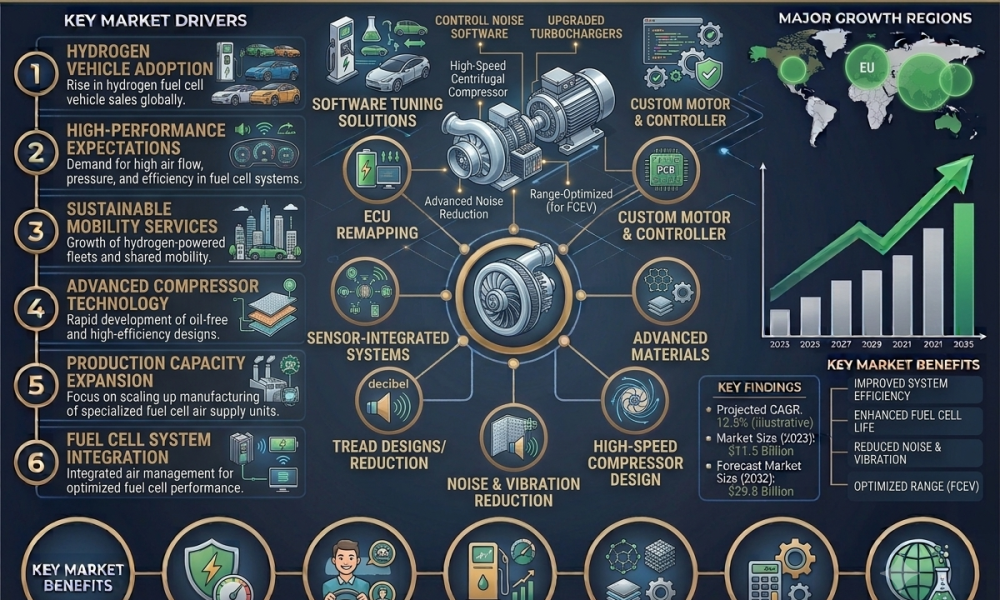
The global hydrogen fuel cell air compressor systems market is projected to expand from USD 726.0 million in 2025 to USD 2,451.9 million by 2036, advancing at a 11.7% CAGR from 2026 to 2036. Demand is being supported by growing fuel cell vehicle programs, particularly trucks, buses, and fleet vehicles that require reliable cathode air supply during extended operating cycles.
A key demand factor is the increasing importance of precise oxygen delivery and stack protection in fuel cell propulsion. Compressors directly regulate the airflow supplied to the cathode side of the fuel cell stack, making pressure response, air purity, durability, and control integration important considerations during vehicle platform qualification. Oil-free centrifugal architectures are gaining traction because they combine high-speed airflow response with lower contamination risk near sensitive stack assemblies.
Global Segment Leaders
- Fuel Cell Propulsion — 70.0% share: Fuel cell propulsion leads the propulsion segment because compressors directly support oxygen delivery and pressure control within hydrogen fuel cell systems.
- Oil-Free Centrifugal Compressors — 57.0% share: Oil-free centrifugal compressors account for the leading architecture share, supported by high-speed response, compact packaging, and reduced contamination risk.
- Heavy Trucks — 34.0% share: Heavy trucks represent the leading vehicle-type segment as long-haul and regional freight applications require sustained airflow delivery under demanding duty cycles.
- Module Systems — 44.0% share: Module systems lead the component segment as OEMs increasingly source pre-qualified compressor, motor, inverter, sensor, and control packages.
- OEM Sales — 52.0% share: OEM sales represent the leading channel as compressor systems require early qualification and integration before commercial fuel cell vehicle launches.
Get detailed market forecasts, competitive benchmarking, and pricing trends:
https://www.futuremarketinsights.com/reports/sample/rep-gb-33452
Country-Level Performance
China is projected to record the highest growth among the profiled countries, expanding at a 13.4% CAGR through 2036. Growth is supported by hydrogen logistics corridors, domestic fuel cell vehicle programs, and increasing deployment of hydrogen-powered commercial vehicles. The development of clustered refueling and fleet infrastructure is creating a practical operating base for compressor suppliers.
India is expected to expand at a 12.8% CAGR, supported by hydrogen bus and truck pilot projects and the development of dedicated refueling infrastructure. The country’s emerging commercial hydrogen mobility ecosystem is creating opportunities for compressor suppliers capable of meeting high-temperature, high-dust, and variable-duty-cycle requirements.
South Korea is projected to grow at a 12.3% CAGR, supported by its established fuel cell technology ecosystem and commercial vehicle programs. Demand is influenced by continued investment in fuel cell platforms, stack systems, and supporting balance-of-plant components.
Japan is expected to record an 11.9% CAGR, supported by its established automotive technology base and continued development of hydrogen mobility solutions. Compressor demand is influenced by requirements for compact packaging, efficient airflow control, and reliable integration with fuel cell power systems.
Germany is projected to expand at an 11.6% CAGR, supported by industrial expertise in automotive engineering, hydrogen technology development, and commercial vehicle applications. OEM and Tier 1 qualification requirements are expected to influence supplier selection.
France is expected to grow at a 10.9% CAGR, supported by hydrogen mobility initiatives and the development of fuel cell applications for commercial transportation. Demand is increasingly linked to fleet-scale deployment and integrated hydrogen vehicle systems.
The United States is projected to record a 10.8% CAGR, supported by heavy-duty fuel cell development, hydrogen mobility programs, and demand for zero-emission commercial transportation. Compressor suppliers are increasingly evaluated on durability, inverter integration, air purity, and performance under demanding truck and bus duty cycles.
The United Kingdom is expected to record the lowest CAGR among the profiled countries at 9.8%. Market development is supported by hydrogen demonstrations for heavy goods vehicles and public transportation, although infrastructure availability remains an important consideration for broader deployment.
Overall, the report covers the major hydrogen mobility markets and profiles eight countries in detail: the United States, United Kingdom, Germany, France, Japan, China, South Korea, and India.
Regional Context
China and India form the faster-growing country group, with CAGRs of 13.4% and 12.8%, respectively. China’s growth is linked to hydrogen logistics corridors, domestic fuel cell vehicle programs, and expanding commercial vehicle applications. India is developing its market through hydrogen bus and truck pilots, refueling infrastructure, and emerging fleet applications.
South Korea and Japan represent the next growth tier at 12.3% and 11.9%, supported by established automotive technology ecosystems and continued investment in fuel cell platforms. Both markets place strong emphasis on compact compressor packaging, high-speed response, and reliable integration with fuel cell stacks.
Germany and France record CAGRs of 11.6% and 10.9%, respectively. Their markets are supported by automotive engineering capabilities, hydrogen mobility initiatives, and commercial vehicle applications that require validated balance-of-plant systems.
The United States and United Kingdom record CAGRs of 10.8% and 9.8%, respectively. Market development in these countries is linked to heavy-duty vehicle demonstrations, fleet programs, and the gradual expansion of hydrogen refueling infrastructure.
Drive Your Business Growth Strategy: Checkout the Report for Key Insights!
https://www.futuremarketinsights.com/checkout/33452
Competitive Landscape
The competitive landscape includes Garrett Motion, Bosch, Toyota Industries, FISCHER Fuel Cell Compressor, Celeroton, Aeristech, and Mitsubishi Heavy Industries. These companies compete through high-speed compressor architectures, oil-free operation, integrated electronics, compact packaging, and fuel cell system integration capabilities.
The broader ecosystem also includes Hyundai, Denso, cellcentric, GM, Honda, and Toyota, which contribute through fuel cell platforms, stack systems, commercial vehicle programs, and related hydrogen mobility technologies.
Fleet-scale hydrogen mobility is shaping compressor sourcing requirements. The International Energy Agency reported in May 2025 that electric truck sales grew by nearly 80.0% in 2024, reflecting broader momentum in heavy transport electrification. California’s air regulator reported 61 hydrogen fueling stations as of August 2025, creating a concentrated service base for fuel cell vehicle operation. China’s Chengdu-Chongqing hydrogen corridor includes a supply center with 6,400 kg per day capacity, sufficient to support 260 heavy-duty trucks at full output.
These developments are increasing attention on compressor durability, air purity, inverter integration, pressure response, and stack protection. Suppliers are therefore competing not only on compressor efficiency but also on their ability to validate complete air supply modules under commercial vehicle operating conditions.
FMI Principal Consultant for Industrial Automation Nikhil Kaitwade observes, “Hydrogen fuel cell air compressor systems are becoming a stack qualification decision rather than a simple component purchase. Commercial vehicle buyers need durable oil-free air supply, fast response, and proven electronics integration. Suppliers showing validated performance across truck and bus duty cycles should gain stronger OEM confidence.”
What Is Driving Demand for Hydrogen Fuel Cell Air Compressor Systems?
Fuel cell trucks and buses require controlled cathode air pressure because stack power output depends on stable oxygen flow during load changes. As commercial vehicles move toward longer operating hours and higher utilization, compressor systems must maintain consistent airflow during acceleration, grade climbs, and other transient conditions.
Heavy-duty fuel cell programs are creating demand for compressor systems engineered for long service intervals. The United States Department of Energy’s 2025 heavy-duty fuel cell target includes 25,000 hours of durability, placing greater emphasis on compressor reliability and system endurance. Suppliers must demonstrate stable performance across variable flow conditions rather than relying solely on rated speed or catalog efficiency.
Oil-free centrifugal compressor architectures are also influencing system design. These compressors can provide high-speed airflow control while reducing contamination concerns around fuel cell stack assemblies. Their compact form factor can support packaging requirements in commercial vehicles where compressor, inverter, thermal management, and stack components must operate within constrained spaces.
Integrated compressor modules represent another area of demand. Combining the compressor, motor, inverter, sensors, and controls into a pre-qualified module can reduce wiring complexity, simplify diagnostics, and support more consistent OEM integration. Early platform sourcing also allows manufacturers to validate compressor performance alongside the fuel cell stack rather than treating the compressor as an independent component.
Hydrogen infrastructure remains an important constraint on deployment. The International Energy Agency reported in 2025 that low-emissions hydrogen production increased by 10.0% in 2024, although it remained below 1.0% of global hydrogen production. Limited hydrogen availability and station coverage can delay commercial fleet deployment, particularly outside established hydrogen corridors.
At the same time, pilot programs are creating field-validation opportunities. India’s Ministry of New and Renewable Energy sanctioned five pilot projects for hydrogen buses and trucks in March 2025, involving 37 vehicles and nine hydrogen refueling stations. These projects can provide compressor suppliers with operating data covering heat, vibration, dust exposure, pressure response, and maintenance requirements.
How Is the Hydrogen Fuel Cell Air Compressor Systems Market Segmented?
- Module Systems — 44.0% share: Integrated modules lead the component segment because OEMs increasingly seek compressor assemblies combining motors, inverters, sensors, and controls.
- Heavy Trucks — 34.0% share: Heavy trucks lead the vehicle segment due to higher airflow requirements across long-haul and regional freight applications.
- Fuel Cell Propulsion — 70.0% share: Fuel cell propulsion dominates because compressors directly support cathode oxygen delivery and stack pressure control.
- Oil-Free Centrifugal Compressors — 57.0% share: This architecture leads due to high-speed response, compact packaging, and lower contamination risk.
- OEM Sales — 52.0% share: OEM channels lead as compressor systems undergo early qualification during vehicle and fuel cell system development.
Which Countries Are Growing Fastest in the Hydrogen Fuel Cell Air Compressor Systems Market?
China leads the profiled countries with a 13.4% CAGR, followed by India at 12.8%, South Korea at 12.3%, Japan at 11.9%, Germany at 11.6%, France at 10.9%, the United States at 10.8%, and the United Kingdom at 9.8% through 2036.
The country outlook reflects differences in hydrogen infrastructure development, commercial vehicle programs, fuel cell manufacturing capabilities, fleet demonstrations, and OEM investment. China and India show the strongest projected growth rates, while established automotive markets continue developing compressor demand through fuel cell platform qualification and heavy-duty applications.
About Future Market Insights
Future Market Insights (FMI) is a leading provider of market research and consulting services, offering syndicated and customized research across industries including automotive, energy, and industrial automation. FMI delivers data-driven insights, market forecasts, competitive intelligence, and strategic analysis to support business decisions across global markets.



