
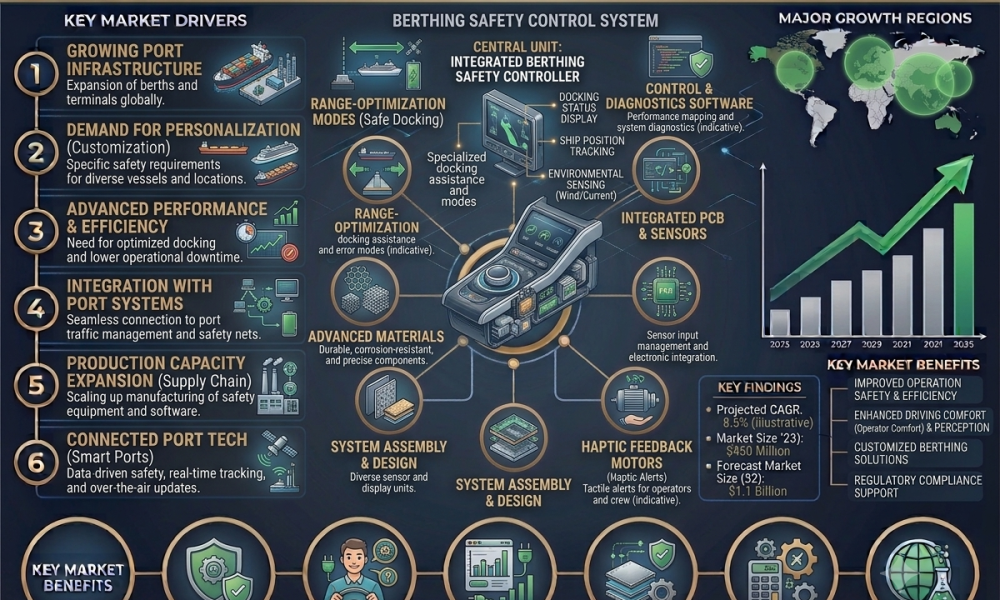
The global berthing safety system market is projected to expand from USD 772.6 million in 2025 to USD 1,953.8 million by 2036, advancing at an 8.8% CAGR from 2026 to 2036. Demand is being supported by port modernization, rising vessel traffic, and the growing need to convert docking visibility into measurable operating control. Retrofit and modernization projects are becoming particularly important as port operators seek to improve berth safety without undertaking complete quay reconstruction.
A key demand factor is the increasing requirement for real-time information during vessel approach and final alignment. Integrated berthing systems can combine vessel distance, approach velocity, and mooring-load information with operator displays and control-room platforms. Energy terminals also contribute to demand as LNG and chemical transfer operations require continuous monitoring and auditable operating records.
Global Segment Leaders
- Integrated Berthing Aid — 38.0% share: Integrated berthing aids lead the system-type segment as ports increasingly combine vessel approach and mooring information within a unified platform.
- Container Terminals — 39.0% share: Container terminals account for the leading application share, supported by berth-window pressure, crane productivity requirements, and the need for stable vessel positioning.
- Sensors — 41.5% share: Sensors lead the component segment as terminals require accurate measurement of vessel distance, approach velocity, and mooring-line loads.
- Retrofit / Modernization — 56.0% share: Retrofit and modernization projects dominate installation demand as existing ports add digital monitoring capabilities without rebuilding complete marine structures.
- Port Integrators — 44.0% share: Port integrators represent the leading sales channel because terminal operators increasingly seek packaged solutions connecting sensors, software, displays, and control-room infrastructure.
Get detailed market forecasts, competitive benchmarking, and pricing trends:
https://www.futuremarketinsights.com/reports/sample/rep-gb-33614
Country-Level Performance
China is projected to record the highest growth among the profiled countries, expanding at a 10.3% CAGR through 2036. Demand is supported by large-scale port development, rising cargo throughput, and continuing investment in port automation. Mega-port modernization programs are creating opportunities for integrated berthing systems that connect vessel approach monitoring with terminal control infrastructure.
India is expected to expand at a 9.6% CAGR, supported by major-port capacity expansion and public-private partnership terminal modernization projects. As terminals increase automation and digital monitoring capabilities, berth operators are evaluating technologies that can provide real-time vessel positioning and event records without requiring complete infrastructure replacement.
The United States is projected to grow at an 8.7% CAGR, supported by its extensive port network and continued investment in terminal productivity and infrastructure modernization. Demand is influenced by the need to improve vessel approach visibility and integrate berth monitoring with established terminal operating systems.
South Korea is expected to record an 8.5% CAGR, supported by its major container terminals, maritime trade activity, and ongoing port automation. Berthing safety systems are increasingly relevant where operators seek centralized monitoring of vessel approach and mooring conditions.
The United Kingdom is projected to expand at an 8.2% CAGR, supported by port modernization and demand for improved berth-management capabilities. Retrofit projects remain relevant as established terminals seek digital monitoring while maintaining existing marine infrastructure.
Germany is expected to grow at an 8.0% CAGR, supported by established port infrastructure and investments in terminal automation and operational efficiency. Integration with control-room systems remains an important consideration for berth technology deployment.
France is projected to record a 7.8% CAGR, supported by port modernization, container-handling activity, and the adoption of digital systems for vessel operations. Demand is increasingly connected to the need for reliable approach information and coordinated terminal operations.
Japan is projected to record the lowest CAGR among the profiled countries at 7.6%. The market continues to be supported by established maritime infrastructure, port modernization, and demand for reliable vessel approach monitoring and berth-management technologies.
Overall, the report profiles North America, Latin America, Europe, Asia Pacific, and the Middle East and Africa, with eight countries covered in the country-level outlook.
Regional Context
China and India form the faster-growing country group, with CAGRs of 10.3% and 9.6%, respectively. China’s market benefits from large-scale port development, rising cargo volumes, and automation initiatives, while India’s growth is supported by major-port expansion and modernization of terminals through public-private investment.
The United States and South Korea represent the next growth tier at 8.7% and 8.5%, supported by established maritime infrastructure, container terminal activity, and continued investments in automation. Both markets provide opportunities for integrated berth monitoring systems capable of connecting sensor data with terminal control-room infrastructure.
The United Kingdom, Germany, France, and Japan record CAGRs of 8.2%, 8.0%, 7.8%, and 7.6%, respectively. Their markets are shaped by modernization of established ports, digitalization of terminal operations, and demand for systems that can be integrated into existing berth infrastructure.
The full country outlook covers China, India, the United States, South Korea, the United Kingdom, Germany, France, and Japan, alongside regional coverage spanning North America, Latin America, Europe, Asia Pacific, and the Middle East and Africa.
Competitive Landscape
The competitive landscape includes Trelleborg Marine & Infrastructure, Cavotec, Straatman Mooring Systems, and Prosertek, alongside other technology and port-integration providers. Trelleborg Marine & Infrastructure and Cavotec strengthen their positions through automated mooring technologies and integrated berthing solutions, while Straatman Mooring Systems and Prosertek focus on customized berthing-aid platforms, software integration, and terminal-specific engineering.
Competitive differentiation is increasingly centered on system integration, monitoring accuracy, retrofit capability, and compatibility with existing port control-room infrastructure. Buyers are moving beyond individual sensors toward integrated platforms that combine approach monitoring, mooring management, operator displays, and operational data.
Market conditions are also being influenced by rising container throughput and investments in automated mooring. UN Trade and Development reported that ports worldwide handled 920 million TEUs in 2024, representing a 6.9% increase from 2023. In February 2025, Cavotec signed a multi-million-euro MoorMaster NxG order for the Port of Dublin, with deliveries planned mainly for the third quarter of 2026, highlighting continued investment in automated mooring infrastructure.
FMI Principal Consultant for Industrial Automation Nikhil Kaitwade observes, “Berthing safety systems are evolving into essential port infrastructure as operators prioritize operational safety, digital integration, and real-time berth management. Port authorities increasingly evaluate suppliers based on system integration, data accuracy, and compatibility with existing control-room infrastructure.”
What Is Driving Demand for Berthing Safety Systems?
Port operators are increasingly deploying integrated berthing systems to reduce uncertainty during vessel approaches while creating digital records for pilots, terminal operators, and safety teams. Real-time distance and approach-speed information can help operators assess vessel positioning during the final stages of docking.
Container terminal productivity is another important demand factor. As berth windows become increasingly important to vessel and crane scheduling, operators require reliable information about vessel position and movement. Berthing systems can provide centralized information that supports repeatable docking procedures and helps operators maintain consistent berth operations.
Retrofit and modernization programs are supporting market expansion because existing ports can install laser-based monitoring systems, sensors, software, and operator displays without reconstructing complete quays. Phased deployment allows operators to modernize individual berths before extending systems across wider terminal areas.
Energy terminals represent another important application area. LNG and oil facilities require continuous monitoring during transfer operations, where reliable mooring information and emergency-release context can support operational safety. The ability to create auditable operating records also increases the value of integrated monitoring systems.
The broader expansion of maritime trade is supporting the requirement for more measurable port operations. UN Trade and Development reported that seaborne trade increased 2.2% in 2024, while its maritime outlook projected slower growth of 0.5% in 2025 followed by an average annual growth rate of approximately 2% from 2026 to 2030. Moderate trade expansion continues to place emphasis on berth productivity as ports handle larger vessels and tighter operating schedules.
How Is the Berthing Safety System Market Segmented?
- Integrated Berthing Aid — 38.0% share: Integrated systems lead the system-type segment as ports seek unified platforms combining approach and mooring information.
- Container Terminals — 39.0% share: Container terminals represent the leading application segment, driven by berth-window and vessel-position stability requirements.
- Sensors — 41.5% share: Sensors account for the largest component share because accurate vessel distance, approach velocity, and mooring-load measurement form the foundation of berth monitoring.
- Retrofit / Modernization — 56.0% share: Retrofit projects lead installation demand as established terminals upgrade live berths in phases.
- Port Integrators — 44.0% share: Port integrators lead the sales channel as operators seek connected packages spanning sensors, software, and control-room interfaces.
Why Does Integrated Berthing Aid Lead by System Type?
Integrated berthing aid systems are projected to account for 38.0% share in 2026, supported by buyer preference for platforms that combine vessel approach and mooring-load records.
Laser docking systems remain relevant because berth operators require precise distance and velocity data during routine container, ferry, and other vessel approaches. Integration with operator displays and terminal systems further expands the functionality of these solutions.
Which Application Leads the Berthing Safety System Market?
Container terminals are expected to hold 39.0% share in 2026, supported by berth-window pressure and crane productivity requirements during vessel operations.
Stable vessel positioning is particularly important where loading and unloading schedules depend on predictable berth operations. LNG and oil terminals also contribute to demand as transfer operations require dependable operator displays and emergency-release context.
Which Component Leads the Berthing Safety System Market?
Sensors are anticipated to account for 41.5% share in 2026, led by the need to measure vessel distance, approach velocity, and mooring-line loads.
Software and analytics are gaining importance as terminal operators seek event replay, historical comparisons, and performance monitoring across multiple berths. The combination of physical sensing and software analysis is helping convert individual berth events into operational data.
Which Installation Type Leads the Berthing Safety System Market?
Retrofit and modernization projects are projected to hold 56.0% share in 2026. Existing ports can add berth monitoring systems without undertaking complete marine infrastructure reconstruction, making phased modernization an important deployment model.
New terminal projects remain significant because LNG jetties, container terminals, and automated ports can specify berthing safety systems during the engineering and construction stages. However, the installed base of operating berths creates substantial opportunities for retrofit suppliers.
Which Sales Channel Leads the Berthing Safety System Market?
Port integrators are expected to represent 44.0% share in 2026, supported by buyer preference for connected packages covering sensors, software interfaces, displays, and control-room integration.
Direct OEM sales remain relevant for single-berth projects requiring factory calibration, application-specific engineering, and technical support. Port integrators can provide broader project coordination where multiple technologies need to operate as a unified berth-management platform.
Drive Your Business Growth Strategy: Checkout the Report for Key Insights!
https://www.futuremarketinsights.com/checkout/33614
What Are the Drivers, Restraints, and Opportunities in the Berthing Safety System Market?
Driver: High-throughput container and energy berths require shared approach data to support safe and repeatable vessel docking operations.
Restraint: Integration complexity can slow modernization at older quays where power access, cabling routes, display infrastructure, and legacy control-room systems limit installation flexibility.
Opportunity: Sensor-linked berth records can strengthen renewal prospects as port operators increasingly request documented safety, operational, and uptime improvements.
Berth Data Records Strengthen Safety Investment
Berth safety investment is gaining relevance as ports convert vessel approaches into measurable operating events. Digital records can provide information on approach speed, vessel distance, mooring conditions, and operational events, helping terminal teams review performance across multiple docking operations.
The International Association of Ports and Harbors reported in May 2025 that 69% of surveyed ports carried out physical infrastructure projects as planned, while another 22% experienced only minor delays. Continued execution of infrastructure programs creates opportunities for berth technology upgrades that can be incorporated into wider terminal modernization projects.
Control-Room Integration Raises Retrofit Requirements
Retrofit projects can become more complex when older berths lack suitable power access, display locations, or standardized communication infrastructure. Energy-transition projects can also introduce additional engineering requirements at existing terminals.
Berthing safety suppliers therefore need to simplify installation, system commissioning, operator training, and handover. Solutions that can integrate with existing control-room systems without extensive infrastructure changes can support faster modernization of live terminals.
Automated Mooring Creates Premium Upside
Automated mooring is creating additional opportunities for integrated berth safety systems. Cavotec reported that its MoorMaster system at APM Terminals MedPort Tangier covered an 800-meter quay segment using 45 units following a phase-three expansion.
Such projects demonstrate how automated mooring, berth productivity, and operational safety can become interconnected investment considerations. Suppliers capable of linking berth monitoring data with mooring hardware and terminal systems can address broader modernization requirements than sensor-only providers.
Which Countries Are Growing in the Berthing Safety System Market?
China is projected to record a 10.3% CAGR through 2036, followed by India at 9.6%, the United States at 8.7%, South Korea at 8.5%, the United Kingdom at 8.2%, Germany at 8.0%, France at 7.8%, and Japan at 7.6%.
China’s growth is associated with large-scale port development, cargo throughput, and automation initiatives. India is benefiting from major-port capacity expansion and terminal modernization. The United States and South Korea are supported by established port infrastructure and automation investments, while European and Japanese markets continue to focus on modernization and digital integration across established terminals.
The country outlook reflects differences in port infrastructure, cargo activity, terminal automation, retrofit requirements, and investment in digital berth-management systems.
About Future Market Insights
Future Market Insights (FMI) is a leading provider of market research and consulting services, offering syndicated and customized research across industries including industrial automation, marine infrastructure, and transportation. FMI provides market intelligence, competitive analysis, and strategic insights to help organizations understand evolving technology and investment trends across global markets.



