
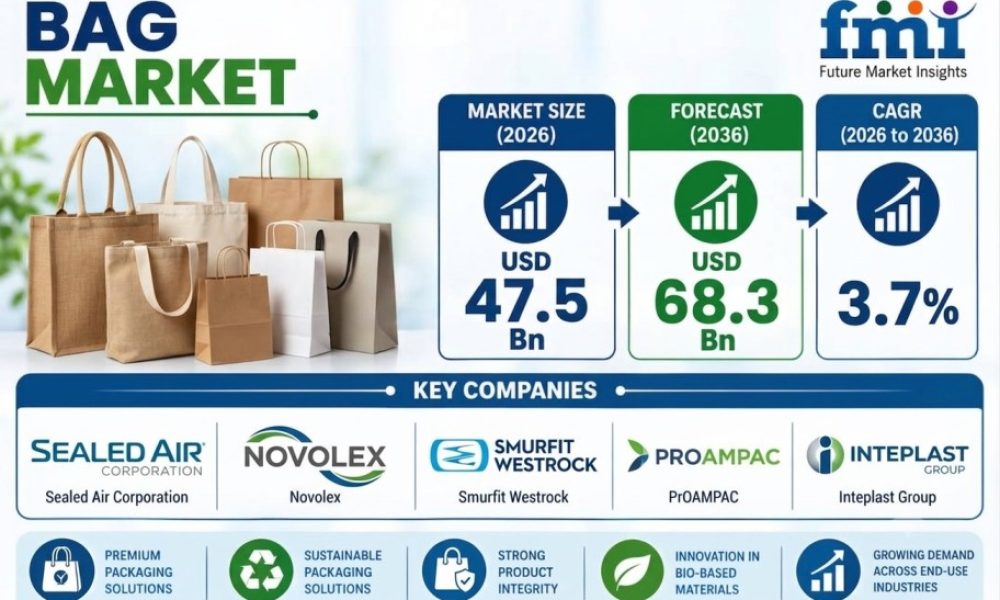
The global Bag Market is projected to grow from USD 47.5 billion in 2026 to USD 68.3 billion by 2036, expanding at a 3.7% CAGR during the forecast period, according to Future Market Insights (FMI). The market was valued at USD 45.8 billion in 2025, creating an absolute dollar opportunity of USD 20.8 billion between 2026 and 2036.
The market covers plastic, paper, and textile bags used across retail, institutional, industrial, and household applications. Demand remains supported by everyday requirements for carrying, packaging, waste containment, and product handling.
At the same time, the composition of bag demand is changing as single-use plastic restrictions encourage greater adoption of recyclable, compostable, paper, and reusable textile alternatives.
>> Get Detailed Market Forecasts, Competitive Benchmarking, and Pricing Trends: https://www.futuremarketinsights.com/reports/sample/rep-gb-14380
Plastic Bags Continue to Lead
Plastic bags are projected to account for 58.0% of the product segment in 2026.
Their continued use is supported by cost efficiency, moisture resistance, flexibility, and suitability across retail checkout, waste containment, and industrial applications.
Within product types, garbage, refuse, and trash bags account for 24.0% of demand. This category provides a relatively stable consumption base because waste containment requirements remain closely linked to household, institutional, hospitality, and industrial activity.
The market therefore has two distinct demand dynamics.
Retail checkout and carry-out bags face stronger pressure from sustainability regulations, while trash and industrial bags continue to depend primarily on functional performance and cost.
Retail and Consumer Applications Represent 42% of Demand
Retail and consumer applications are expected to account for 42.0% of end-use demand in 2026.
This includes grocery checkout bags, fashion retail bags, general merchandise carry-out bags, food delivery bags, and other consumer packaging formats.
Retailers are increasingly evaluating bag materials against sustainability requirements. Paper bags, recyclable plastic structures, and reusable textile bags are gaining attention where regulations or consumer expectations make conventional single-use formats less attractive.
For manufacturers, the shift creates a need for broader material capabilities.
As Nandini Roy Choudhury, Principal Consultant at Future Market Insights, explains:
“Manufacturers that can serve both conventional and sustainable bag formats while managing the cost implications of material transitions are positioned to retain and grow share across retail, institutional, and industrial customer segments.”
Regulation Is Reshaping Material Selection
Single-use plastic restrictions are creating a structural shift in retail bag procurement.
European, North American, and Asian markets are introducing bans, charges, and extended producer responsibility frameworks that influence the economics of conventional plastic checkout bags.
In the UK, for example, charges on single-use carrier bags have encouraged greater use of reusable alternatives, while packaging regulations continue to influence material specifications.
Across the European Union, sustainability requirements are encouraging retailers to evaluate paper and reusable textile alternatives alongside recyclable and compostable materials.
The impact is more limited for waste containment and industrial applications, where functional requirements remain a primary purchasing consideration.
Recyclable Bags Gain Importance
Recyclable bags account for 38.0% of the sustainability segment in 2026.
Manufacturers are responding through lightweighting, recycled-content formulations, recyclable structures, and compostable alternatives.
However, material transition also creates cost and production challenges.
Bag manufacturers serving large retail accounts increasingly need the ability to produce multiple material formats while maintaining consistent quality and competitive pricing.
This is becoming an important differentiator as retailers shift specifications between plastic, paper, and textile-based solutions.
>> Exclusive Discounts on Full Report: https://www.futuremarketinsights.com/reports/brochure/rep-gb-14380
USA Leads Country Growth
The USA is projected to grow at a 3.9% CAGR through 2036, making it the fastest-growing country among the markets highlighted by FMI.
The country’s large retail sector, institutional waste management requirements, and transition toward recyclable and compostable alternatives support demand.
Institutional procurement across healthcare, hospitality, and education also provides stable demand for trash bags and waste liners.
Japan follows with a projected 3.8% CAGR, supported by its packaging-intensive retail environment, efficient waste management systems, and demand for high-quality bag products.
South Korea is projected to grow at 3.7%, while the EU is expected to expand at 3.6%. The UK is forecast at 3.5% CAGR.
Competitive Landscape
The competitive environment includes companies with broad portfolios across plastic, paper, protective, retail, institutional, and sustainable bag formats.
Key companies profiled in the market include Amcor plc, Mondi Group, Amcor plc following the Berry Global combination, Sealed Air Corporation, Novolex, Smurfit Westrock, ProAmpac, and Inteplast Group.
Mondi Group and Smurfit Westrock participate in paper bag manufacturing as demand for recyclable retail alternatives expands. Sealed Air serves protective and industrial applications, while Novolex and ProAmpac have broad positions across North American retail, food service, and institutional markets.
Emerging companies such as TIPA Corp, Notpla, Grounded Packaging, Better Packaging Co., BioPak, and Earthwise Packaging are also developing alternative material and sustainable packaging solutions.
Outlook for Bag Manufacturers
The long-term opportunity is not simply about replacing plastic bags.
Manufacturers must balance cost, functionality, regulation, material availability, and sustainability requirements across different applications.
Retail packaging will continue to experience material transitions, while garbage bags, refuse bags, and industrial formats provide a more stable functional demand base.
This creates an increasingly diversified market in which manufacturers with multi-material capabilities can serve customers across conventional and sustainable packaging requirements.
To explore how FMI Custom Research can support your strategic priorities, connect with our team at – [email protected]
About Future Market Insights (FMI)
Future Market Insights, Inc. is an ESOMAR-certified, ISO 9001:2015 market research and consulting organization trusted by Fortune 500 companies. With a global presence across the U.S., UK, India, and Dubai, FMI delivers data-driven insights across 30+ industries and 1200 markets worldwide.



