
The global Semiconductor Intellectual Property (IP) Market is emerging as one of the most critical segments within the semiconductor value chain. Semiconductor IP refers to pre-designed, reusable circuit blocks or cores that semiconductor companies license to accelerate chip development. These IP cores significantly reduce development time, cost, and complexity while enabling companies to focus on product differentiation and innovation.
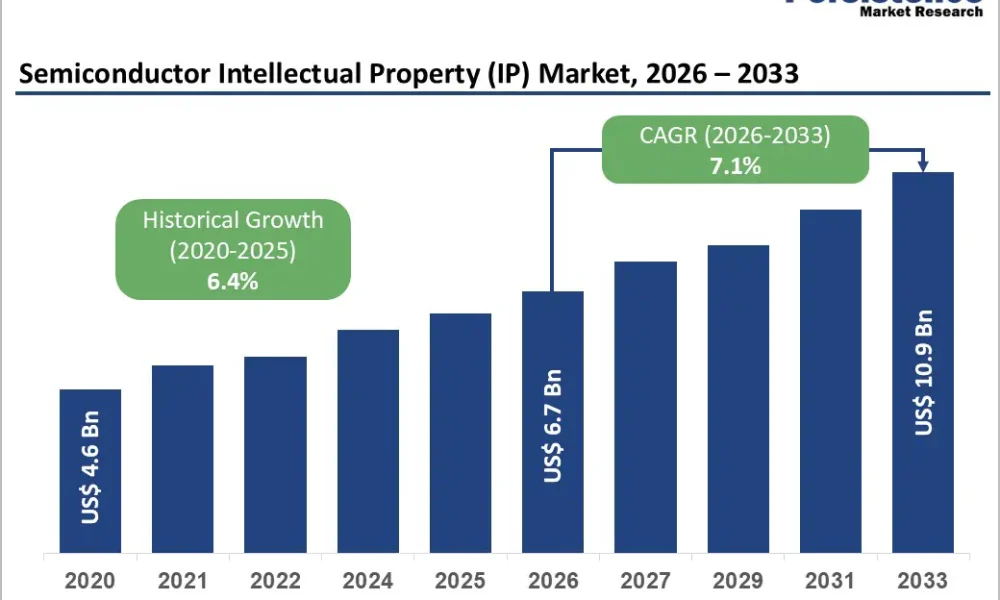
The market is gaining strong momentum as the semiconductor industry undergoes rapid transformation fueled by artificial intelligence (AI), high-performance computing (HPC), automotive electronics, and next-generation connectivity technologies. According to industry projections, the global semiconductor IP market size is expected to reach US$ 6.7 billion in 2026 and grow to US$ 10.9 billion by 2033, registering a compound annual growth rate (CAGR) of 7.1% between 2026 and 2033.
The steady growth trajectory reflects the increasing reliance on advanced chip architectures, the rising complexity of semiconductor designs, and the growing adoption of reusable IP components across multiple industries. As organizations strive to bring sophisticated chips to market faster, semiconductor IP providers are becoming indispensable partners in the chip development ecosystem.
Understanding Semiconductor Intellectual Property in Modern Chip Design
Semiconductor IP is essentially a licensed design component used in the creation of integrated circuits (ICs). Instead of designing every function of a chip from scratch, semiconductor companies integrate pre-validated IP cores, which significantly accelerates product development.
These IP cores typically fall into several major categories:
- Processor IP – CPU architectures and microcontroller cores
- Memory IP – DRAM, SRAM, and NAND-based architectures
- Interface IP – communication protocols such as PCIe, USB, and DDR
- Analog and mixed-signal IP – power management and signal conversion blocks
- Security IP – encryption, authentication, and hardware protection technologies
Using semiconductor IP allows companies to reduce development risks while ensuring compatibility with advanced semiconductor manufacturing nodes.
As chip designs become more complex—particularly for AI processors, automotive systems, and data center accelerators—the demand for advanced IP solutions continues to expand rapidly.
AI and Data Center Expansion Driving Market Growth
One of the most powerful growth drivers for the semiconductor IP market is the rapid expansion of artificial intelligence infrastructure and hyperscale data centers.
The AI semiconductor market is projected to grow dramatically over the next few years, increasing from approximately US$150 billion in 2025 to around US$500 billion by 2028. This explosive growth requires advanced chip architectures optimized for machine learning workloads, neural networks, and large-scale data processing.
To support these applications, chip manufacturers require specialized IP solutions such as:
- High-performance processor cores
- AI accelerator architectures
- High-bandwidth memory controllers
- Advanced interconnect and interface IP
Companies designing AI processors are increasingly licensing advanced IP to shorten design cycles and improve performance efficiency. Major technology firms are also developing custom chips using licensed processor architectures to power cloud computing platforms and AI workloads.
The growth of hyperscale cloud providers and large data centers has further accelerated demand for advanced semiconductor IP solutions capable of delivering higher performance and improved power efficiency.
Government Investments Strengthening Semiconductor Ecosystems
Governments worldwide have recognized semiconductors as strategic assets and are investing heavily in building domestic semiconductor ecosystems. These initiatives directly support the growth of the semiconductor IP market by encouraging research, innovation, and intellectual property development.
A major example is the CHIPS and Science Act, which allocated US$52.7 billion to strengthen semiconductor manufacturing, research, and design capabilities in the United States.
Similarly, several countries in Asia and Europe have launched semiconductor initiatives to reduce dependence on global supply chains and strengthen local innovation capabilities.
In India, government programs such as the Design Linked Incentive (DLI) scheme and the Production Linked Incentive (PLI) program are promoting domestic semiconductor design and IP development. These initiatives aim to position India as a global hub for semiconductor innovation, offering new opportunities for IP licensing and collaborative design.
By strengthening patent protection systems and accelerating semiconductor R&D investments, these policies are creating a favorable environment for semiconductor IP development worldwide.
Rising Memory Demand Accelerating Innovation
Memory IP is among the fastest-growing segments in the semiconductor IP market due to increasing data processing and storage requirements.
The rise of big data, artificial intelligence, cloud computing, and edge computing has dramatically increased the need for high-performance memory technologies. Global semiconductor memory sales have experienced significant growth in recent years, particularly in DRAM and NAND flash products.
Advanced memory IP solutions now support:
- DDR4 and DDR5 DRAM technologies
- High-bandwidth memory (HBM) architectures
- SRAM configurations for processors
- Next-generation storage interfaces
These memory architectures play a critical role in AI training systems, GPUs, and high-performance computing clusters. As chip designers seek higher bandwidth and lower latency memory systems, the demand for advanced memory IP continues to rise.
Companies specializing in interface and memory IP are focusing on improving data throughput, power efficiency, and thermal performance to meet the requirements of modern computing platforms.
Challenges: High Licensing Costs and Complex Royalty Models
Despite its promising growth prospects, the semiconductor IP market faces certain challenges. One of the primary constraints is the high cost associated with IP licensing.
Advanced processor architectures and specialized IP blocks often require licensing agreements worth millions of dollars. These agreements may include:
- Upfront licensing fees
- Per-unit royalties
- Revenue-based royalty structures
For smaller semiconductor startups or emerging design companies, these costs can create significant barriers to entry. Early-stage firms with limited production volumes may find it difficult to justify large licensing investments before achieving commercial scale.
Additionally, complex royalty agreements can make cost forecasting challenging, particularly for companies producing chips at variable volumes.
These financial barriers can limit market participation and consolidate IP adoption among larger semiconductor companies with greater financial resources.
Opportunities in China’s Semiconductor Self-Sufficiency Strategy
China represents one of the most significant growth opportunities for the semiconductor IP market. The country has prioritized semiconductor self-sufficiency as part of its long-term industrial strategy.
Government initiatives such as Made in China 2025 aim to establish a comprehensive domestic semiconductor ecosystem, including chip design, manufacturing, and intellectual property development.
Chinese technology companies are investing heavily in semiconductor innovation to reduce reliance on foreign technologies. Several domestic chip designers and AI processor developers are emerging as key players in the global semiconductor landscape.
China has also become one of the leading countries in global patent filings, demonstrating the rapid expansion of its intellectual property capabilities.
As domestic semiconductor companies expand their design activities, demand for processor IP, memory IP, and interface IP is expected to increase significantly within the Chinese market.
Elevate your business strategy with comprehensive market data. Request a sample report now: https://www.persistencemarketresearch.com/samples/32395
India Emerging as a Global Semiconductor Design Hub
India is rapidly emerging as an important center for semiconductor design and intellectual property creation. With a large pool of engineering talent and increasing government support, the country is strengthening its presence in the global semiconductor ecosystem.
Several multinational semiconductor companies already operate large design centers in India, focusing on chip architecture, verification, and IP development.
Government initiatives have further accelerated this momentum by providing incentives for semiconductor design startups and technology firms.
Events such as SEMICON India highlight the country’s growing role in global semiconductor innovation. The establishment of semiconductor packaging and testing facilities, along with design-focused initiatives, is helping India transition from a semiconductor consumer to an active contributor in global chip development.
As the semiconductor ecosystem expands in India, the demand for licensed IP cores and collaborative design solutions is expected to grow steadily.
Processor IP Dominates the Market
Among all semiconductor IP categories, processor IP remains the largest segment. It accounts for approximately 45% of the total market share in 2026.
Processor IP includes CPU architectures and microcontroller cores used in a wide range of applications such as:
- Smartphones and tablets
- Personal computers
- Data center processors
- AI accelerators
- Embedded systems
Many semiconductor companies rely on licensed CPU architectures to develop customized chips tailored to their specific applications.
One of the most prominent providers of processor IP is Arm Limited, whose architecture powers billions of devices worldwide. The company’s processor designs are widely used in mobile devices, IoT systems, and increasingly in data center processors.
Processor IP continues to evolve to support AI workloads, energy-efficient computing, and advanced semiconductor manufacturing nodes.
Consumer Electronics Remains the Largest End-Use Industry
The consumer electronics sector represents the largest end-use industry for semiconductor IP, accounting for nearly 38% of the market share.
Modern consumer electronics products rely heavily on semiconductor components, including:
- Smartphones
- Tablets
- Gaming consoles
- Smart TVs
- Wearable devices
These products require high-performance processors, efficient memory systems, and advanced connectivity interfaces, all of which rely on licensed semiconductor IP.
The rapid evolution of consumer technology, including augmented reality devices, smart home ecosystems, and portable computing platforms, continues to drive strong demand for advanced chip architectures and IP solutions.
Automotive Industry Emerging as the Fastest-Growing Segment
While consumer electronics dominates today, the automotive sector is expected to become the fastest-growing end-use segment in the semiconductor IP market.
Modern vehicles increasingly rely on semiconductors to support:
- Advanced driver assistance systems (ADAS)
- Autonomous driving technologies
- Electric vehicle power systems
- In-vehicle infotainment platforms
These systems require sophisticated processors, high-bandwidth memory architectures, and advanced connectivity interfaces.
As the automotive industry shifts toward electrification and autonomy, semiconductor complexity is increasing significantly, creating strong demand for specialized semiconductor IP.
Regional Market Trends
East Asia Leading Global Market Growth
East Asia currently holds the largest share of the global semiconductor IP market, accounting for approximately 35% of global demand.
Countries such as China, South Korea, and Taiwan play a dominant role in semiconductor manufacturing and chip design. Major semiconductor foundries and design companies in the region are heavily investing in advanced chip technologies and IP development.
The region’s strong semiconductor ecosystem, combined with government-backed innovation initiatives, continues to drive demand for advanced processor, memory, and interface IP.
North America Driving Innovation
North America represents roughly 30% of the global semiconductor IP market and remains a major center for semiconductor innovation.
Several leading IP providers and semiconductor companies are headquartered in the region, including Synopsys and Cadence Design Systems.
The region benefits from strong venture capital investment, advanced research institutions, and large-scale data center infrastructure. These factors contribute to continued demand for cutting-edge semiconductor IP technologies.
Europe Strengthening Semiconductor Capabilities
Europe accounts for approximately 15% of the global semiconductor IP market. The region is focusing on strengthening semiconductor innovation through collaborative research programs and policy initiatives.
One major initiative is the European Chips Act, which aims to enhance semiconductor research, manufacturing, and IP development across the European Union.
By fostering collaboration between universities, research institutions, and technology companies, Europe is working to strengthen its position in the global semiconductor ecosystem.
Competitive Landscape
The semiconductor IP market is relatively consolidated, with a few key players dominating the industry. These companies maintain extensive IP portfolios and invest heavily in research and development to maintain technological leadership.
Major companies operating in the market include:
- Arm Limited
- Synopsys
- Cadence Design Systems
- Imagination Technologies
- Rambus
- CEVA
These companies compete primarily through technological innovation, portfolio expansion, and strategic partnerships with semiconductor manufacturers.
Future Outlook
The semiconductor intellectual property market is poised for sustained growth as chip designs become more complex and innovation cycles accelerate. The continued expansion of artificial intelligence, cloud computing, automotive electronics, and advanced connectivity technologies will drive strong demand for reusable IP components.
Emerging semiconductor hubs in Asia and India, combined with government-backed semiconductor strategies across the globe, are expected to further expand the market.
As the semiconductor industry moves toward advanced process nodes, chiplet architectures, and AI-optimized designs, semiconductor IP will remain a critical enabler of next-generation computing technologies.
With the market projected to reach US$10.9 billion by 2033, semiconductor IP providers will play a central role in shaping the future of global semiconductor innovation.
Related Reports:




