
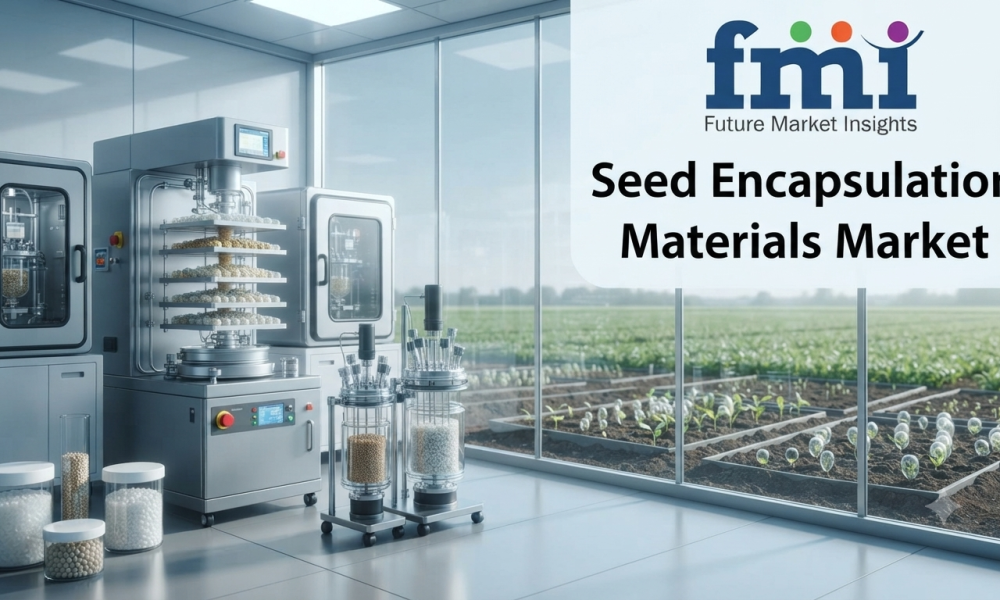
The global Seed Encapsulation Materials Market is projected to grow from USD 260.7 million in 2026 to USD 740.3 million by 2036, expanding at an 11.0% CAGR during the forecast period. Growth is being shaped by the increasing use of treated seed to deliver chemical, nutrient, and biological functions while reducing the need for separate field application steps.
Commercial treatment scale is becoming an important consideration for material suppliers. EPA’s June 2026 exposure guidance describes automated facilities handling more than 100,000 pounds of seed, highlighting the need for encapsulation materials that maintain consistent loading, seed safety, drying behavior, and processing performance across large commercial lots.
Regulatory Shifts Create Demand for Replacement Materials
Regulatory requirements are also influencing formulation decisions. In April 2025, the European Commission published implementation guidance concerning restrictions on intentionally added synthetic polymer microparticles. Seed-coating formulators affected by these requirements need alternatives that can preserve adhesion and dust control while remaining compatible with established treatment equipment.
This creates an opportunity for suppliers developing microplastic-free and biological-compatible encapsulation systems. However, substitution can take time because seed companies must validate new materials for germination, active retention, dust behavior, drying, and compatibility with existing treatment recipes.
Get detailed market forecasts, competitive benchmarking, and pricing trends: https://www.futuremarketinsights.com/reports/sample/rep-gb-35333
Polymer-Based Systems Lead Product Demand
Polymer-based systems are projected to account for 42.7% of the product type category in 2026, reflecting their role in adhesion and film formation. Commercial film-coating and encrusting processes require materials that retain treatment components on seed without compromising germination or water exchange.
The formulation category is led by liquid slurries, with an estimated 38.4% share in 2026. Their use supports metering accuracy and compatibility with commercial treatment equipment. Biological formulations add another technical requirement because viscosity, mixing, moisture, and drying conditions can affect microbial viability.
Corn and Cereals Represent the Largest Crop Segment
Corn and cereals are expected to account for 49.7% of the crop type category in 2026. High seed volumes and standardized treatment programs make repeatable coating performance particularly important for field crops.
The treatment point segment is led by in-plant treatment, with a projected 44.2% share in 2026. Centralized treatment enables seed companies to control recipes and quality at the production line, making application testing an important step before new encapsulation materials enter routine production.
Meanwhile, agri-input distributors are expected to hold 35.1% of the sales channel category in 2026, supported by their local market access and technical support for dispersed customer accounts.
Biological Compatibility Opens New Opportunities
The expansion of biological seed treatments is creating additional demand for encapsulation materials capable of protecting active ingredients during treatment and storage. Increasing biological production capacity can increase the number of formulations requiring stable on-seed delivery systems.
At the same time, material substitution remains a challenge. New carriers may require additional qualification before they can replace established materials. Regulatory compliance alone does not guarantee equivalent adhesion, drying, active retention, germination, or line performance.
For suppliers, the opportunity lies in developing materials that combine regulatory compatibility with measurable performance on existing commercial equipment. Application data that reduces qualification time can also support adoption among seed companies and commercial treaters.
Regional Growth Outlook
Country-level forecasts show differing market trajectories. The USA is projected to expand at 10.7% CAGR, followed by South Korea at 10.4%, the UK at 10.1%, Germany at 9.8%, and Japan at 8.8% through 2036.
The USA benefits from large-scale commercial seed-treatment infrastructure, while South Korea’s demand is linked to crop timing and disease-management practices. The UK and Germany are influenced by authorization requirements and concentrated cereal production, while Japan’s market is supported by demand for consistent disease prevention and vegetable-seed quality.
Analyst Perspective
“Seed companies compare encapsulation materials on seed safety and line consistency before unit price becomes decisive. Commercial value concentrates in materials that shorten qualification work without weakening active retention or germination on existing treatment equipment.”
— Nikhil Kaitwade, Principal Consultant, Future Market Insights
Access the Complete Report in PDF Format: https://www.futuremarketinsights.com/reports/brochure/rep-gb-35333
Competitive Landscape
The competitive landscape includes seed-enhancement specialists and integrated agriscience companies. Verdesian Life Sciences, Bayer SeedGrowth, Syngenta, Corteva Agriscience, BASF, Germains Seed Technology, Incotec (Croda), and Centor Group are among the companies profiled.
Competition spans coating and encapsulation materials, biological and nutrient integration, commercial treatment support, and geographic reach. Germains Seed Technology and Incotec (Croda) focus strongly on coating and seed-enhancement applications, while Bayer SeedGrowth, Syngenta, BASF, Corteva Agriscience, and Verdesian Life Sciences participate through broader seed-treatment, biological, nutrient, or crop-protection portfolios.
Recent developments include Incotec’s expansion of film-coating production capacity in Argentina, Germains Seed Technology’s launch of Xbeet enrich 400, and Corteva Agriscience’s launch of Lumiscend LUXE in Canada.
Seed Encapsulation Materials Market Report Scope
The report covers product type, crop type, treatment point, formulation, sales channel, and region. The analysis provides revenue estimates in USD million and CAGR forecasts for 2026 to 2036 across North America, Latin America, Western Europe, Eastern Europe, East Asia, South Asia and Pacific, and the Middle East and Africa.
The study includes the USA, South Korea, UK, Germany, Japan, and more than 25 additional countries. FMI’s research combines primary interviews with manufacturers, technology developers, distributors, end users, procurement teams, and subject-matter experts with desk research covering government statistics, regulatory publications, company announcements, technical literature, and industry data.
Business Impact
FMI helps organizations transform market complexity into strategic clarity, enabling leadership teams to identify growth opportunities faster, optimize resource allocation, strengthen competitive positioning, and make high-stakes business decisions with confidence.
To explore how FMI Custom Research can support your strategic priorities, please connect with our team at – [email protected]
About Future Market Insights (FMI)
Future Market Insights, Inc. (FMI) is an ESOMAR-certified, ISO 9001:2015 market research and consulting organization, trusted by Fortune 500 clients and global enterprises. With operations in the U.S., UK, India, and Dubai, FMI provides data-backed insights and strategic intelligence across 30+ industries and 1200 markets worldwide.



