
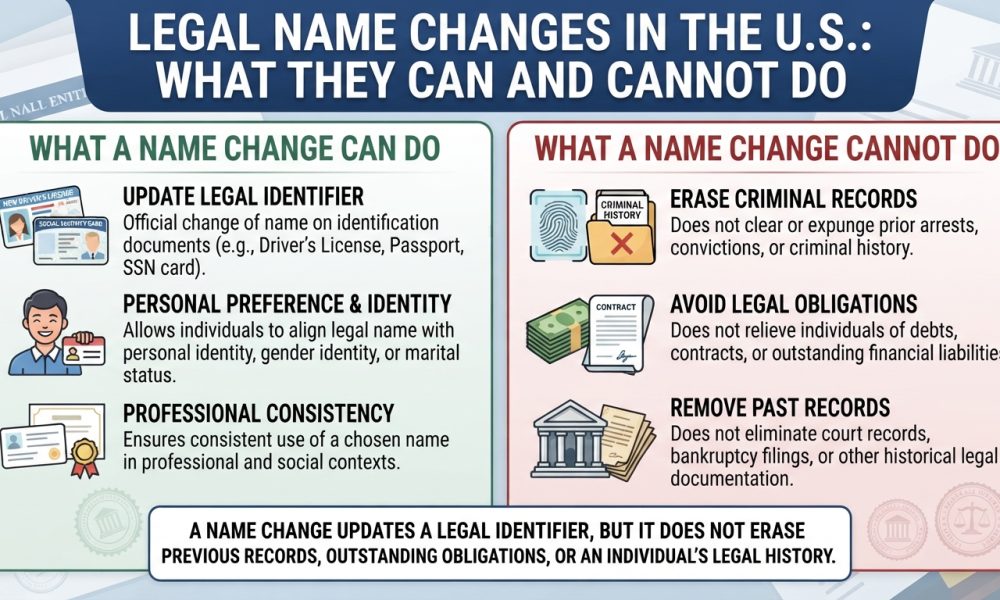
Changing a name updates a legal identifier, but it doesn’t erase previous records, outstanding obligations, or an individual’s legal history.
Washington, DC, October 20, 2026
A legal name change can reflect a marriage, a divorce, a personal identity, or a new chapter in someone’s life. Still, it does not create a different legal person or cancel responsibilities accumulated under an earlier name.
For Americans considering the process, that distinction matters well beyond the courthouse, because banks, government agencies, employers, and travel authorities may need documentation connecting the former name to the new one before updating their records.
The practical benefit is recognition: a person can establish an accepted name for Identification and everyday transactions while retaining the financial accounts, qualifications, family relationships, and legal rights that belonged to them before the change.
The mistake is assuming recognition amounts to erasure, especially when online marketing presents a changed name as a shortcut to a clean financial history, unrestricted travel, or complete separation from earlier records.
Start With the Rules Where You Live
No single nationwide court Application covers every adult name change, and the right route depends on state law, the reason for the change, and the documentation the relevant agency will accept as evidence.
In qualifying circumstances, a marriage certificate or divorce decree may provide the necessary basis, while someone choosing a name for another reason may need a separate court proceeding and an order that clearly records the authorized change.
The federal government’s guide to changing your name and notifying agencies directs applicants to the relevant local process, then explains that government records require follow-up rather than assuming one approval automatically updates every Identification document.
Before filing, applicants should confirm the correct court, residency requirements, supporting documents, fees, and any applicable notice rules, particularly when copying instructions from another state would create avoidable mistakes or overlook protections available in their own jurisdiction.
A New Name Leaves Existing Obligations Intact
A mortgage, personal loan, credit card balance, or court Judgment does not disappear when the borrower changes their surname, and updating the name on an account does not, by itself, change the terms governing repayment.
Minnesota’s judicial guidance explicitly warns that name changes cannot be used to avoid debts, lawsuits, arrest, or criminal charges, illustrating the broader distinction between a lawful personal change and an attempt to frustrate another party’s legal rights.
People who owe money should treat the transition as an account-maintenance task, ask each lender what evidence it needs, and keep payments current. At the same time, the institution updates its customer records and reporting systems.
For anyone facing financial distress, useful questions focus on repayment arrangements, disputed charges, or available legal remedies, because changing the spelling on Identification doesn’t resolve the underlying issue or replace dealing directly with the obligation.
Credit History Needs Continuity, Not Reinvention
Experian explains that a name change does not affect a credit score because credit reporting relies on multiple identifying details and existing account Information, not on treating each newly adopted name as an unrelated financial identity.
That continuity can protect the consumer as much as the lender, since a person who has spent years making timely payments generally wants those established accounts and their repayment history to remain accurately associated with the updated name.
After notifying financial institutions, consumers should review their reports for missing accounts, incorrect identifying Information, or someone else’s debt, and keep copies of relevant correspondence so they can clearly explain any genuine error to the organizations involved.
The Consumer Financial Protection Bureau advises disputing inaccurate Information with both the reporting company and the company that supplied it, a process that addresses errors directly rather than assuming a name change will repair a damaged record.
Criminal Records Require Separate Legal Analysis
A name change does not dismiss a pending prosecution, cancel a warrant, or expunge a conviction, and anyone with an active case should discuss applicable disclosure and notification duties with counsel before submitting an Application or updating documents.
New York court guidance, for example, identifies special requirements for some applicants with specified convictions who are imprisoned or on parole, including disclosing conviction details and notifying relevant prosecutors and sentencing courts under the applicable rules.
Those requirements should not be mistaken for a nationwide prohibition against people with criminal histories changing their names, because eligibility and procedure depend on the jurisdiction, the conviction and the applicant’s circumstances at the time of filing.
Record sealing, expungement and other forms of legal relief involve separate standards, so someone seeking those outcomes needs advice about the relevant remedy rather than treating a name change order as an instruction to delete their legal history.
Privacy Protections Have a Specific Scope
Privacy can be a legitimate reason to seek a name change, particularly for someone experiencing stalking, domestic abuse or targeted harassment. Still, the Protection available depends on the relevant law and the handling of the Application itself.
California’s court guidance describes confidentiality procedures for qualifying cases, including certain applications connected with its Safe at Home program, showing why applicants facing safety concerns should investigate available protections before filing material that might otherwise become publicly accessible.
Earlier Associated Press reporting on efforts to protect the privacy of name change applicants highlighted the concern that public court records can expose connections between names, particularly for transgender people seeking greater control over personal Information.
Confidentiality should therefore be understood as a defined Protection for particular records, rather than a promise that every institution will forget the earlier name or that material already published elsewhere will automatically disappear after a court grants relief.
Someone facing an immediate safety concern should ask a lawyer or qualified victim advocate how filing procedures, address confidentiality, and document handling fit together, because an administrative change is only one part of a practical personal safety plan.
Government Records Still Need Individual Attention
Changing the name on a Social Security record ordinarily preserves the existing number, and the Social Security Administration explains that even when it assigns a new number in limited circumstances, its records retain the connections needed to credit earnings correctly.
That makes orderly updates important for employment and taxation, since a newly adopted name used on payroll or a tax return can create a mismatch when the corresponding government record still reflects the name used before the change.
Applicants should list the agencies and organizations they use, check each one’s evidence requirements, and avoid mailing the same packet everywhere or assuming a replacement identity card will trigger every other update.
A simple tracking record can note the organization contacted, the documents submitted, the confirmation received, and any unresolved issue, giving the applicant a practical way to distinguish completed changes from requests that still require additional Information or action.
Travel Documents Must Tell a Consistent Story
The State Department uses different procedures for passport name changes depending on the applicant’s circumstances, including when the passport was issued and when the name change occurred, so travelers should check the current instructions before selecting a form.
A court order or marriage certificate can help establish the connection between names. Still, it does not replace a valid passport, a required visa, or any other authorization a destination requires for the proposed journey.
Before booking travel during the transition, passengers should verify the name required on their reservation and ask the relevant airline or issuing Authority how to handle any discrepancy involving their passport, visa, or other existing travel records.
A name change also does not create citizenship, confer immigration status, or resolve an existing admissibility issue, and applications requesting earlier names or previous immigration history still require accurate answers within the scope of the questions being asked.
Travelers with documents issued by more than one country should allow additional time to establish whether the change will be recognized abroad and which supporting records are required, rather than assuming one domestic order updates every foreign document.
Family Names and Parental Authority Are Different Questions
A parent who changes a surname may need records linking their current Identification to the name on a child’s birth certificate, especially when preparing travel paperwork or dealing with an institution that must establish the relationship.
The distinction is relevant to the family documentation issues addressed by AMICUS INTERNATIONAL CONSULTING in its coverage of Mexico’s children’s passports and parental photographs, where the broader planning question concerns how identity documents help explain family relationships during travel.
A parent’s name change does not, by itself, alter custody, establish permission for an international trip or eliminate another parent’s legal rights, so families should review the documents governing those matters separately from paperwork recording a new surname.
When a child’s name is changed, parents should check local procedures and any consent or notice requirements, recognizing that the legal considerations may differ from those for an adult changing only their personal name.
Employment and Professional Records Need a Clear Connection
Someone who changes their name after earning a degree or professional qualification may still need to show the credential belongs to them, so documenting the transition helps when applying for work, renewing a license, or continuing education.
Rather than assuming every historical document must be reissued immediately, the person should ask the relevant employer, school, or licensing Authority whether it accepts the existing record, along with evidence of the name change and updated Identification on documents.
The same practical approach applies to benefits and medical administration, where notifying the appropriate office and confirming the update can help prevent confusion between records that were created at different times under different versions of the same person’s name.
Read any request for previous names carefully in its specific context, and seek legal advice when disclosure rules are unclear, because neither automatic concealment nor indiscriminate sharing of sensitive personal history is a sound administrative strategy.
Keep the Evidence That Connects Your Records
Before sending original paperwork, ask whether the recipient will return it, whether a certified copy is sufficient, and how you can track the submission, especially when you’ll need the same evidence for several applications within a limited period. When an appointment or transaction is approaching, contact the organization in advance to explain the documents you currently have and request its requirements in writing, giving yourself time to address any mismatch before it interrupts access to an important service.
The document authorizing a name change can remain useful long after the first replacement ID arrives, especially when an older account, inheritance record, or qualification later needs to be connected to the name the person currently uses.
Applicants should ask which organizations require certified copies, plan how to obtain those copies, and store them securely, while avoiding unnecessary circulation of documents that may reveal a former name or other sensitive details about their lives.
It also helps to inspect each replacement document when it arrives, comparing spelling and other personal details with the supporting evidence, because correcting an error promptly can prevent the same inconsistency from being copied into additional accounts or applications.
For a straightforward transition, the goal is a reliable set of records that institutions can reconcile without repeated explanations. At the same time, complex circumstances involving litigation, safety concerns, or foreign documents may justify tailored advice before proceeding.
Measure Success by Accuracy and Recognition
A successful legal name change lets someone be recognized under the name they have lawfully adopted while preserving access to the rights, assets, and achievements that continue to belong to them throughout the transition between documents.
The most useful preparation is therefore concrete: establish the correct procedure, understand any privacy implications, obtain acceptable evidence, and organize updates around upcoming obligations, such as travel, employment onboarding, or transactions that require consistent Identification from the outset.
When a service promises that a new name will erase debts, defeat Background checks, or guarantee an unconnected legal identity, consumers should ask for the precise legal basis and independently verify the claim before paying for the proposed assistance.
For most applicants, the lasting value comes from getting the records right and reducing administrative friction, with a clear understanding that changing how the law identifies a person does not erase the life, responsibilities, or history attached to them.




