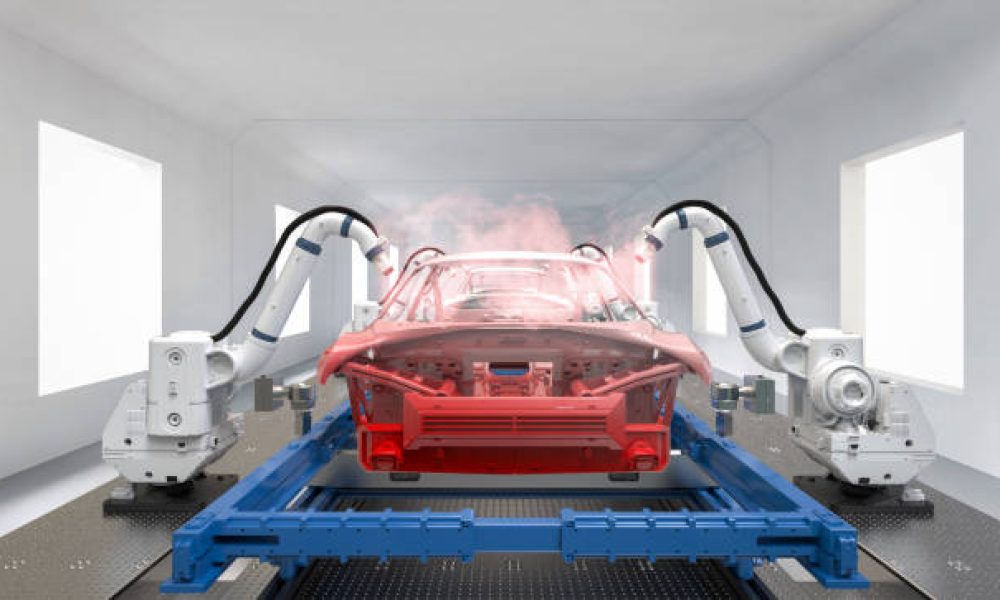
As global manufacturing shifts toward smart automation, the demand for robotic paint booth systems is growing rapidly across multiple industries. These advanced systems, combining robotic arms with controlled painting environments, are transforming traditional paint shops into efficient, high-precision finishing hubs.
According to Prophecy Market Insights, the global Robotics Paint Booth Market, segmented by type (Paint Booth, Paint Robot) and application (Automotive Sector, Non-Automotive Sector), is poised for significant expansion in the coming decade. This growth is driven by rising automotive production, stringent environmental regulations, labor shortage challenges, and the need for consistent, high-quality paint finishes.
Major players such as Dürr AG, FANUC Corporation, ABB, Eisenmann SE, Yaskawa Electric Corporation, Kawasaki, Giffin, and Staubli are leading the charge in delivering next-gen robotic painting systems with AI integration, energy efficiency, and minimal overspray technologies.
📌 Request Sample Report: Click Here
The Rise of Robotic Paint Booths in Smart Manufacturing
Paint booth automation is no longer a luxury but a necessity in industries like automotive, aerospace, machinery, and even consumer electronics. The integration of robotic arms inside paint booths offers benefits such as:
✅ Uniform paint coating with millimeter-level precision
✅ Reduced paint wastage and emissions
✅ Faster cycle times and increased throughput
✅ Enhanced worker safety by minimizing exposure to VOCs
✅ Scalability in batch production and customization
With Industry 4.0 principles at the core of factory upgrades, robotic paint booths are becoming central to the automated finishing process.
Market Segmentation
🔹 By Type
Paint Booths: These are enclosed environments designed to control temperature, humidity, airflow, and contamination, ensuring perfect finishes. When integrated with robotic systems, they offer real-time paint control, automatic cleaning, and sensor-driven adjustments.
Paint Robots: Robotic arms fitted with spray guns, vision systems, and electrostatic equipment for precise application. These robots are programmable and capable of adjusting in real time based on surface geometry and coating requirements.
🔹 By Application
Automotive Sector: The largest user segment. Robotic paint booths are integral to OEM plants, tier-1 auto suppliers, and EV manufacturers, where they offer high throughput and flawless color application.
Non-Automotive Sector: Includes aerospace, appliances, railways, agricultural machinery, and construction equipment. These sectors are adopting robotic paint solutions for uniform coating, cost reduction, and eco-friendly operation.
Key Market Drivers
🚗 Rising global vehicle production, including EVs
🌿 Environmental regulations promoting reduced VOC emissions and paint overspray
🏭 Labor shortages and safety concerns in hazardous painting environments
📈 Increased demand for customized and consistent coatings
🧠 AI and machine vision integration for smart paint path planning
⚙️ Growing investments in smart factories and industrial robotics
Industry Use Cases
OEM Automotive Plants: Automated booths ensure each vehicle receives consistent, high-quality paint jobs while reducing paint material consumption and operating costs.
Heavy Machinery Manufacturing: Uniform painting of large, complex parts where manual work is error-prone.
Aircraft Components: Precision is critical for surface protection, corrosion resistance, and appearance.
Appliance Coatings: Robotic arms apply smooth and scratch-resistant finishes to refrigerators, ovens, and washing machines.
Leading Companies in the Robotics Paint Booth Market
Dürr AG – Global leader in automotive paint shops, offering fully automated painting lines with EcoRP robots.
FANUC Corporation – Specializes in multi-axis robots and integration of painting systems with vision and AI tools.
ABB – Offers the IRB 5500 and other paint robots optimized for high-speed, large-area painting in both vehicle and industrial settings.
Eisenmann SE – Known for modular, eco-friendly paint booths that integrate robotics and energy-saving systems.
Yaskawa Electric Corporation – Delivers painting robots with explosion-proof ratings, high-speed wrist movement, and anti-collision systems.
Giffin – Offers turnkey solutions for automated paint lines, particularly in the U.S. automotive industry.
Kawasaki Robotics – Combines precision robotics with custom paint process development.
Staubli – Focuses on compact, agile robotic arms for confined painting spaces and high-precision applications.
These companies are also investing in IoT-enabled diagnostics, predictive maintenance, and green technologies to future-proof their paint automation systems.
Regional Outlook
🌎 North America
A key market driven by large automotive OEMs in the U.S. and Canada. Significant investments in EV production facilities are driving new demand for robotic paint lines.
🌍 Europe
Germany, France, and Italy are leading adopters of smart paint shops, supported by Industry 4.0 initiatives and sustainability mandates.
🌏 Asia-Pacific
China, Japan, South Korea, and India are major contributors, given the strong presence of automotive and electronics manufacturing hubs. China alone accounts for a significant share of global robot installation.
🌍 Middle East & Africa / Latin America
An emerging opportunity for localized manufacturing and assembly lines requiring compact robotic painting cells.
Emerging Trends in Robotic Paint Booth Technology
🔸 Electrostatic Painting
New-generation robotic arms offer electrostatic spray technology, enhancing material transfer efficiency and reducing paint consumption.
🔸 AI-Based Trajectory Mapping
Machine learning helps optimize painting path planning, especially for non-standard or complex shapes.
🔸 Eco-Friendly Painting Systems
Water-based paints, dry filter booths, and energy-recovery systems are being integrated to support green manufacturing goals.
🔸 Real-Time Analytics & Quality Control
Sensors and cameras now enable real-time thickness measurement, defect detection, and automated rework triggers.
🔸 Modular Paint Booths
Compact and modular booths with robotic arms cater to SMEs and low-volume manufacturing, increasing accessibility.
Challenges in Adoption
⚠️ High initial setup and integration costs
⚠️ Need for skilled technicians for maintenance and programming
⚠️ Customization required for non-standard parts or industries
⚠️ Downtime during retrofitting of legacy systems
Despite these hurdles, ROI from reduced waste, labor, and rework costs is accelerating adoption globally.
Strategic Outlook
✔️ The market is being fueled by a push for sustainability, speed, and precision in surface finishing operations.
✔️ Vendors who integrate AI, analytics, and eco-design will capture greater market share.
✔️ Non-automotive industries present untapped potential for robotic painting expansion.
✔️ Adoption of compact, modular systems for mid-sized manufacturers is set to rise.
📌 Request PDF Report: Click Here
Author
Authored by Shweta R., Business Development Specialist at Prophecy Market Insights.
This article is based on a combination of primary and secondary research, providing strategic insights into the evolving dynamics of the global Robotics Paint Booth Market.
About Prophecy Market Insights
Prophecy Market Insights is a leading provider of strategic market intelligence and custom research solutions. We empower businesses with data-driven insights across industrial automation, automotive innovation, smart manufacturing, and more.