
The retail e-commerce packaging market has become one of the most dynamic segments within the global packaging industry, driven by the rapid expansion of online retail and changing consumer shopping behaviors. E-commerce packaging plays a critical role in ensuring that products ordered online reach customers safely, efficiently, and in optimal condition. Unlike traditional retail packaging, e-commerce packaging must withstand longer supply chains, complex logistics networks, and last-mile delivery challenges while maintaining product integrity and enhancing the consumer unboxing experience. As online retail continues to reshape global commerce, packaging solutions designed specifically for e-commerce distribution are becoming increasingly essential.
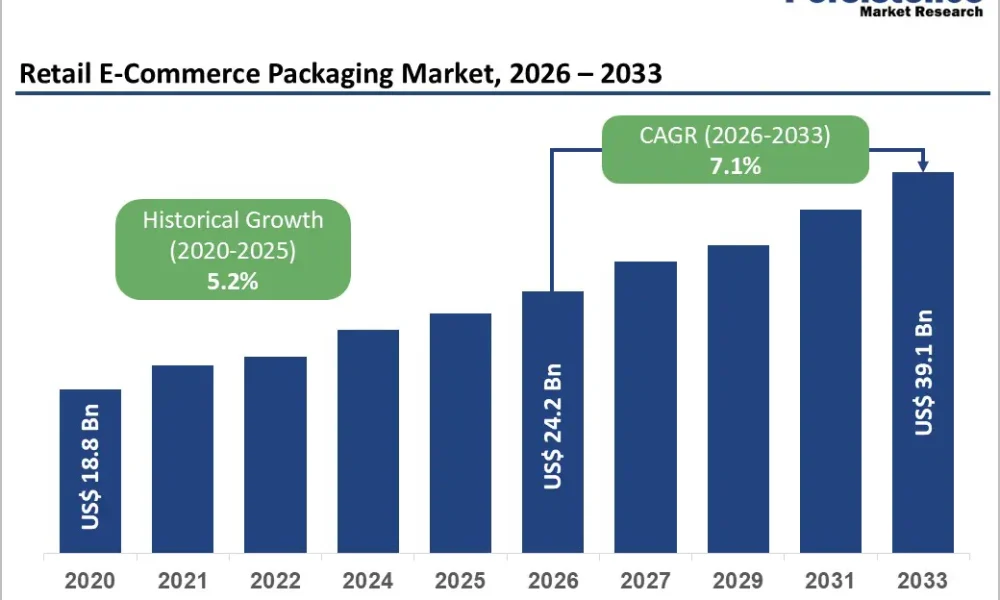
The global retail e-commerce packaging market is projected to reach US$24.2 billion by 2026 and expand further to US$39.1 billion by 2033, registering a compound annual growth rate (CAGR) of 7.1% between 2026 and 2033. The strong growth trajectory is primarily driven by rising online retail sales volumes, increased demand for protective and sustainable packaging solutions, and evolving regulatory requirements regarding recyclability and recycled content. Among packaging formats, corrugated boxes and protective packaging solutions remain the dominant segment due to their durability, cost-effectiveness, and ability to protect products during transportation. In terms of regional performance, Asia-Pacific leads the retail e-commerce packaging market, supported by the region’s booming digital commerce ecosystem, large consumer base, and rapidly expanding logistics infrastructure in countries such as China, India, Japan, and Southeast Asian economies.
𝐆𝐞𝐭 𝐚 𝐒𝐧𝐞𝐚𝐤 𝐏𝐞𝐞𝐤, 𝐒𝐚𝐦𝐩𝐥𝐞 𝐏𝐃𝐅 𝐈𝐧𝐬𝐢𝐝𝐞: https://www.persistencemarketresearch.com/samples/36070
Key Highlights from the Report
• The global retail e-commerce packaging market is expected to grow from US$24.2 billion in 2026 to US$39.1 billion by 2033.
• The market is projected to expand at a CAGR of 7.1% during the forecast period.
• Rapid growth in global online retail sales is driving demand for durable and protective packaging solutions.
• Corrugated boxes remain the leading packaging format in e-commerce logistics.
• Asia-Pacific holds the largest share of the market due to the expansion of digital commerce platforms.
• Sustainability regulations and recyclable packaging innovations are influencing product design and market strategies.
Market Segmentation Analysis
The retail e-commerce packaging market is segmented based on packaging type, material type, application, and end-use industries. These segments reflect the evolving needs of online retailers and logistics providers as they adapt to growing consumer expectations and complex supply chains.
Based on packaging type, the market includes corrugated boxes, mailers, protective packaging, tapes and labels, and cushioning materials. Corrugated boxes represent the most widely used packaging format due to their ability to provide structural strength and protection during shipping. They are particularly important for transporting fragile goods such as electronics, appliances, and consumer products. Mailers, including padded envelopes and poly mailers, are commonly used for lightweight items such as clothing, books, and accessories. Protective packaging materials such as air pillows, bubble wrap, and molded pulp inserts are increasingly being used to safeguard products from impact damage during transportation.
From a material perspective, e-commerce packaging solutions are primarily manufactured using paperboard, corrugated fiberboard, plastic materials, and biodegradable packaging materials. Paper-based packaging dominates the market due to its recyclability, cost efficiency, and compliance with sustainability regulations. Corrugated fiberboard is particularly valued for its strength and flexibility, making it suitable for a wide range of product sizes and weights. Plastic packaging materials such as polyethylene mailers are also widely used due to their lightweight and water-resistant properties. However, the industry is witnessing a growing shift toward biodegradable and recyclable materials as environmental concerns increase.
In terms of application, retail e-commerce packaging is used across numerous product categories including consumer electronics, apparel and fashion, personal care products, food and beverages, home goods, and pharmaceuticals. Apparel and fashion products represent one of the largest application segments because of the high volume of online clothing purchases worldwide. Consumer electronics packaging also accounts for a significant share due to the need for robust protective materials that can prevent damage during transit.
Considering end-user industries, the primary customers of e-commerce packaging solutions include online retailers, third-party logistics providers, fulfillment centers, and subscription box companies. Major e-commerce platforms rely on specialized packaging solutions designed to optimize warehouse operations and improve delivery efficiency. Fulfillment centers play a critical role in the supply chain, requiring packaging solutions that are compatible with automated sorting and packaging systems.
𝐎𝐧𝐞 𝐂𝐥𝐢𝐜𝐤 → 𝐘𝐨𝐮𝐫 𝐂𝐮𝐬𝐭𝐨𝐦 𝐌𝐚𝐫𝐤𝐞𝐭 𝐕𝐢𝐞𝐰: https://www.persistencemarketresearch.com/request-customization/36070
Regional Insights
The Asia-Pacific region dominates the global retail e-commerce packaging market due to its rapidly expanding digital commerce ecosystem and large population of online shoppers. Countries such as China, India, Japan, and South Korea have witnessed exponential growth in e-commerce adoption over the past decade. China remains the largest e-commerce market globally, supported by major platforms and an advanced logistics infrastructure capable of handling massive shipment volumes. The region’s strong manufacturing base and cost-efficient production capabilities also allow packaging manufacturers to supply large quantities of packaging materials at competitive prices.
In North America, the retail e-commerce packaging market is driven by high levels of online retail penetration and advanced logistics networks. The United States, in particular, has a highly developed e-commerce ecosystem with strong demand for innovative packaging solutions that improve delivery efficiency and reduce shipping costs. Companies in the region are increasingly investing in automation technologies, sustainable packaging materials, and smart packaging solutions to enhance supply chain performance.
The European market is characterized by strong regulatory frameworks focused on sustainability and environmental responsibility. Governments across the region are implementing strict policies aimed at reducing plastic waste and increasing the use of recyclable packaging materials. As a result, many packaging manufacturers are investing in eco-friendly alternatives such as paper-based mailers, molded pulp cushioning, and biodegradable protective materials. These regulatory requirements are driving innovation and creating opportunities for sustainable packaging solutions in the European e-commerce sector.
In Latin America, the e-commerce packaging market is experiencing steady growth as digital retail adoption increases across countries such as Brazil, Mexico, and Argentina. The growth of mobile commerce and improvements in logistics infrastructure are supporting the expansion of online retail in the region.
Meanwhile, the Middle East and Africa region is gradually emerging as a promising market due to increasing internet penetration, growing consumer demand for online shopping, and expanding logistics capabilities. Governments in several countries are investing in digital transformation initiatives that encourage the growth of e-commerce platforms and supporting infrastructure.
Market Drivers
The primary driver of the retail e-commerce packaging market is the continued expansion of global online retail. Consumers are increasingly turning to digital platforms for purchasing a wide range of products, from clothing and electronics to groceries and household goods. This shift in consumer behavior has led to a dramatic increase in parcel shipments, creating strong demand for packaging solutions capable of protecting products during transportation while maintaining cost efficiency.
Another important factor driving market growth is the rising focus on protective packaging solutions. Products shipped through e-commerce supply chains often pass through multiple distribution centers and transportation stages before reaching the end consumer. This increases the risk of product damage, making protective packaging materials such as cushioning inserts, foam padding, and air pillows essential components of e-commerce packaging systems.
Sustainability trends are also playing a major role in shaping the market. Consumers and regulators are increasingly demanding packaging materials that are recyclable, biodegradable, or made from recycled content. As a result, packaging manufacturers are investing heavily in sustainable materials and innovative packaging designs that reduce environmental impact while maintaining product protection.
Market Restraints
Despite strong growth prospects, the retail e-commerce packaging market faces several challenges. One of the key restraints is raw material price volatility, particularly for paperboard and plastic materials. Fluctuations in raw material prices can significantly impact production costs and create uncertainty for packaging manufacturers and retailers.
Another challenge is the complexity of last-mile delivery logistics. E-commerce shipments often require packaging that balances durability with lightweight design to minimize shipping costs. However, achieving this balance can be difficult, particularly for fragile or irregularly shaped products.
Environmental concerns also pose a challenge for the industry. The rapid growth of e-commerce has led to a significant increase in packaging waste, raising concerns among regulators and consumers about sustainability. Packaging manufacturers must continuously innovate to develop materials and designs that reduce waste while meeting the performance requirements of e-commerce distribution.
Market Opportunities
The retail e-commerce packaging market offers numerous opportunities for innovation and growth. One of the most promising opportunities lies in the development of sustainable packaging solutions that use recyclable, biodegradable, or compostable materials. These innovations allow companies to meet regulatory requirements and appeal to environmentally conscious consumers.
Another opportunity is the integration of smart packaging technologies. Digital tracking labels, QR codes, and temperature-monitoring sensors can enhance supply chain visibility and improve product traceability. These technologies are particularly valuable for high-value or sensitive products that require careful handling during transportation.
The growth of subscription-based e-commerce services also presents a new avenue for packaging innovation. Subscription boxes often require customized packaging designs that enhance the consumer unboxing experience and reinforce brand identity. Packaging manufacturers are increasingly collaborating with brands to create visually appealing and functional packaging solutions that support marketing objectives.
𝐁𝐮𝐲 𝐍𝐨𝐰 𝐭𝐡𝐞 𝐃𝐞𝐭𝐚𝐢𝐥𝐞𝐝 𝐑𝐞𝐩𝐨𝐫𝐭: https://www.persistencemarketresearch.com/checkout/36070
Company Insights
The retail e-commerce packaging market is highly competitive, with numerous global packaging companies focusing on innovation, sustainability, and strategic partnerships with e-commerce retailers and logistics providers.
Key Players
• International Paper Company
• Smurfit Kappa Group
• DS Smith Plc
• Mondi Group
• Amcor Plc
• WestRock Company
• Sealed Air Corporation
• Sonoco Products Company
• Pregis LLC
• Stora Enso Oyj
Recent Developments
Several major packaging companies have recently announced capacity expansion projects aimed at increasing production of corrugated packaging solutions to meet rising demand from e-commerce retailers. These investments focus particularly on Asia-Pacific and North America, where parcel shipment volumes continue to grow rapidly.
Additionally, leading packaging manufacturers are investing in recyclable and fiber-based protective packaging solutions designed to replace traditional plastic cushioning materials. These innovations help retailers meet sustainability goals while maintaining effective product protection during transportation.
Conclusion
The retail e-commerce packaging market is set to experience significant growth as digital commerce continues to transform global retail landscapes. With the market expected to expand from US$24.2 billion in 2026 to US$39.1 billion by 2033, packaging solutions designed specifically for e-commerce logistics will remain essential for ensuring safe, efficient, and sustainable product delivery. Rising online retail volumes, growing demand for protective packaging, and increasing regulatory pressure for recyclable materials are key factors shaping the future of this market.




