
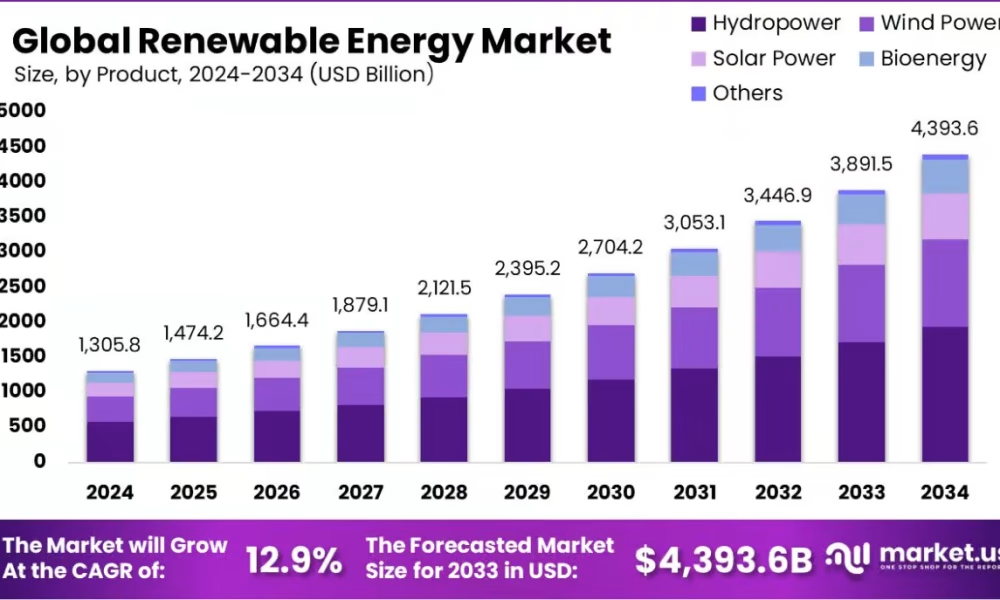
According to market.us, the global renewable energy market is projected to grow significantly, reaching approximately USD 4,393.6 billion by 2034, rising from USD 1,305.8 billion in 2024, with a robust CAGR of 12.9% from 2025 to 2034. Asia-Pacific remains the dominant region, holding a 45.2% share valued at USD 591.5 billion. Renewable energy, sourced from naturally replenishing elements like solar, wind, hydro, biomass, and geothermal, offers a low-emission alternative to fossil fuels. As of 2024, the global renewable energy capacity stood at around 3,000 GW, with Asia alone adding 450 GW in that year.
India has emerged as a key market, having surpassed 200 GW in total renewable energy capacity by November 2024, which represents 46.3% of its total installed power capacity. This growth is supported by substantial investment, with USD 386 billion committed by September 2024. Technological advancements and declining costs have made renewable energy increasingly competitive, while global policies and heightened environmental awareness have further fueled market adoption.
India plans to add 35 GW of new solar and wind capacity by March 2025. The International Energy Agency (IEA) forecasts that renewables will drive over 90% of global electricity capacity additions from 2022 to 2027, totaling around 2,400 GW. India targets 500 GW by 2030.
Key Takeaways
- The Global Renewable Energy Market is expected to be worth around USD 4,393.6 Billion by 2034, up from USD 1305.8 Billion in 2024, and grow at a CAGR of 12.9% from 2025 to 2034.
- Hydropower dominates the renewable energy market, accounting for 44.3% share globally.
- On-grid renewable energy solutions lead, comprising 88.3% of total installations.
- The industrial sector drives renewable adoption, contributing 47.4% of market demand worldwide.
- In 2024, Asia-Pacific dominated the Renewable Energy Market with 45.2%, generating USD 591.5 billion.
Access a Complimentary Sample of This Premium Report: https://market.us/report/renewable-energy-market/request-sample/
Factors Affecting the Growth of the Renewable Energy Market
Government Policies and Regulatory Support: The expansion of the renewable energy market is strongly influenced by national and regional policies that promote clean energy adoption. Supportive frameworks such as tax incentives, subsidies, feed-in tariffs, and renewable energy mandates play a critical role in driving investment and project development. Additionally, global climate commitments and emission reduction targets under international agreements contribute significantly to policy-driven momentum.
Technological Advancements: Continued innovation in renewable technologies—including solar panels, wind turbines, and battery storage systems—has enhanced efficiency and reliability while lowering production costs. Advancements in grid integration, smart metering, and energy forecasting tools are also enabling better management of variable renewable resources, thereby increasing their appeal for large-scale deployment.
Energy Security and Diversification Needs: Countries are increasingly prioritizing energy diversification to reduce dependence on imported fossil fuels and enhance energy security. Renewables offer a domestic and stable energy source, which makes them strategically important, especially for nations seeking to insulate their economies from global fuel price volatility and geopolitical disruptions.
Environmental and Climate Concerns: Rising awareness of environmental degradation and climate change has accelerated the global shift toward sustainable energy. Governments, corporations, and consumers are actively seeking low-carbon alternatives to conventional energy sources. This ecological urgency is compelling energy transitions and influencing investment decisions across both public and private sectors.
Investment Trends and Financial Commitment: The growing involvement of institutional investors, sovereign funds, and green financing mechanisms is a major catalyst for renewable energy growth. Increasing availability of capital through green bonds, public-private partnerships, and climate funds is enabling large-scale infrastructure development. Investor confidence is further strengthened by long-term return potential and favorable risk profiles in the renewable sector.
Key Market Segmentation
By Product Analysis
In 2024, hydropower dominated the Renewable Energy Market’s by-product segment with a 44.3% share, driven by its cost-effectiveness, reliability, and continued investment in large-scale projects and dam refurbishments. Wind power followed with a 28.7% share, supported by advancements in offshore wind technology, falling turbine costs, and favorable government incentives.
Solar power accounted for 21.6%, propelled by the widespread adoption of photovoltaic systems, including rooftop and utility-scale installations, backed by improved panel efficiency and regulatory support. Bioenergy held a 5.4% share, driven by the increasing use of biomass, biogas, and waste-to-energy solutions, especially in rural and industrial applications.
By Deployment Analysis
In 2024, the On-Grid segment dominated the renewable energy market by deployment with an 88.3% share, driven by well-developed grid infrastructure and high adoption in urban areas. Its lower installation costs and efficient energy distribution made it ideal for large-scale, grid-connected projects.
In contrast, the Off-Grid segment accounted for 11.7%, gaining momentum in remote and rural regions. The growth of off-grid deployment was supported by advancements in battery storage and modular systems, improving localized energy access in underserved communities.
By Application Analysis
In 2024, the Industrial segment led the Renewable Energy Market by application with a 47.4% share, driven by high energy demands and increased adoption of clean energy in manufacturing and processing sectors. Residential applications accounted for 31.8%, supported by the growing use of solar panels and small-scale wind systems in homes, encouraged by cost reductions and policy incentives.
The Commercial segment held a 20.8% share, with rising adoption of renewable energy in offices, retail, and hospitality spaces aimed at reducing energy costs and meeting sustainability targets.
Key Market Segments
By Product
- Hydropower
- Wind Power
- Solar Power
- Bioenergy
- Others
By Deployment
- On-Grid
- Off-Grid
By Application
- Industrial
- Residential
- Commercial
Regional Analysis
The global renewable energy market shows strong regional differences, with Asia-Pacific leading at 45.2% of the total share, valued at USD 591.5 billion, driven by large-scale investments in solar, wind, and hydropower, especially in China and India. North America follows, supported by U.S. and Canadian policies and carbon neutrality targets, with the U.S. contributing over 23% of global wind energy capacity.
Europe remains a key player, driven by the EU Green Deal and emissions goals, with countries like Germany, the UK, and France focusing on offshore wind and hydrogen. The Middle East & Africa region is gaining momentum through large-scale solar projects in the UAE and Saudi Arabia, while Latin America sees increasing adoption in Brazil and Chile, supported by favorable conditions and policy incentives.
Top Key Players in the Market
- ABB
- Acconia S.A.
- Enel Spa
- General Electric
- Innergex
- Invenergy
- Schneider Electric
- Siemens Gamesa Renewable Energy, S.A.
- Suzlon Energy Ltd.
- Tata Power
- ACCIONA
- EDF Renewables
- Xcel Energy Inc.
- Enel Green Power S.p.A.
- National Grid Renewables
Get in Touch with Us:
Market.us (Powered By Prudour Pvt. Ltd.)
Address: 420 Lexington Avenue, Suite 300 New York City, NY 10170, United States
Send Email: [email protected]
Refer to More Related Reports:



