
Renewable Aviation Fuel Market: Transforming the Future of Air Travel
The renewable aviation fuel market is rapidly emerging as a pivotal component of the global aviation industry’s decarbonization strategy. As airlines, governments, and fuel producers aim to curb greenhouse gas (GHG) emissions, sustainable aviation fuels (SAFs) — often referred to as renewable aviation fuels — are gaining traction. These fuels offer a practical pathway to lower aviation’s carbon footprint while maintaining compatibility with existing aircraft engines and infrastructure. Increasing environmental regulations, ambitious net-zero commitments, and technological innovations are driving investment and growth in this dynamic market.
Market Overview and Growth Forecast
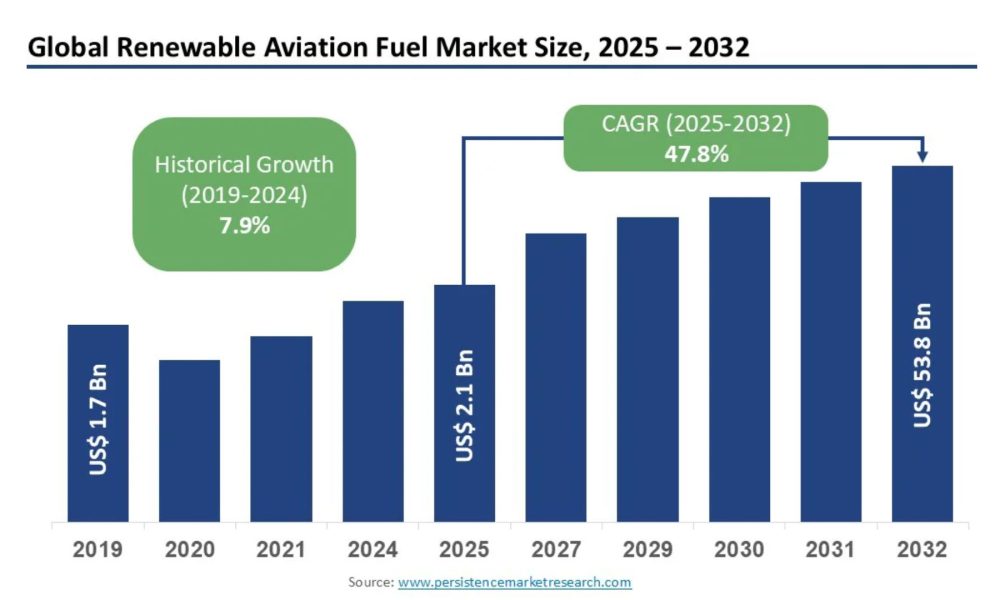
The global renewable aviation fuel market is on an extraordinary growth trajectory. In 2025, the market size is estimated at approximately US$2.1 billion, with projections soaring to US$53.8 billion by 2032. This represents an exceptional Compound Annual Growth Rate (CAGR) of around 47.8% over the forecast period from 2025 to 2032. Market expansion is primarily driven by national emissions mandates, rising airline demand for sustainability, and expanded SAF infrastructure globally.
The dramatic projected growth reflects a broader industry shift from niche experimental use toward large-scale commercial adoption. Airlines are increasingly signing offtake agreements and investing in SAF supply chains to hedge against future regulatory penalties and reputational risks associated with climate change. As environmental policies tighten and consumer demand for sustainable travel rises, SAF is positioned as a key enabler of aviation’s low-carbon future.
Get Your FREE Sample Report Instantly – Click Now: https://www.persistencemarketresearch.com/samples/35925
Drivers of Renewable Aviation Fuel Adoption
Regulatory Pressure and Policy Support
Government policies and regulatory frameworks are perhaps the strongest catalysts for renewable aviation fuel market growth. In Europe, the ReFuelEU Aviation regulation mandates incremental increases in SAF blending — starting at 2% in 2025 and potentially rising to 70% by 2050 — pushing fuel suppliers and airlines to adopt greener alternatives. Similar initiatives in the United States, such as significant SAF tax credits under climate legislation, aim to scale production and incentivize investment. On a global scale, the International Civil Aviation Organization (ICAO) and its Carbon Offsetting and Reduction Scheme for International Aviation (CORSIA) provide monitoring and support frameworks that underpin widespread adoption.
These regulatory levers are crucial in guaranteeing long-term demand, giving confidence to investors and producers to scale up SAF facilities and supply networks. By embedding SAF into national and regional climate strategies, authorities are shaping an aviation fuel ecosystem that supports both environmental goals and economic opportunities.
Key Market Segments
By Fuel Type
The renewable aviation fuel market comprises two major fuel categories: biofuels and synthetic fuels. Biofuels account for the majority share, estimated at nearly 78% of global revenue in 2025. These fuels are produced through established conversion technologies such as Hydroprocessed Esters and Fatty Acids Synthetic Paraffinic Kerosene (HEFA-SPK) and Alcohol-to-Jet Synthetic Paraffinic Kerosene (ATJ-SPK). Their relative maturity and compatibility with existing aircraft engines make them attractive to early adopters.
Conversely, synthetic fuels — notably Power-to-Liquids (PtL) and e-kerosene — represent the fastest-growing segment through 2032. These fuels are produced using renewable electricity and captured carbon dioxide, offering near-zero life-cycle emissions. While PtL is currently more capital-intensive and technologically complex, falling renewable energy costs and robust regulatory support are accelerating its commercial viability.
Feedstock Dynamics
The availability and diversification of feedstocks — the raw materials used to produce SAF — remain a critical factor in market evolution. Used cooking oil (UCO) and waste animal fats are dominant feedstocks today, representing roughly 43% to 85% of supply share in various market estimates for 2025. Their widespread use is supported by established collection networks and strong sustainability credentials.
However, feedstock supply constraints pose challenges. Regional imbalances in availability, logistical hurdles, and competition with other biofuel markets can limit expansion. This has prompted the industry to explore alternative carbon sources such as lignocellulosic biomass, agricultural residues, renewable electricity, and green hydrogen, especially for synthetic fuel production. As renewable energy costs decline and green hydrogen becomes more accessible, these feedstocks are expected to play an increasingly significant role.
Get a Customized Market View in One Click: https://www.persistencemarketresearch.com/request-customization/35925
Technological Innovation and Market Advancements
Technological innovation is at the heart of SAF’s rapid evolution. HEFA-SPK technology, which involves hydrogenation and distillation of fatty acid esters and triglycerides, remains the most commercially deployed conversion pathway, capturing significant market share due to its lower capital requirements and efficiency.
At the same time, advanced conversion technologies such as Fischer-Tropsch synthesis and PtL processes are gaining momentum. Fischer-Tropsch pathways, in particular, offer feedstock flexibility and scalable production potential. PtL — which synthesizes e-kerosene using renewable electricity and CO₂ — holds long-term promise due to its ability to produce carbon-neutral fuel at volume, especially as renewable energy infrastructure expands.
The synergy between technological advancements and policy support is critical: by lowering production costs and reducing lifecycle emissions, emerging technologies can make renewable aviation fuels more competitive against traditional jet fuel.
Regional Market Insights
North America
North America is propelled by robust policy incentives, such as federal tax credits and state-level programs that make SAF production economically attractive. The United States hosts multiple production hubs with expanding capacity, backed by industry players and supportive regulatory frameworks. Canada and Mexico are also emerging, leveraging agricultural and waste feedstocks to expand production.
Europe
Europe remains the largest regional market, bolstered by comprehensive climate policies and funding mechanisms. Germany leads in PtL development, while countries such as the Netherlands, France, and the U.K. are steadily expanding production and technology deployment. Europe’s stringent sustainability criteria and anti-fraud measures help maintain high environmental standards for SAF supply chains.
Asia Pacific
The Asia Pacific region is one of the fastest-growing SAF markets. China’s state-backed investments and India’s emerging initiatives are expanding regional capacity, while Southeast Asia’s feedstock resources present strong potential. However, policy frameworks are less uniform than in Europe, highlighting both challenges and opportunities for coordinated regional growth.
Challenges and Market Barriers
Despite its promising prospects, the renewable aviation fuel market faces notable challenges. High production costs, which often exceed traditional jet fuel prices by a factor of two to five, remain a significant barrier. Logistical complexities around feedstock sourcing, storage, and distribution also increase operational expenses and limit scalability.
Furthermore, while policy mandates are key growth drivers, uneven adoption rates and implementation difficulties can delay market progress. For instance, some countries have fallen short of initial SAF blending targets, underscoring the challenges in scaling production swiftly.
For In-Depth Competitive Analysis, Buy Now: https://www.persistencemarketresearch.com/checkout/35925
Future Outlook and Strategic Implications
The renewable aviation fuel market plays an increasingly pivotal role in the broader aviation decarbonization narrative. With stringent environmental regulations tightening and net-zero commitments from airlines and governments, SAF adoption is expected to accelerate. Investments in feedstock diversification, innovative production technologies, and expanded supply networks will be crucial in building a resilient and scalable market.
Collaboration across the aviation value chain — involving airlines, fuel producers, technology innovators, and regulators — will be instrumental in overcoming economic and logistical hurdles. As SAF becomes more cost-competitive and widely available, its integration into mainstream aviation fuel supplies will help reduce carbon emissions substantially while supporting industry growth.
The renewable aviation fuel market is set for remarkable growth, driven by strong policy support, technological innovation, and sustained industry commitment. As airlines and fuel producers continue to scale renewable fuel production and diversify feedstock strategies, SAF will play an indispensable role in shaping a sustainable future for aviation. With continued investment and coordinated global efforts, the aviation industry can rise to the challenge of reducing carbon emissions while meeting the world’s growing demand for air travel.




