
The Regenerable Acid Gas Removal Chemicals Market is projected to witness robust growth through 2036 as industries worldwide intensify efforts to reduce harmful gaseous emissions, enhance air quality, and comply with increasingly stringent environmental regulations. Acid gases such as sulfides, sulfur dioxide (SO₂), hydrogen chloride (HCl), and carbon dioxide (CO₂) are common by-products of combustion and industrial processes, and their removal is critical for protecting human health, equipment integrity, and environmental sustainability. Regenerable acid gas removal chemicals — engineered materials capable of repeated use through regeneration cycles — play a vital role in gas purification systems across power generation, refining, petrochemicals, and industrial gas processing applications.
These chemicals are used in adsorption and absorption systems to capture and release acid gases efficiently, enabling continuous operations and reducing the total cost of ownership compared with single-use sorbents. Across industrial sectors, the push for cleaner processes, carbon capture initiatives, and emissions reduction commitments are driving adoption of regenerable solutions that balance performance, sustainability, and cost efficiency.
Market Outlook (2026–2036)
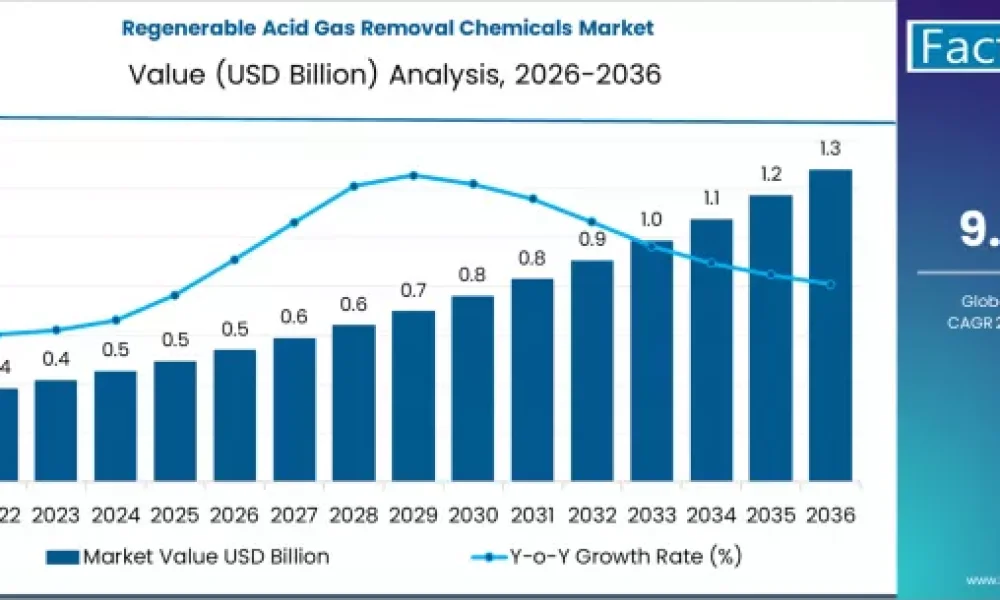
Market Value (2026): USD 1.43 billion
Market Forecast Value (2036): USD 3.79 billion
Forecast CAGR (2026–2036): Approximately 10.5%
Key Application Areas: Power plants, petrochemical processing, natural gas treatment, industrial emissions control
Core Drivers: Regulatory emissions standards, carbon capture technologies, industrial process optimization
Leading Regions: North America, Europe, Asia Pacific
To Access the Complete Data Tables & in-depth Insights, Request a Discount on this report: https://www.factmr.com/connectus/sample?flag=S&rep_id=13100
Market Overview
Regenerable acid gas removal chemicals are advanced sorbents, solvents, and surface-functionalized materials engineered to capture acid gases from industrial off-gases and flue streams. These chemicals are integrated into systems such as fixed-bed absorbers, fluidized beds, and membrane reactors, where they selectively bind acid gas molecules. Upon saturation, the used chemical media undergo controlled regeneration through thermal swing, pressure swing, or chemical stripping, releasing captured gases for further processing or disposal and restoring the sorbent’s capacity for subsequent cycles.
This regenerable capability reduces waste generation, lowers operating costs, and supports continuous, high-throughput industrial processes. Regenerable acid gas removal systems are especially valuable in industries where gas purification is critical for product quality, equipment longevity, and regulatory compliance.
Key Market Drivers
1. Stricter Environmental Regulations and Emission Standards
National and international regulatory bodies are enforcing tighter limits on acid gas emissions to protect air quality and public health. Power generation utilities, refineries, and chemical producers are under pressure to meet emission thresholds for SO₂, NOx, HCl, and other acid gases. Regenerable removal chemicals help facilities achieve compliance through efficient capture and recycling of pollutants, reducing dependency on disposable sorbents.
2. Decarbonization Initiatives and Carbon Capture Technologies
Global decarbonization commitments have accelerated investment in carbon capture, utilization, and storage (CCUS) technologies. Regenerable acid gas removal chemicals are integral to processes aimed at capturing CO₂ from flue gas and industrial off-gas streams. As carbon capture systems scale up, demand for high-performance, regenerable sorbents and solvents is growing.
3. Industrial Growth and Fuel Diversification
Expansion of industrial sectors, particularly in emerging economies, is driving broader use of emission control technologies. As industries diversify fuel sources — including increased use of natural gas, biomass, and alternative fuels — acid gas profiles in process streams can vary, creating demand for adaptable regenerable chemicals capable of handling different gas mixtures effectively.
4. Operational Efficiency and Cost Reduction
Regenerable sorbents and solvents offer lower lifecycle costs compared with one-time use alternatives. Their ability to undergo multiple regeneration cycles reduces material waste, inventory requirements, and disposal costs. Industrial operators are adopting regenerable solutions to optimize total cost of ownership while maintaining consistent gas removal performance.
Market Segmentation Insights
By Chemical Type
Regenerable Sorbents: Engineered solid materials with high surface area and selective binding capacity for acid gases, often used in fixed-bed or fluidized bed processes.
Regenerable Solvents: Liquid absorption systems formulated for efficient gas uptake and ease of regeneration through thermal or pressure swing techniques.
Amine-Based Systems: Widely used for CO₂ and acid gas removal due to strong chemical affinity and established regeneration methods.
Metal Oxide-Based Sorbents: Designed for high-temperature gas streams and specific acid gas removal scenarios.
Other Advanced Materials: Includes polymer-functionalized, nanostructured, and hybrid sorbent systems tailored for challenging gas compositions.
By Application
Power Generation: A leading segment due to regulatory pressure on flue gas emissions from coal and gas-fired plants.
Natural Gas Processing: Removal of CO₂, H₂S, and other acid gases is critical for meeting pipeline specifications and protecting downstream equipment.
Refining and Petrochemicals: Acid gas control is essential for process efficiency, product quality, and refinery emissions compliance.
Industrial Manufacturing: Includes chemicals, fertilizers, and steel production where acid gas streams must be managed.
Carbon Capture and Storage: A growth area as CCUS adoption scales up across sectors.
Regional Demand Dynamics
North America leads the market due to strong environmental regulations, high adoption of advanced emission control systems, and significant investment in carbon capture technologies. The presence of large industrial bases and utility fleets requiring acid gas control supports demand for regenerable solutions.
Europe is another major regional market driven by stringent emissions standards, ambitious decarbonization targets, and proactive environmental policies. Industrial operators in Europe are increasingly integrating regenerable gas removal chemicals into existing and new emission control systems.
Asia Pacific is expected to exhibit rapid growth due to expanding industrial infrastructure, increasing power generation capacity, and rising environmental awareness. Countries in this region are investing in technology upgrades and compliance strategies, fueling demand for regenerable acid gas removal systems.
Emerging regions in Latin America, the Middle East, and Africa are also experiencing incremental market growth as industrial activities expand and regulatory frameworks evolve to support air quality improvements.
Competitive Landscape
The regenerable acid gas removal chemicals market is moderately competitive, featuring global chemical manufacturers, specialty material developers, and technology providers. Key market participants are focused on enhancing performance characteristics, extending sorbent life cycles, and developing solutions tailored for specific industrial processes.
Strategic initiatives include investment in R&D for advanced regenerable materials, partnerships with industrial end users and systems integrators, and expansion of production capabilities to meet diverse regional demand. Product innovation is centered on improving thermal stability, gas selectivity, regeneration efficiency, and cost competitiveness.
Future Outlook
The regenerable acid gas removal chemicals market is expected to sustain strong momentum through 2036 as regulatory pressures, emission control mandates, and industrial decarbonization initiatives intensify. Continued adoption of CCUS technologies, coupled with expansion of gas processing and power generation infrastructure, will further enhance demand for high-performance regenerable sorbents and solvents.
As industries seek cost-effective, sustainable solutions for acid gas management, regenerable removal chemicals are poised to play a key role in achieving environmental compliance, operational efficiency, and long-term emissions reductions.
Have specific requirements or need assistance on report pricing or have a limited budget? Please contact [email protected]
About Fact.MR:
Fact.MR is a global market research and consulting firm, trusted by Fortune 500 companies and emerging businesses for reliable insights and strategic intelligence. With a presence across the U.S., UK, India, and Dubai, we deliver data-driven research and tailored consulting solutions across 30+ industries and 1,000+ markets. Backed by deep expertise and advanced analytics, Fact.MR helps organizations uncover opportunities, reduce risks, and make informed decisions for sustainable growth



