
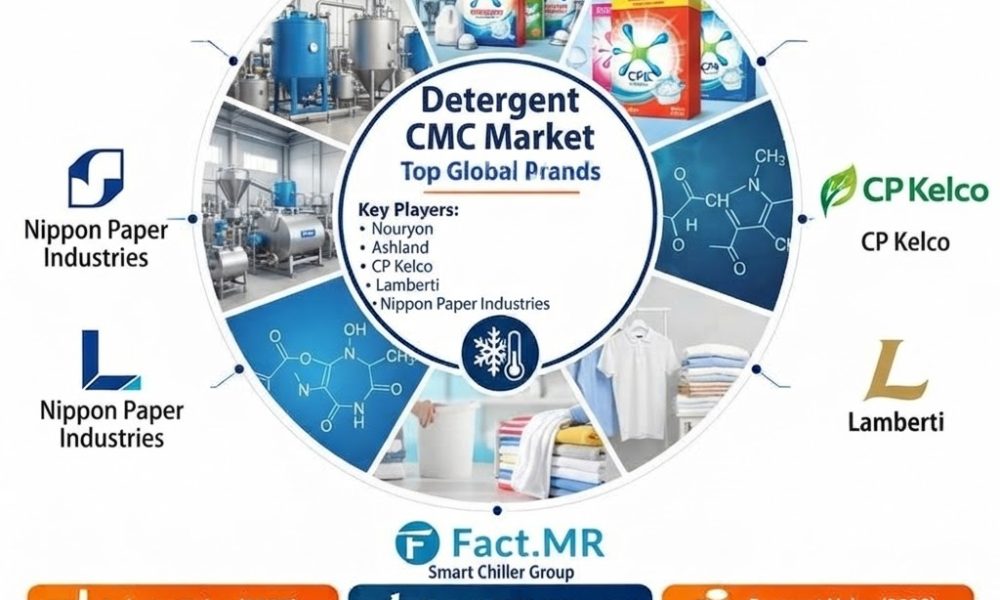
The global Detergent CMC Market is estimated at USD 335 million in 2026 and is projected to reach USD 590 million by 2036, expanding at a 5.8% CAGR during the forecast period. The market was valued at approximately USD 316.6 million in 2025, reflecting established demand for sodium carboxymethyl cellulose as a functional additive across household and industrial laundry formulations.
The market is benefiting from continued detergent production, formulation upgrades, and demand for additives that improve soil suspension, viscosity control, and fabric appearance. The absolute opportunity is expected to reach approximately USD 255 million between 2026 and 2036.
Powder laundry detergents remain the largest application segment, accounting for 55.0% of demand in 2026. Anti-redeposition represents the leading functional application with a 48.0% share, highlighting the importance of CMC in preventing removed soil from settling back onto fabrics during washing.
Get detailed market forecasts, competitive benchmarking, and pricing trends: https://www.factmr.com/connectus/sample?flag=S&rep_id=15589
Powder Detergents Remain the Core Demand Base
CMC is widely used in detergent formulations because of its ability to support anti-redeposition and soil suspension. In powder detergents, the polymer can be dry-blended into the formulation before hydrating during the wash cycle.
The powder segment benefits from its continued importance in heavy-duty laundry applications, particularly where cotton and cotton-blend fabrics represent a substantial share of washing loads. Liquid detergents are also creating demand for grades designed around controlled hydration, viscosity, solubility, and compatibility.
By function, anti-redeposition holds 48.0% of market demand, followed by soil suspension at 22.0% and viscosity control at 12.0%. By CMC grade, standard-viscosity products lead with 37.0% of sales, reflecting their broad suitability across powder and liquid processing requirements.
Wood pulp remains the leading cellulose source, accounting for 46.0% of the market, supported by industrial availability, established processing routes, and cost considerations. Cotton linter accounts for 22.0%, while sustainably sourced pulp represents 17.0%.
FMCG detergent brands represent the largest customer group at 42.0% of demand, supported by high-volume production, formal supplier qualification, and recurring procurement requirements.
Country Markets Show Varied Growth Opportunities
The United States is projected to expand at a 6.4% CAGR from 2026 to 2036, supported by demand for liquid, tablet, private-label, and institutional detergent formulations. Formulators are increasingly focused on controlled rheology, compatibility, and technical qualification when selecting CMC grades.
Germany follows with a 6.1% CAGR, reflecting demand from sophisticated detergent formulators that evaluate formulation performance, process consistency, and renewable-material claims. France is forecast to grow at 6.0%, while Poland is expected to advance at 5.8%. Brazil follows with a 5.7% CAGR, supported by its powder-led detergent market and substantial domestic pulp industry.
Europe remains relevant to the market because detergent manufacturers and ingredient suppliers increasingly evaluate cellulose sourcing, biodegradability documentation, formulation performance, and supply-chain traceability.
Bio-Based CMC Opens New Product Development Opportunities
Sustainability considerations are creating additional opportunities for detergent-grade CMC suppliers. Renewable cellulose inputs and documented sourcing are becoming increasingly relevant to multinational FMCG accounts seeking more specific ingredient claims.
Nouryon introduced FinnFix PB MAX, positioned as a fully bio-based and biodegradable CMC for laundry detergents. The product combines wood-derived cellulose with an attributed bio-based route for monochloroacetic acid, illustrating how suppliers are combining functional detergent performance with raw-material documentation.
Other opportunities include low-dust granulated CMC, compact liquid detergent systems, certified bio-based portfolios, and application laboratories supporting regional detergent manufacturers.
Formulation Performance Remains a Key Purchasing Consideration
CMC performance depends on the wider detergent formulation rather than the polymer alone. Surfactants, builders, enzymes, electrolytes, water conditions, dosage, textile mix, and wash cycles can influence results.
For detergent manufacturers, this creates demand for grades qualified against actual formulation conditions. Suppliers are therefore expected to support customers with technical data covering hydration, viscosity, compatibility, substitution degree, particle form, and soil redeposition.
Moisture sensitivity and storage conditions also remain relevant, particularly for powder applications. Proper packaging, dry storage, and stock rotation can help maintain consistent handling and dispersion.
Competitive Landscape
The competitive landscape includes Nouryon, Ashland, CP Kelco, Lamberti, and Nippon Paper Industries. Nouryon holds an estimated 18.0% share, followed by Ashland at 12.0%, CP Kelco at 9.0%, Lamberti at 6.0%, and Nippon Paper Industries at 4.0%.
Competition is centered on anti-redeposition performance, viscosity ranges, particle form, cellulose sourcing, bio-based positioning, technical support, and regional availability.
According to Shambhu Nath Jha, Senior Analyst at Fact.MR, “Detergent CMC is bought on the strength of formulation evidence: a familiar label is less useful than data on hydration, viscosity, compatibility, and soil redeposition under the customer’s wash conditions. Suppliers that connect those results to reliable particle form and traceable cellulose inputs can defend value even in a cost-sensitive additive category.”
Outlook for Detergent CMC Suppliers
The Detergent CMC Market is expected to benefit from detergent volume growth, continued powder formulation demand, liquid detergent development, and greater attention to traceable cellulose inputs. Suppliers that can demonstrate formulation-specific performance while maintaining reliable supply and technical support are positioned to address evolving procurement requirements.
The Fact.MR study covers detergent-grade CMC used in household and industrial laundry formulations across detergent format, function, CMC grade, cellulose source, customer group, and region. The report evaluates more than 30 countries and profiles major suppliers operating across the detergent ingredient value chain.
Top Trending Reports:
Bottled Water Market Forecast 2026-2036: Market to Reach USD 470 billion by 2036 at 3.6 % CAGR
About Fact.MR
Fact.MR is a market research and consulting firm known for delivering comprehensive market intelligence across chemicals and materials, packaging, technology, healthcare, automotive, and other industries. Its research combines primary interviews, secondary research, market sizing, competitive analysis, and forecasting to support strategic business decisions.



