
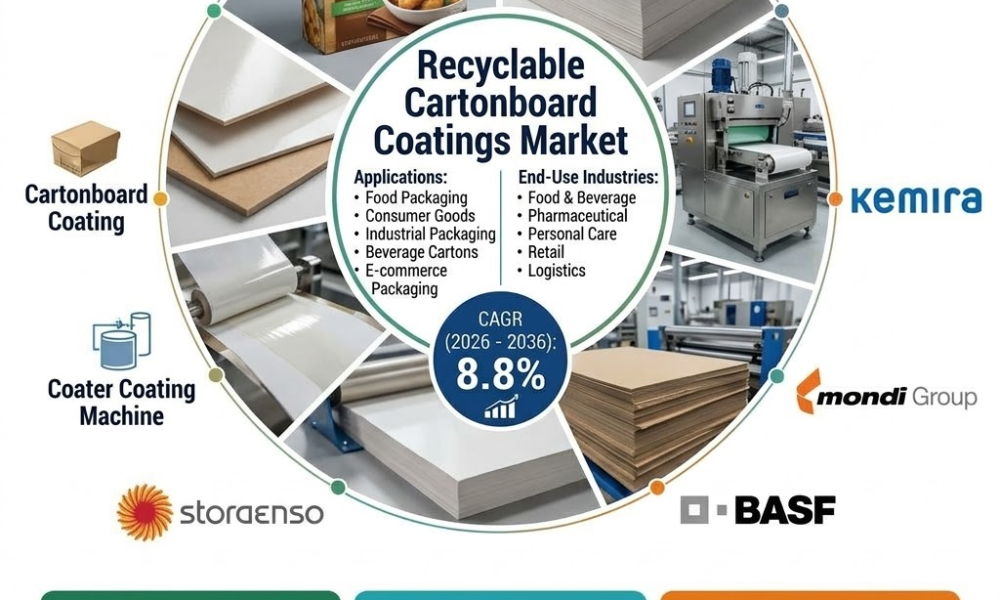
Recyclable Cartonboard Coatings Market Set to Reach USD 3.5 Billion by 2036 as Fiber-Based Packaging Gains Ground
Market expected to expand at 8.8% CAGR from 2026 to 2036, with food packaging, water-based coatings, and grease and oil resistance shaping demand
The global recyclable cartonboard coatings market is projected to grow from USD 1.5 billion in 2026 to USD 3.5 billion by 2036, according to Fact.MR. The market, valued at USD 1.4 billion in 2025, is expected to register an 8.8% CAGR during the 2026–2036 forecast period.
The market is gaining attention as fiber-based packaging replaces selected plastic barrier structures. Coating formulators, paperboard mills, converters, and packaging brands are focusing on barrier performance while also addressing recycling, food-contact requirements, drying speed, and finished-package performance.
Get detailed market forecasts, competitive benchmarking, and pricing trends https://www.factmr.com/connectus/sample?flag=S&rep_id=15826
The market is expected to create an absolute opportunity of USD 2.0 billion by 2036. Demand is particularly linked to food packaging applications, where converters require coatings that provide grease protection without compromising commercial line speed.
Water-based coatings are expected to remain central to market development. Dispersion – water-based coatings are projected to account for 46.0% of the market in 2026. Their adjustable film formation and compatibility with familiar mill workflows support adoption across existing production environments.
Grease and oil resistance is another major area of demand. This barrier property is projected to represent 34.0% share in 2026. Food-carton performance remains a key consideration, with formulators evaluating fluorine-free barrier coatings and other approaches while also considering fold durability and recovery compatibility.
Application methods also influence commercial adoption. Blade – rod coating is anticipated to hold 38.0% share in 2026, supported by controlled metering on installed equipment. Maintaining consistent drying and coat weight across cartonboard grades remains important for mills and converters seeking to introduce new coating systems without disrupting production.
Food packaging is expected to represent 48.0% share in 2026, making it the leading end-use segment. Fresh food and on-the-go food packaging require coatings capable of maintaining barrier performance through filling, distribution, folding, and other commercial processes.
Folding boxboard is forecast to lead the substrate category with a 40.0% share in 2026. Its efficient conversion characteristics support its position, although coatings must withstand demanding scoring and glue-seam conditions during carton conversion.
Regulatory and qualification requirements are also shaping market development. The FDA ended 35 PFAS food-contact notifications in January 2025, creating a direct reformulation requirement. In Europe, Regulation (EU) 2025-40 generally applies from August 2026 and advances reviews of coating and complete-package recyclability.
The United Kingdom is anticipated to record a 9.1% CAGR through 2036. Germany and Brazil are each forecast to expand at an 8.5% CAGR. Market development in these countries reflects differences in recyclability reporting, fee structures, fiber substitution, food packaging requirements, and collection infrastructure.
Commercial qualification remains a key consideration for industry participants. Coating performance cannot be established solely through flat-sheet or laboratory testing. Finished structures need to be assessed across printing, folding, filling, adhesive, drying, and recycling conditions.
Shambhu Nath Jha, Principal Consultant at Fact.MR, states: “Commercial acceptance depends on the complete coated carton instead of one favorable laboratory result during qualification programs. Formulators are expected to balance barrier protection with drying speed and fold durability across commercial lines.”
Opportunities are emerging around multi-barrier water-based systems, print-applied flexographic barriers, bio-polymer cartonboard coatings, and low-coat-weight recovery systems. These approaches are being assessed for their ability to provide protection while maintaining compatibility with recyclable cartonboard structures.
The competitive landscape includes BASF, Solenis, Michelman, Archroma, Kemira, Stora Enso, and Mondi Group. Competition spans specialty chemistry companies and integrated board producers. Providers are competing across chemistry breadth, substrate design, food-contact documentation, converting performance, and finished-package recycling results.
Fact.MR’s analysis covers the market by coating type, barrier property, application method, end use, substrate, and region. The study includes North America, Europe, Asia Pacific, Latin America, and the Middle East & Africa, with country-level analysis covering the United States, United Kingdom, Germany, Brazil, Japan, India, China, and other markets.
The research draws on more than 120 sources, 35+ company portfolios, 25+ countries, and more than 20 industry interviews. The analysis combines primary research, desk research, market sizing, forecasting, and data validation.
To view related Reports
About (Fact.MR)
(Fact.MR) provides market intelligence and research across industries and geographies. Its research combines primary interviews, secondary research, market data, and analytical methods to help organizations understand market size, growth patterns, competitive activity, and emerging opportunities.



