
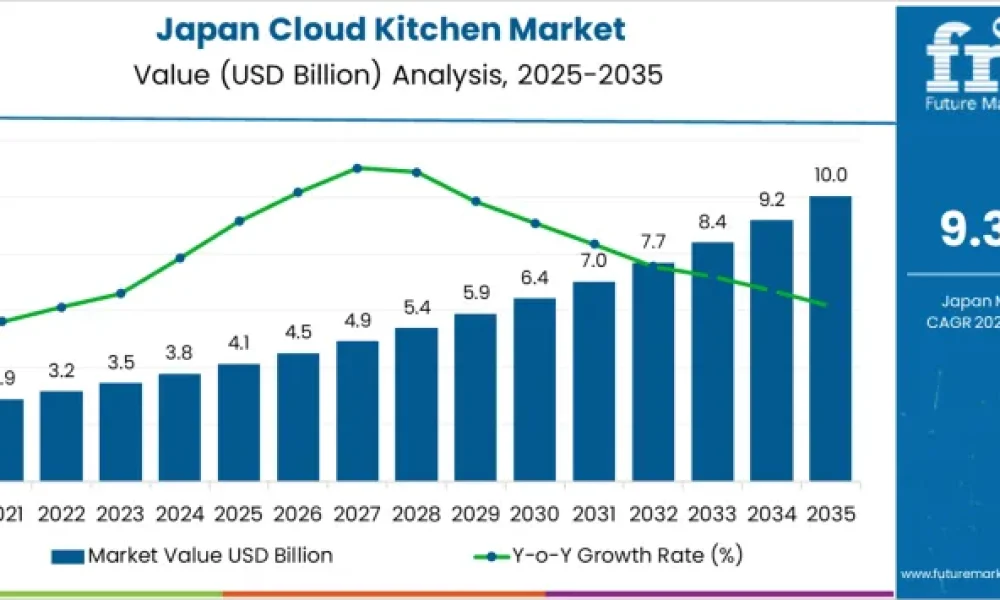
The cloud kitchen market in Japan is witnessing rapid expansion, driven by shifting consumer preferences and technological advancements. Forecasts predict the market value to soar from USD 4.1 billion in 2025 to an impressive USD 10.0 billion by 2035, reflecting a robust CAGR of 9.3%. Here’s a concise overview of this growing trend and the factors shaping the cloud kitchen landscape in Japan.
Independent cloud kitchens lead Japan’s market, offering flexibility and low costs. Urban areas drive demand, with Kanto and Kansai as hotspots. Aggregator and hybrid models also boost growth. Diverse food options meet rising delivery needs.
Subscribe for Year-Round Insights → Stay ahead with quarterly and annual data updates – https://www.futuremarketinsights.com/reports/sample/rep-gb-29586
Independent Cloud Kitchens Dominate the Market
- Independent cloud kitchens represent 56% of the demand, leading the sector.
- Their flexibility, lower overhead costs, and ability to offer diverse menus make them highly popular.
- These kitchens thrive in urban hubs like Kanto and Kansai, where food delivery demand is surging.
Key Business Models Supporting Market Growth
- Apart from independent kitchens, aggregator-based and hybrid cloud kitchens also contribute significantly.
- Aggregator-based models connect restaurants with delivery platforms, enhancing reach and efficiency.
- Brand-owned kitchens and franchise models enable scalability and greater market penetration.
Food Segments Driving Demand
- Fast food and casual dining remain the primary food types, meeting the need for quick, affordable meals.
- Healthy and diet-focused food segments are growing, reflecting rising health-consciousness among Japanese consumers.
Individual Consumers Lead End-User Demand
- Individual consumers make up 51% of cloud kitchen demand in Japan.
- Convenience and ease of ordering meals online are key drivers.
- Other important users include corporate offices, small restaurants, and food service providers leveraging cloud kitchens to optimize operations.
Regional Demand Highlights
- Kyushu & Okinawa lead with the highest CAGR at 11.6%, fueled by a strong tourism sector and health-conscious consumers.
- Kanto follows with a 10.7% CAGR, driven by dense urban populations like Tokyo.
- Kansai, Chubu, and Tohoku also show steady growth ranging between 7% to 9%.
- Even less urbanized areas in the rest of Japan are seeing increasing adoption, indicating nationwide growth.
Why is Demand for Cloud Kitchens Rising in Japan?
- Changing consumer behavior post-pandemic has accelerated preference for delivery and takeout.
- Busy urban lifestyles and dense populations increase demand for fast, convenient food delivery.
- Cloud kitchens offer a cost-effective alternative to traditional restaurants by eliminating dine-in overheads.
- Technological advancements in order management and delivery logistics enhance efficiency and customer experience.
Role of Technology in Market Expansion
- Integration with food delivery platforms like Uber Eats and Demae-can streamlines ordering.
- Real-time tracking, AI-driven inventory management, and data analytics optimize operations.
- Virtual brands and multi-brand kitchens allow rapid adaptation to consumer trends.
- These tech innovations make cloud kitchens scalable and highly efficient.
Challenges and Restraints
- High competition requires consistent quality, fast delivery, and hygiene standards to maintain customer trust.
- Regulatory compliance with food safety and licensing adds complexity.
- Logistics challenges such as delivery timing and food preservation during transport remain critical.
- Consumer preferences may shift back to dine-in experiences or fresh home-cooked meals.
Leading Players in Japan’s Cloud Kitchen Market
- Top companies include Rebel Foods, Kitopi, CloudKitchens, Ghost Kitchens Private Limited, and Luckin Coffee (Sgp) Pte. Ltd.
- Rebel Foods commands a significant market share with multiple virtual brands.
- These players leverage shared kitchen spaces, advanced delivery systems, and data-driven strategies to expand reach.
Future Outlook: What to Expect by 2035
- Continued growth is expected as cloud kitchens become integral to Japan’s foodservice industry.
- Expansion into suburban and rural areas will broaden market reach.
- Increasing consumer demand for healthy, ethnic, and customized food options will diversify offerings.
- Investments in sustainable packaging and eco-friendly delivery methods will become more common.
- The sector will continue evolving with innovations in robotics, AI, and cloud computing.
Conclusion
The demand for cloud kitchens in Japan is set for a decade of strong growth, fueled by evolving consumer lifestyles, technological innovation, and new business models. With the market value projected to reach USD 10 billion by 2035, independent cloud kitchens remain the dominant force, especially in urban centers. As convenience, variety, and efficiency become priorities for Japanese consumers, cloud kitchens offer an adaptable, cost-effective solution that reshapes the country’s food delivery landscape.
Have a specific Requirements and Need Assistant on Report Pricing or Limited Budget please contact us – [email protected]
About Future Market Insights (FMI)
Future Market Insights, Inc. (FMI) is an ESOMAR-certified, ISO 9001:2015 market research and consulting organization, trusted by Fortune 500 clients and global enterprises. With operations in the U.S., UK, India, and Dubai, FMI provides data-backed insights and strategic intelligence across 30+ industries and 1200 markets worldwide.



