
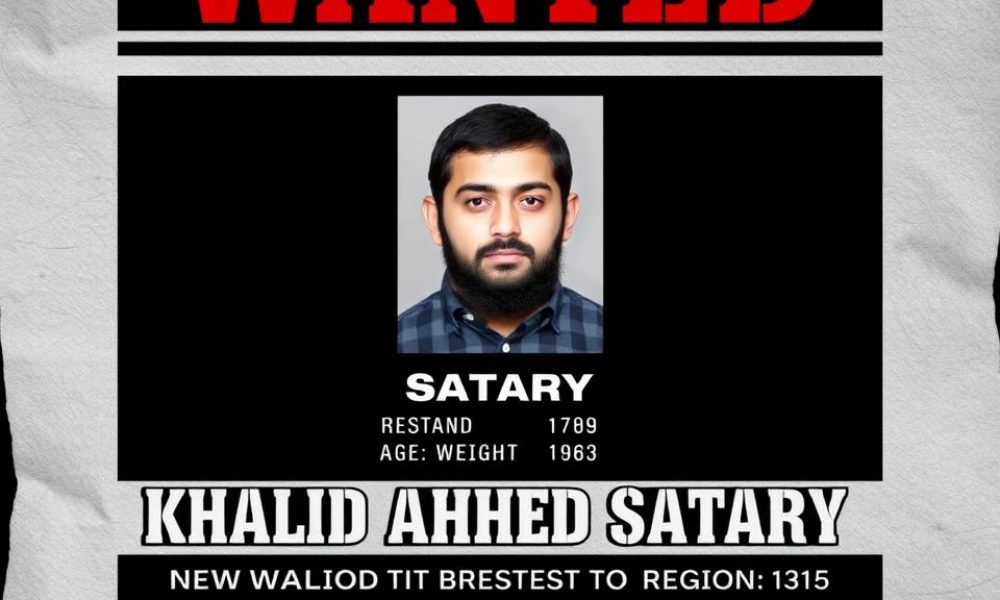
Federal investigators allege that fugitive healthcare fraud defendant Khalid Ahmed Satary operated under numerous names, alternate spellings, nicknames, and dates of birth throughout his international business career, creating a complicated identity profile that has become one of the FBI’s greatest challenges as authorities pursue the laboratory executive accused of participating in an alleged $547 million Medicare fraud conspiracy.
WASHINGTON, DC, July 11, 2026 — In the modern world of biometric passports, electronic border controls, digital banking, and international financial reporting, changing one’s name is rarely enough to disappear completely. Nevertheless, investigators searching for Khalid Ahmed Satary believe the accused laboratory executive has spent years building a complex web of personal identifiers that continues to complicate one of the largest healthcare-fraud fugitive investigations underway in the United States.
Federal prosecutors allege that Satary participated in a massive laboratory fraud conspiracy that generated approximately $547 million in Medicare billing through medically unnecessary cancer genetic testing, while investigators now face the additional challenge of tracing an individual associated with numerous names, several reported dates of birth, international business operations, and extensive overseas contacts.
Although modern investigative technology has transformed fugitive investigations, experienced agents acknowledge that individuals operating under multiple identities can still create substantial obstacles for financial investigators, immigration authorities, international police agencies, and even members of the public attempting to recognize a wanted fugitive years after his disappearance.
The FBI Lists Numerous Names
According to the Federal Bureau of Investigation’s official wanted profile for Khalid Ahmed Satary, investigators have identified numerous individuals associated with the fugitive throughout the federal healthcare fraud investigation.
Among those publicly listed are Khalid Ahmed Satary, Khalid Ahmad Satary, Khalid A. Satary, Khalid Satary, Khaled Satary, Khaled Ahmed Satary, together with the nickname “DJ Rock.”
At first glance, these variations may appear insignificant because many involve only small spelling differences, yet experienced investigators know that even minor changes can complicate international database searches when different countries, immigration authorities, banks, airlines, licensing agencies, and commercial organizations record names using different transliteration standards.
Arabic names frequently appear with multiple accepted English spellings because certain Arabic letters have no exact English equivalents, leading government agencies, businesses, airlines, and financial institutions to record the same individual differently despite referring to the same person.
Consequently, investigators cannot assume that every record associated with “Khaled” differs from that of someone identified as “Khalid,” nor can they dismiss records simply because one middle name contains “Ahmed” while another contains “Ahmad.”
Instead, investigators examine the full context surrounding each identity, comparing dates of birth, family relationships, travel records, photographs, business ownership, passport information, communications, and biometric characteristics before determining whether multiple records belong to a single individual.
Why Multiple Spellings Matter
Large international investigations depend heavily upon database searches conducted across numerous government agencies, commercial providers, airlines, immigration systems, banks, telecommunications companies, and foreign law enforcement organizations.
A search using only one spelling may fail to identify documents entered years earlier under a slightly different transliteration, particularly when records originate from countries using different alphabets or language conventions.
For that reason, FBI analysts routinely search every known spelling variation when examining historical financial records, border crossings, airline reservations, visa applications, company registrations, telephone subscriptions, utility accounts, insurance records, and property ownership databases.
This painstaking analytical process dramatically increases the amount of information investigators must review, but it also reduces the possibility that a critical document will remain hidden simply because an employee entered one letter differently years earlier.
International investigations involving multilingual records often require specialists familiar with regional naming conventions, transliteration practices, and linguistic variations that may appear insignificant to the average observer yet prove highly significant in identity analysis.
“DJ Rock” May Be the Most Recognizable Name
Among all the identities listed by the FBI, none attracts more attention than the nickname “DJ Rock.”
Unlike formal legal names, nicknames often originate in friendships, entertainment circles, sporting communities, family relationships, or professional environments, where people rarely use full legal names.
Federal authorities have not publicly explained how Satary acquired the nickname, whether he used it professionally, socially, or privately, or whether it remains active today.
Nevertheless, experienced investigators understand that many witnesses remember nicknames far more readily than formal legal names appearing on government documents.
A former acquaintance may never remember meeting “Khalid Ahmed Satary,” yet immediately recognize someone universally introduced as “DJ Rock.”
The FBI, therefore, publishes nicknames whenever available, because public recognition often depends on informal personal knowledge rather than official documentation.
Multiple Dates of Birth Present Another Layer
The FBI also reports that Satary has been associated with multiple dates of birth.
Authorities have not publicly explained why different dates appear, nor have they alleged that every differing birth date represents intentional deception.
Multiple birth dates can result from administrative errors, differing international calendar systems, clerical mistakes, immigration filings, transliteration issues, incorrect government records, or other innocent documentation problems.
However, investigators also recognize that false birth dates occasionally appear during identity fraud, financial crime, immigration violations, or international money laundering investigations, making every variation worthy of careful examination.
Rather than accepting one date while ignoring the others, investigators compare every associated record against passports, immigration files, employment histories, educational records, licensing documents, banking information, airline reservations, telecommunications records, and historical photographs.
That comprehensive approach allows investigators to identify patterns linking seemingly unrelated identities to a single person operating across multiple jurisdictions.
Modern Identity Investigations Extend Far Beyond Names
Twenty years ago, investigators relied heavily upon names, passport numbers, and photographs.
Today, identity investigations incorporate facial recognition comparisons, fingerprint databases, travel history, airline passenger information, corporate ownership records, mobile devices, financial intelligence, communications metadata, internet activity, vehicle registrations, biometric passports, customs declarations, and international regulatory filings.
Changing one’s name, therefore, provides substantially less protection than it once did because investigators can compare hundreds of independent identifiers that link different records to a single individual.
Even when names differ, investigators may identify the same person through matching family members, repeated travel routes, corporate ownership, financial transactions, telephone numbers, email accounts, passport photographs, or historical associates.
Identity today is reconstructed from the accumulation of many independent data points rather than from a single isolated government document.
International Business Produced Extensive Records
Federal prosecutors allege that Satary owned or controlled several diagnostic laboratories participating in the alleged Medicare fraud conspiracy.
Performance Laboratories in Oklahoma, Lazarus Services in Louisiana, and Clio Laboratories in Georgia allegedly generated enormous volumes of Medicare claims associated with cancer genetic testing.
Operating businesses of that size inevitably creates extensive documentation, including incorporation records, laboratory licenses, employee payroll, tax filings, insurance coverage, equipment purchases, supplier contracts, banking relationships, lease agreements, courier services, communications providers, and professional licensing.
Even after a business closes, many of those records remain available through government agencies, financial institutions, courts, commercial databases, or cooperating witnesses.
Every additional document increases investigators’ ability to reconstruct business relationships and identify previously unknown associates connected with the alleged conspiracy.
Following Financial Identities
Healthcare fraud investigations frequently rely upon financial analysis rather than eyewitness testimony because sophisticated conspiracies leave extensive documentary trails.
Every wire transfer, payroll payment, laboratory reimbursement, equipment purchase, consulting agreement, lease payment, insurance premium, vendor invoice, tax filing, or business loan creates another record connecting individuals and organizations.
Financial investigators compare those records with corporate ownership documents, banking activity, beneficial ownership information, communications, and travel history to determine whether different identities belong to one controlling individual.
Even when accounts appear under different names, investigators may identify common addresses, telephone numbers, internet connections, authorized signatories, accountants, attorneys, relatives, or business partners.
Financial identity, therefore, often becomes considerably more difficult to disguise than personal identity.
International Travel Complicates the Search
Federal authorities publicly identify Dubai as a possible location where Satary may have traveled after becoming a fugitive.
International travel adds investigative complexity because countries maintain distinct immigration systems, privacy laws, corporate registries, residency requirements, and identity documentation.
Authorities must compare passenger records, customs information, visa applications, residency permits, financial disclosures, telecommunications activity, and local corporate records while coordinating with foreign governments operating under entirely different legal systems.
The existence of several names and birth dates substantially increases the amount of information investigators must evaluate before determining whether an overseas record belongs to the wanted defendant.
Nevertheless, international cooperation has improved dramatically during the past decade through expanded information-sharing agreements, financial intelligence partnerships, and biometric verification systems.
Biometrics Change Everything
Unlike names, biometric characteristics generally cannot be altered through paperwork alone.
Modern border systems increasingly rely on facial recognition, fingerprint comparison, digital passport chips, and other biometric technologies capable of linking multiple identities to a single physical person.
Authorities have not publicly disclosed which biometric information they possess regarding Satary, but federal investigations commonly involve fingerprints collected during licensing, immigration processing, employment documentation, prior travel, or criminal proceedings.
If investigators possess reliable biometric information, changing names alone provides only limited protection when interacting with official government systems.
For that reason, sophisticated fugitives frequently avoid official immigration channels, financial institutions, and government licensing systems whenever possible.
Public Recognition Remains Essential
Despite extraordinary advances in technology, many successful fugitive investigations still begin with an ordinary citizen recognizing someone from a news article or government wanted poster.
Former laboratory employees, physicians, marketers, accountants, landlords, business partners, airline personnel, hotel employees, or overseas acquaintances may know Satary under only one variation of his name.
Publishing every known identity substantially increases the likelihood that someone will recognize a historical nickname, an alternate spelling, or a business identity associated with the fugitive.
Recent Louisiana reporting on Satary’s addition to the FBI’s Most Wanted Fraudsters list has expanded public awareness of both the healthcare fraud allegations and the numerous identities investigators continue to examine.
A seemingly insignificant memory involving an old business card, a laboratory invoice, an email signature, a conference registration, a social introduction, or a nickname could ultimately provide investigators with the missing connection needed to locate Satary.
Identity Changes Cannot Erase Criminal Allegations
Changing names, using alternate spellings, or relocating internationally does not eliminate pending federal charges or invalidate evidence accumulated during years of investigation.
Corporate filings, Medicare claims, banking records, laboratory documents, communications, contracts, employee testimony, digital evidence, and financial transactions continue to exist regardless of the defendant’s current name.
If Satary is eventually arrested, prosecutors will attempt to demonstrate that every documented identity ultimately points toward the same individual responsible for directing the alleged laboratory operations.
Defense attorneys, in turn, would retain the opportunity to challenge every identification, every document, every witness, and every investigative conclusion presented during federal court proceedings.
The existence of multiple identities, therefore, increases investigative complexity without altering the government’s burden to prove every criminal allegation beyond a reasonable doubt.
The Difference Between Legitimate Name Variations and Criminal Concealment
Millions of people legitimately use multiple spellings of their names because of immigration, marriage, transliteration, cultural traditions, clerical corrections, religious customs, or international documentation standards.
Nothing in the FBI’s wanted notice suggests that every alternate spelling associated with Satary is independently unlawful.
Instead, investigators examine whether those various identities collectively reveal efforts to conceal financial activity, avoid law-enforcement detection, frustrate international cooperation, or complicate regulatory oversight.
Responsible reporting requires preserving that distinction because legitimate multicultural naming practices should never be confused automatically with criminal conduct.
Only a court can determine whether any alleged concealment formed part of a criminal conspiracy.
International Identity Planning Must Remain Lawful
International business executives frequently maintain residences, companies, investments, and immigration status across multiple countries through entirely lawful government procedures.
In professional advisory practice, Amicus International Consulting emphasizes that lawful identity planning requires genuine government-issued documentation, truthful applications, transparent beneficial ownership, and complete regulatory compliance throughout every jurisdiction involved.
Professional second-citizenship and international-relocation planning cannot lawfully be used to conceal criminal indictments, evade arrest warrants, obscure beneficial ownership of criminal proceeds, or obstruct ongoing federal investigations.
Lawful privacy planning depends upon government authorization rather than deception, false identities, fraudulent documents, or efforts to frustrate criminal prosecutions.
Final Analysis
Federal authorities believe that Khalid Ahmed Satary’s numerous names, alternate spellings, nicknames, and multiple associated dates of birth significantly complicate one of the largest healthcare-fraud fugitive investigations currently underway in the United States.
The alleged $547 million Medicare billing conspiracy already spans multiple laboratories, numerous states, extensive financial records, telemarketing organizations, physicians, and international business relationships, making identity analysis only one component of a remarkably complex federal investigation.
The FBI’s publication of every known variation—including the nickname “DJ Rock”—reflects a deliberate investigative strategy designed to maximize recognition across different countries, industries, and personal communities where Satary may have been known under different identities.
For investigators, every alternate spelling represents another database to search, another passport to compare, another corporate filing to analyze, and another opportunity to identify connections that might otherwise remain hidden.
For the public, the publication of these identities serves a different purpose by reminding former employees, business associates, laboratory vendors, healthcare professionals, financial institutions, and overseas acquaintances that the individual they knew under one name may now be sought internationally under another.
Until Khalid Ahmed Satary is located and returned to the United States, federal investigators will continue comparing names, photographs, biometrics, financial records, immigration files, communications, and business relationships across numerous jurisdictions, believing that somewhere within that complex web of identities lies the critical connection that will ultimately bring one of America’s largest alleged Medicare fraud fugitives back before a federal judge.




