Quaternary ammonium salts disinfectants, commonly known as QACs or “quats,” are antimicrobial agents used extensively in healthcare, food processing, and institutional cleaning sectors. These compounds carry a positive charge, allowing them to interact with the negatively charged microbial cell membranes, ultimately causing cell lysis and death.
The most widely used QACs include benzalkonium chloride (BAC), didecyldimethylammonium chloride (DDAC), and alkyl dimethyl benzyl ammonium chloride, all known for broad-spectrum efficacy against bacteria, fungi, and enveloped viruses.
Get free sample of this report at : https://www.24lifesciences.com/download-sample/965/quaternary-ammonium-salts-disinfectant-market
Due to their low toxicity, compatibility with various surfaces, and persistent antimicrobial action, quaternary ammonium salts have become a cornerstone of disinfection protocols in hospitals, laboratories, and food preparation facilities.
Market Size
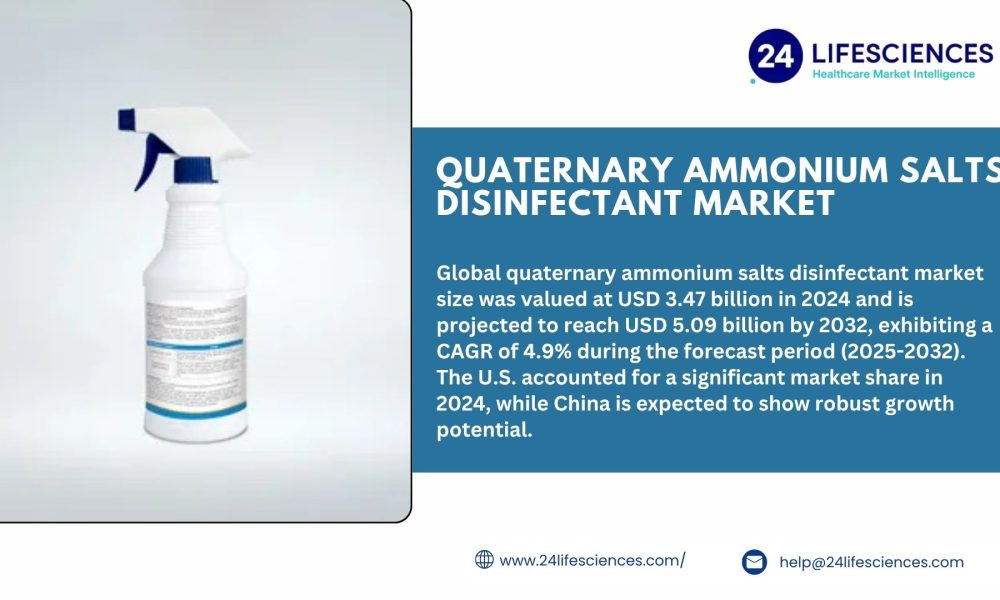
The global quaternary ammonium salts disinfectant market was valued at USD 3.47 billion in 2024 and is projected to reach USD 5.09 billion by 2032, growing at a CAGR of 4.9% during the forecast period (2025–2032).
The U.S. accounted for a major share in 2024, driven by strict infection control guidelines and institutional cleaning mandates, while China and India are expected to show robust growth due to industrial expansion and rising hygiene awareness.
Increased demand across food processing, water treatment, and agricultural sectors is further accelerating global adoption of QAC-based disinfectants, as industries prioritize sanitation and environmental safety.
Recent Development
Recent years have witnessed notable innovation in the QAC disinfectant segment, focusing on formulation efficiency, environmental compatibility, and antimicrobial persistence.
- 3M Company launched an advanced multi-surface QAC disinfectant combining high efficacy with reduced chemical residue.
- Unilever PLC introduced biodegradable QAC-based cleaning solutions, aligning with sustainability goals and regulatory compliance.
- Procter & Gamble (P&G) expanded its hospital-grade disinfectant line featuring improved skin and surface compatibility.
- Saniswiss (Switzerland) and ADRANOX (U.S.) have invested in electrolyzed QAC solutions to enhance disinfection speed while minimizing ecological impact.
- Ongoing research explores QAC resistance management and integration with nanotechnology for targeted microbial inactivation.
These developments underline a global shift toward next-generation disinfectants that deliver superior safety, efficacy, and sustainability.
Market Dynamics (Drivers, Restraints, Opportunities)
Drivers
- Rising hygiene awareness: Post-COVID-19, disinfection protocols have become standard practice across industries.
- Growing demand in healthcare and food processing: QACs are essential in sanitizing instruments, surfaces, and food-contact areas.
- Regulatory mandates: Stringent safety standards by WHO, FDA, and EPA boost the adoption of effective disinfectants.
- Broad-spectrum efficacy: QACs effectively eliminate a wide range of pathogens, including bacteria, fungi, and enveloped viruses.
Restraints
- Environmental persistence: QAC residues in wastewater pose ecological risks if untreated.
- Potential microbial resistance: Overuse can contribute to bacterial adaptation and decreased efficacy.
- Regulatory scrutiny: Environmental agencies are tightening restrictions on QAC concentration levels.
Opportunities
- Sustainable formulations: Rising demand for biodegradable and plant-derived QAC alternatives.
- Emerging industrial uses: Expansion in agriculture, water treatment, and textile sanitization.
- Smart disinfection technologies: Integration with automated and sensor-based disinfection systems.
Regional Analysis
North America
North America leads the global market with strong regulatory frameworks, hospital-grade sanitation protocols, and high product adoption across commercial and institutional sectors. The U.S. dominates due to large-scale use in healthcare and food manufacturing.
Europe
Europe exhibits steady growth, driven by stringent EU hygiene regulations, particularly in food safety and public sanitation. Germany, France, and the U.K. are leading markets emphasizing sustainable formulations.
Asia-Pacific
Asia-Pacific is projected to record the fastest CAGR (6.1%) through 2032. Rapid urbanization, healthcare infrastructure expansion, and government-led hygiene programs in China, India, Japan, and South Korea are major growth drivers.
Latin America and Middle East–Africa
These regions represent emerging markets, supported by healthcare modernization, rising infection control awareness, and industrial growth in countries like Brazil, Saudi Arabia, and South Africa.
Competitor Analysis
The market is moderately consolidated, featuring global giants and specialized regional players focused on innovation, regulatory compliance, and sustainability.
Major Companies Include:
- 3M Company (U.S.)
- Unilever PLC (U.K.)
- Procter & Gamble (U.S.)
- Lion Corporation (Japan)
- Hospitex International (France)
- Turkuaz Medikal Kozmetik (Turkey)
- Vhern (Spain)
- ADRANOX (U.S.)
- Sunrise Healthcare Technology (China)
- Prestige Medical Limited (U.K.)
- Neo G (Singapore)
- Dinamo (Italy)
- DIVERSEY Holdings (U.S.)
- Bull Products (Germany)
- Saniswiss (Switzerland)
Key competitive strategies include product diversification, global expansion, and partnerships with healthcare and food service providers. Many companies are emphasizing green chemistry innovations to maintain compliance with tightening environmental regulations.
Market Segmentation (by Application)
- Healthcare Facilities:
- Largest segment due to strict infection prevention protocols and widespread surface disinfection use.
- Food Service and Processing:
- Growing adoption for equipment and surface sanitization to prevent contamination.
- Industrial Applications:
- Increasing use in manufacturing units and cleanroom environments.
- Residential Cleaning:
- Rising awareness among consumers for safe and effective home disinfection.
- Water Treatment:
- Emerging use in microbial control and biofilm management in municipal systems.
Market Segmentation (by Type)
- Benzalkonium Bromide:
- Subtypes: Alkyl dimethyl benzyl ammonium chloride, Didecyl dimethyl ammonium chloride.
- Dominance: Leads the market for its high efficacy, stability, and cost-effectiveness.
- Chlorhexidine:
- Widely used in healthcare and dental disinfection.
- Tetraalkylammonium Salts:
- Subtypes: Tetramethylammonium, Tetraethylammonium.
- Application: Preferred in specialty industrial formulations.
- Other Specialty Formulations:
- Subtypes: Dumiphene, Xinjieling Disinfectant.
- Emerging for high-performance niche applications.
Key Company
3M Company, Unilever, and Procter & Gamble dominate the market through extensive distribution networks and high investment in R&D. DIVERSEY, Saniswiss, and ADRANOX are pioneers in eco-friendly disinfectant technologies.
Regional manufacturers like Turkuaz Medikal (Turkey) and Sunrise Healthcare (China) are expanding through localized production and cost-effective formulations tailored for hospitals and industrial users.
Geographic Segmentation
| Region | Market Share (2024) | Key Countries | Growth Potential |
| North America | 35% | U.S., Canada | Mature market with consistent innovation |
| Europe | 28% | Germany, France, U.K. | Focused on sustainable disinfectants |
| Asia-Pacific | 25% | China, Japan, India | Fastest-growing region |
| Latin America | 7% | Brazil, Mexico | Growing industrial cleaning segment |
| Middle East & Africa | 5% | Saudi Arabia, South Africa | Expanding hospital and food processing sectors |
Future Outlook
The quaternary ammonium salts disinfectant market is poised for sustained growth through 2032, fueled by global infection prevention mandates, green chemistry innovation, and rising demand from non-traditional sectors such as agriculture and water treatment.
Future trends will emphasize biodegradable quats, nanotechnology-based delivery systems, and automated disinfection technologies integrated into smart facilities. Manufacturers investing in R&D, sustainable production, and regional partnerships will gain a competitive edge.
Key Innovation
- Eco-friendly QAC formulations: Reduced environmental persistence with equal antimicrobial strength.
- Nanostructured disinfectants: Enhanced microbial kill rates through controlled release mechanisms.
- Alcohol-free blends: Lower toxicity options for sensitive surfaces and skin.
- Smart disinfection systems: Automated QAC dispensers for hospitals and industrial settings.
- Hybrid multi-action formulations: Combining QACs with peroxides or enzymes for improved efficacy.
Get free sample of this report at : https://www.24lifesciences.com/download-sample/965/quaternary-ammonium-salts-disinfectant-market
About 24lifesciences
Founded in 2017, 24LifeScience has emerged as a trusted research and analytics partner for organizations operating within the global life sciences and chemical industries. Our core mission is to provide intelligent, future-ready insights that help clients stay ahead in an increasingly complex and innovation-driven market
International: +1(332) 2424 294 | Asia: +91 9425150513 (Asia)
Website: http://www.24lifesciences.com
Follow us on LinkedIn: http://www.linkedin.com/company/lifesciences24




