
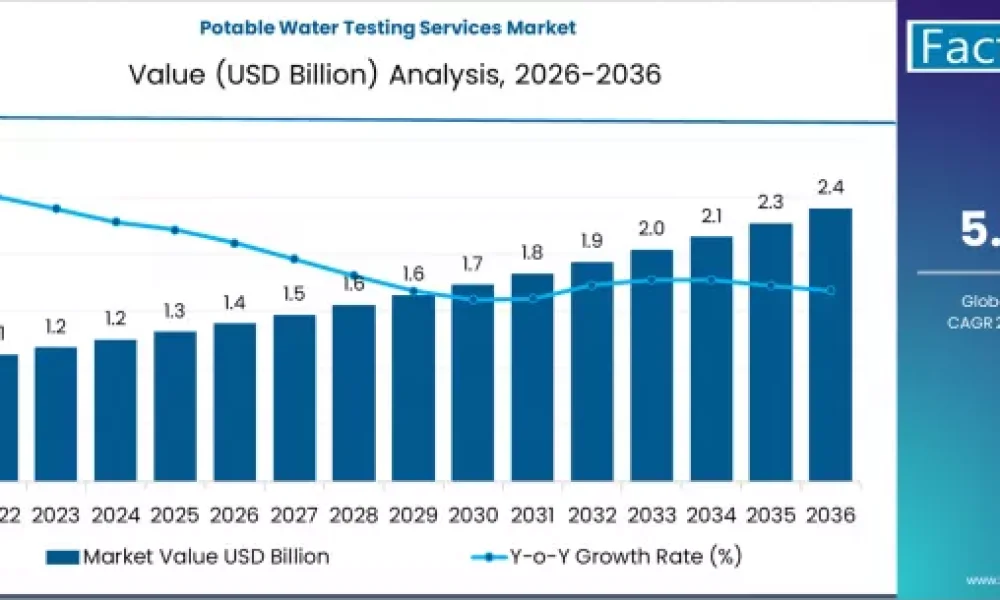
The global Potable Water Testing Services Market is poised for significant growth through 2036 as governments, utilities, industries, and communities worldwide prioritize access to safe, clean drinking water. Potable water testing services encompass laboratory analysis, field diagnostics, monitoring solutions, and compliance testing to assess chemical, biological, and physical parameters in drinking water. These services help ensure regulatory compliance, prevent waterborne disease outbreaks, protect public health, and support sustainable water management in urban and rural settings.
As industrialization, urban expansion, climate change, and aging water infrastructure increase pressure on water quality, demand for reliable and comprehensive testing services is rising. Growing public awareness of contaminants such as heavy metals, pathogens, disinfection byproducts, and emerging pollutants — including pharmaceuticals and microplastics — is driving investment in advanced testing methodologies and regular monitoring programs.
Market Outlook (2026–2036)
Market Value in 2026: Estimated at USD 8.7 billion
Market Value in 2036: Projected to reach USD 18.9 billion
Forecast CAGR (2026–2036): Approximately 8.2%
Leading Service Type: Chemical and Biological Contaminant Analysis
Dominant End User: Municipal Water Authorities
Primary Drivers: Regulatory enforcement, public health priorities, industrial compliance
The steady compound annual growth rate reflects expanded regulatory frameworks, rising investments in water quality infrastructure, and greater emphasis on preventive public health measures.
To Access the Complete Data Tables & in-depth Insights, Request a Discount on this report: https://www.factmr.com/connectus/sample?flag=S&rep_id=13417
Market Overview
Potable water testing services are essential components of water safety and quality assurance systems. These services involve sampling, laboratory analysis, real-time monitoring, and risk assessment to detect contaminants that could adversely affect human health or fail to meet water quality standards. Testing parameters include microbial contaminants (e.g., E. coli, coliforms), inorganic substances (e.g., lead, arsenic), organic pollutants, turbidity, pH, and residual disinfectant levels.
Service providers employ a range of technologies such as chromatography, spectroscopy, polymerase chain reaction (PCR), and sensor networks to provide accurate and timely results. Many utilities and industrial clients also engage in proactive testing programs that integrate data analytics and digital reporting to track trends, predict issues, and manage water quality across distribution systems.
Key Market Drivers
1. Strengthening Regulatory Standards
Governments and regulatory bodies are imposing stringent water quality standards and frequent testing mandates to protect public health. Compliance with these regulations requires regular and comprehensive testing services, driving demand among municipal water authorities and private sector entities.
2. Rising Public Health Awareness
Increasing consumer awareness of contaminants and potential health risks has led to greater demand for transparent water quality testing and reporting. Public concern over issues such as lead contamination, pathogen outbreaks, and chemical exposure is prompting more frequent testing and independent verification services.
3. Aging Water Infrastructure
In many regions, aging pipelines, storage facilities, and treatment plants contribute to water quality deterioration. Regular testing helps identify contamination sources, assess infrastructure performance, and guide maintenance or rehabilitation efforts.
4. Industrial and Commercial Compliance
Industries that discharge wastewater or rely on potable water in their operations — including food and beverage, pharmaceuticals, and hospitality — must meet strict water quality criteria. Outsourced testing services ensure compliance, reduce liability, and support environmental stewardship.
Market Segmentation Insights
By Service Type:
Microbiological Testing
Chemical Contaminant Analysis
Physical Parameter Measurement
Advanced or Emerging Pollutant Screening
Field Monitoring and Rapid Response Testing
By Testing Modality:
Laboratory-Based Testing
On-Site/Field Testing
Remote Sensor-Assisted Monitoring
Integrated Digital and Cloud-Based Reporting
By End Use Sector:
Municipal Water Authorities
Industrial and Manufacturing
Healthcare and Pharmaceuticals
Commercial and Residential Properties
Research and Academic Institutions
By Delivery Model:
Contract Laboratory Services
Water Utility In-House Testing
Mobile Testing Units
Subscription and Managed Monitoring Services
Regional Demand Dynamics
North America is expected to hold a leading share of the market due to well-established regulatory frameworks, advanced laboratory infrastructure, and high public demand for water safety reporting. Federal and state mandates in the region require frequent testing and transparent reporting, sustaining robust demand.
Europe represents a key regional market supported by comprehensive drinking water directives and strong environmental policies. Investments in water quality monitoring networks and digital reporting further drive adoption of testing services.
Asia Pacific is poised to register rapid growth, fueled by expanding urban populations, industrialization, and increasing focus on public health infrastructure. Governments across the region are enhancing water quality standards, upgrading treatment facilities, and expanding testing capacity to meet rising demand.
Emerging markets in Latin America and Middle East & Africa are also strengthening potable water testing programs as part of broader efforts to improve public health, enhance infrastructure, and attract investment in urban services.
Competitive Landscape
The potable water testing services market features a competitive landscape comprising independent testing laboratories, environmental consulting firms, analytical service providers, and integrated utility service vendors. Companies are focusing on expanding service portfolios, adopting advanced analytical technologies, and offering value-added services such as real-time monitoring, predictive analytics, and comprehensive reporting dashboards.
Strategic initiatives include collaboration with technology partners to deploy field sensors and IoT platforms, investment in high-throughput analytical equipment, and development of standardized testing protocols aligned with global best practices. Service quality, turnaround time, accreditation, and data reliability are key differentiators in this competitive environment.
Future Outlook
The Potable Water Testing Services Market is expected to maintain steady growth through 2036 as water safety remains a priority for governments, industries, and consumers. Continued innovation in testing technologies, integration of digital monitoring solutions, and expansion of regulatory testing mandates will further propel market expansion.
As communities seek greater transparency and assurance regarding the water they consume, potable water testing services will play a central role in safeguarding public health, supporting infrastructure planning, and ensuring environmental compliance. Improved accessibility, rapid field testing, and predictive water quality analytics will shape the future of this vital market.
Have specific requirements or need assistance on report pricing or have a limited budget? Please contact [email protected]
About Fact.MR:
Fact.MR is a global market research and consulting firm, trusted by Fortune 500 companies and emerging businesses for reliable insights and strategic intelligence. With a presence across the U.S., UK, India, and Dubai, we deliver data-driven research and tailored consulting solutions across 30+ industries and 1,000+ markets. Backed by deep expertise and advanced analytics, Fact.MR helps organizations uncover opportunities, reduce risks, and make informed decisions for sustainable growth



