
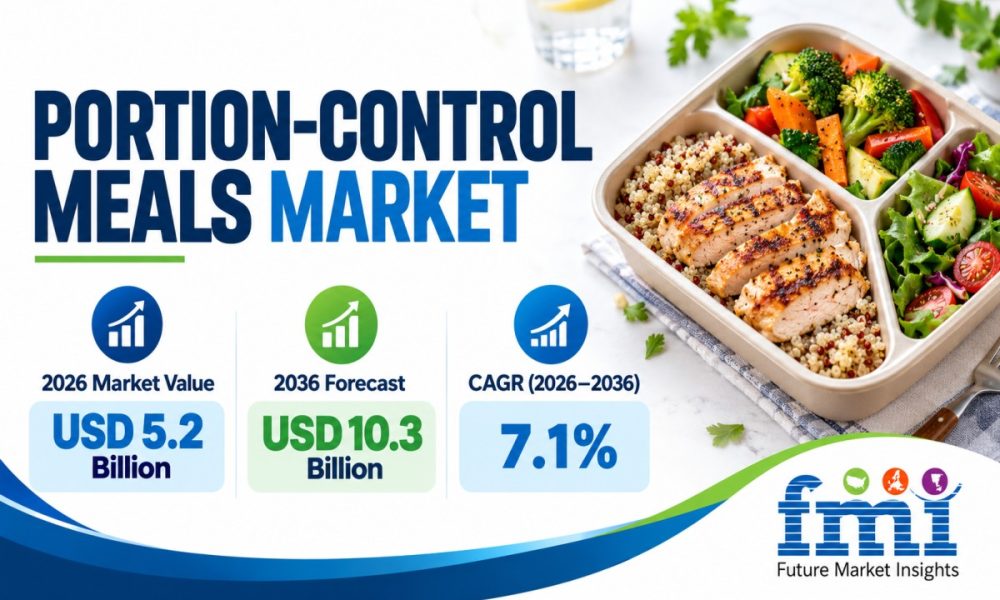
Summary: Global portion-control meals market is set to reach USD 10.3 billion by 2036, driven by weight-management needs, calorie awareness, and demand for convenient, nutritionally balanced meals with predefined serving sizes.
The global portion-control meals market is expanding as consumers seek convenient ways to manage calorie intake, meal composition, and portion sizes without weighing ingredients or calculating recipes. The market is projected to grow from USD 5.2 billion in 2026 to USD 10.3 billion by 2036, registering a 7.1% CAGR during the forecast period, according to the latest insights by Future Market Insights (FMI).
Global Portion-Control Meals Market Snapshot
2026 market value: USD 5.2 billion
2036 forecast: USD 10.3 billion
CAGR, 2026–2036: 7.1%
Leading product type: Frozen entrees
Frozen entrees share, 2026: 28.1%
Leading calorie band: 301–400 kcal
301–400 kcal share, 2026: 45.6%
Leading diet claim: Weight management
Weight management share, 2026: 36.1%
Get detailed market forecasts, competitive benchmarking, and pricing trends:
https://www.futuremarketinsights.com/reports/sample/rep-gb-34749
Why Is the Portion-Control Meals Market Growing?
The market is gaining momentum as consumers increasingly prioritize calorie awareness, weight management, and convenient meal planning. Pre-portioned meals simplify everyday food decisions by providing a defined serving with accessible nutrition information.
The U.S. Food and Drug Administration explained in March 2024 that nutrition information on packaged foods is generally presented per serving and that serving sizes reflect typical consumption rather than recommended intake. Portion-controlled products can simplify comparisons by aligning an individual meal with understandable calorie and nutrient information.
Frozen Entrees Lead the Product Type Category
Frozen entrees are estimated to account for 28.1% of product type demand in 2026, making them the leading category.
Their position reflects the combination of predefined serving sizes, freezer storage, convenient preparation, and broad grocery distribution. Frozen formats allow manufacturers to offer multiple cuisines and nutrition profiles while giving consumers flexibility to store meals until needed.
Why Does the 301–400 kcal Band Lead?
The 301–400 kcal calorie band is projected to represent 45.6% of calorie-band demand in 2026.
This range provides formulators with room to incorporate protein, vegetables, grains, sauces, and other ingredients while maintaining a defined calorie target. For consumers, it can offer a practical balance between calorie control and a satisfying meal experience.
Weight Management Anchors the Diet Claim Category
Weight management is estimated to account for 36.1% of diet-claim demand in 2026.
Pre-portioned meals help consumers follow calorie or macronutrient targets without repeatedly measuring food or calculating individual recipes. These products also appeal to consumers seeking structured eating routines or nutrition options compatible with appetite changes associated with GLP-1 medications.
Supermarkets and Hypermarkets Lead Sales Channels
Supermarkets and hypermarkets are projected to account for 31.6% of sales-channel demand in 2026.
These outlets allow shoppers to compare calorie levels, nutritional claims, pack formats, and prices during routine grocery trips. Freezer and chilled sections also support immediate replenishment, while recognizable packaging helps consumers identify products suited to their dietary goals.
Nestlé USA’s September 2024 launch of Vital Pursuit through national retailers, including Walmart, Target, and Kroger, illustrates the importance of mainstream grocery distribution for portion-focused frozen meals.
Price, Satiety, and Packaging Shape Repeat Purchases
The main commercial challenge is ensuring that smaller portions remain satisfying and affordable. Packaged meals must justify their price against home cooking and conventional prepared foods while delivering acceptable taste, texture, and nutrient density.
Trays are estimated to account for 37.2% of packaging demand in 2026, supported by their ability to contain predefined servings and accommodate reheating. Convenient packaging can reduce preparation steps, but manufacturers must also consider ease of opening, heating performance, and distribution durability.
South Korea Leads the Profiled Country Growth
South Korea is projected to register a 7.2% CAGR through 2036, supported by active weight-management behavior and consumer interest in balanced, lower-calorie eating. The Korea Disease Control and Prevention Agency reported in November 2025 that 34.4% of adults were obese in its analysis of 2024 survey data, while 65% had tried to lose or maintain weight.
The USA follows with a 6.8% CAGR, supported by established frozen-meal distribution and demand for convenient nutrition. Manufacturers can differentiate products through clear calorie labeling, higher protein content, and accessible retail availability.
The UK is forecast to grow at 6.3% CAGR, with weight-management needs and affordability influencing product selection. Brands need to balance nutritional positioning with accessible price points to encourage repeat purchases.
Germany is projected to register a 5.8% CAGR, supported by interest in health-promoting food choices. Transparent nutrition information, familiar recipes, and competitive pricing remain important for established supermarket channels.
Japan is anticipated to record a 5.4% CAGR through 2036. Consumer interest in balanced meals is accompanied by demand for less preparation effort and better value, creating opportunities for convenient products that do not compromise meal quality.
Competitive Landscape: Nestlé, Conagra and Prepared-Meal Platforms Strengthen Market Competition
The competitive environment includes mainstream frozen-food brands, structured weight-management programs, and direct-to-consumer meal providers.
Nestlé (Lean Cuisine), Conagra (Healthy Choice), Kraft Heinz (Smart Ones), and Amy’s Kitchen compete through retail meal ranges and established grocery distribution. Nutrisystem and BistroMD offer structured weight-management meal programs, while Factor (HelloFresh) and Trifecta address prepared-meal delivery and nutrition-focused purchasing. WeightWatchers combines nutrition and behavioral guidance to support weight-management routines.
What Does the Market Mean for Industry Decision-Makers?
The 7.1% CAGR indicates sustained demand for meals that simplify calorie management and everyday nutrition decisions.
For manufacturers, the priority is combining controlled portions with taste, satiety, nutrient density, and competitive pricing. Retailers and meal-delivery providers can strengthen their offerings through clear calorie information, diverse menus, and convenient replenishment.
The strongest opportunities are likely to emerge where practical portion control, credible nutrition positioning, and satisfying eating experiences come together.
Get the Complete Story—Read More About Our Latest Report:
https://www.futuremarketinsights.com/reports/portion-control-meals-market
Related Food & Beverages Industry Reports
For companies tracking convenient nutrition and weight-management food products, relevant FMI research areas include:
Meal Replacement Products Market
Weight Management Market
Frozen Food Market
Prepared Meals Market
High-Protein Foods Market
About Future Market Insights (FMI)
Future Market Insights, Inc. is an ESOMAR-certified, ISO 9001:2015 market research and consulting organization trusted by Fortune 500 companies. With a global presence across the U.S., UK, India and Dubai, FMI delivers data-driven insights across 30+ industries and 1,200 markets worldwide.



