
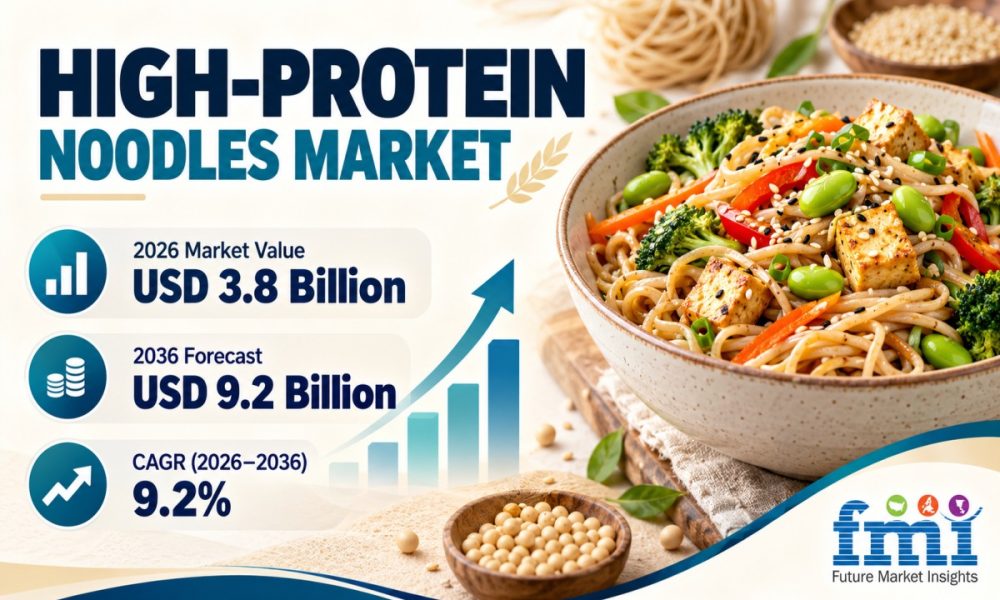
Summary: Global high-protein noodles market is set to reach USD 9.2 billion by 2036, driven by demand for protein-rich convenience foods, familiar meal formats, and formulations that balance nutritional value with taste and texture.
The global high-protein noodles market is expanding as consumers seek convenient ways to increase protein intake without changing their established eating habits. The market is projected to grow from USD 3.8 billion in 2026 to USD 9.2 billion by 2036, registering a 9.2% CAGR during the forecast period, according to the latest insights by Future Market Insights (FMI).
Global High-Protein Noodles Market Snapshot
2026 market value: USD 3.8 billion
2036 forecast: USD 9.2 billion
CAGR, 2026–2036: 9.2%
Leading protein source: Wheat gluten
Wheat gluten share, 2026: 29.7%
Leading product type: Instant ramen
Instant ramen share, 2026: 33.6%
Leading protein content: 10–15 g/serving
Protein content share, 2026: 41.9%
Leading nature category: Conventional
Get detailed market forecasts, competitive benchmarking, and pricing trends:
https://www.futuremarketinsights.com/reports/sample/rep-gb-34744
Why Is the High-Protein Noodles Market Growing?
Consumer interest in protein-rich diets is creating opportunities for manufacturers to incorporate additional protein into familiar meals. The International Food Information Council reported in July 2025 that 71% of Americans were trying to consume protein, while high-protein diets remained the most followed eating pattern for a third consecutive year.
High-protein noodles allow consumers to increase protein intake without adding a separate shake, bar, or supplement. However, repeat purchases depend on taste, cooking performance, price, and the overall nutritional profile rather than protein content alone.
Wheat Gluten Leads the Protein Source Category
Wheat gluten is estimated to account for 29.7% of protein source demand in 2026, making it the leading category.
Its structural protein network supports elasticity, bite, and cooking tolerance, helping manufacturers maintain the familiar texture associated with conventional noodles. Wheat-based formulations can also incorporate chickpea, pea, or lentil ingredients to increase protein content while preserving established product characteristics.
Why Does Instant Ramen Lead the Product Type Category?
Instant ramen is projected to represent 33.6% of product type demand in 2026.
The category benefits from convenience, familiar preparation routines, and the ability to deliver protein within a single-meal format. It also offers opportunities for flavor variety and portion control, making it attractive to consumers seeking convenient nutrition.
Vite Ramen announced in February 2024 that its Pro+ ramen would launch with 42 grams of protein and 460 calories. Meanwhile, established manufacturers continue to combine protein enrichment with broader nutritional improvements. Nissin Foods announced in January 2025 that its renewed Cup Noodles PRO line would retain 15 grams of protein while reducing carbohydrates and salt relative to reference products.
The 10–15 g/Serving Category Balances Nutrition and Taste
The 10–15 g/serving protein tier is estimated to account for 41.9% of protein content demand in 2026.
This range offers a visible nutritional improvement without necessarily requiring the extensive ingredient substitution associated with very high-protein formulations. It can help manufacturers balance protein content with texture, cooking behavior, flavor, and serving size.
The commercial advantage lies in appealing to consumers who want better everyday nutrition rather than products positioned exclusively for performance-focused diets.
Conventional Products and Supermarkets Strengthen Market Access
Conventional high-protein noodles are projected to account for 55.8% of the nature category in 2026. Their broader ingredient options support familiar textures, scalable production, and mainstream pricing compared with some specialized gluten-free or organic formulations.
Formulation Challenges Create Opportunities for Innovation
Increasing protein content can affect firmness, cooking loss, tensile strength, and flavor. A product may offer an attractive nutritional profile but struggle to generate repeat purchases if its texture differs significantly from consumer expectations.
Research published in June 2023 by Liang and colleagues found that increasing soy protein isolate in wheat noodles raised protein content but also affected cooking loss and textural properties. The findings highlight why manufacturers must balance nutritional enhancement with sensory performance.
South Korea Leads the Profiled Country Growth
South Korea is projected to register a 9.4% CAGR through 2036, supported by its established ramyeon culture, product competition, and manufacturing capabilities. The country’s broader noodle ecosystem offers opportunities for protein-forward variants that maintain familiar flavors and convenience.
The USA follows with an 8.8% CAGR, supported by consumer interest in protein, diverse retail channels, and demand for convenient nutrition. Clear protein labeling, competitive pricing, and familiar product formats are important for repeat purchases.
The UK is projected to grow at 8.1% CAGR, with supermarkets and online channels providing access to protein-rich products. Marketing restrictions for qualifying less-healthy foods make balanced nutritional formulations and retailer communication important considerations.
Germany is forecast to register a 7.6% CAGR, supported by conventional pasta demand and interest in plant-forward foods. Wheat-legume blends can appeal to consumers seeking additional protein while maintaining familiar cooking performance.
Japan is projected to record a 6.9% CAGR through 2036. Its mature instant-noodle market creates opportunities for protein-enriched products, provided manufacturers preserve recognizable flavors, preparation convenience, and acceptable sodium levels.
Competitive Landscape: Nissin Foods, Banza and Barilla Expand Protein-Forward Choices
The competitive environment includes established noodle manufacturers, mainstream pasta brands, and specialist nutrition-focused companies.
Nissin Foods, Vite Ramen, immi, and Borealis Foods (Chef Woo) compete in convenient, protein-forward ramen formats. Banza, Barilla, and ZENB offer mainstream or legume-based pasta propositions, while Liviva, Kaizen Food Company, and The Only Bean address specialty bean-based and low-carbohydrate pasta needs.
Competition increasingly depends on delivering meaningful protein content while maintaining familiar taste, texture, cooking performance, and competitive pricing. Brands that integrate nutritional benefits into established eating occasions can reach consumers beyond specialist sports-nutrition segments.
What Does the Market Mean for Industry Decision-Makers?
The 9.2% CAGR indicates growing opportunities for protein-rich noodles across instant meals, dried pasta, and specialty formats.
For manufacturers, the priority is balancing protein content with sensory quality, affordability, and convenient preparation. For retailers, clear nutritional information and reliable product performance can support category expansion and repeat purchases.
Get the Complete Story—Read More About Our Latest Report:
https://www.futuremarketinsights.com/reports/high-protein-noodles-market
Related Food & Beverages Industry Reports
For companies tracking protein enrichment and convenient nutrition, relevant FMI research areas include:
Plant-Based Protein Market
Pasta Market
Instant Noodles Market
Protein Ingredients Market
Gluten-Free Products Market
About Future Market Insights (FMI)
Future Market Insights, Inc. is an ESOMAR-certified, ISO 9001:2015 market research and consulting organization trusted by Fortune 500 companies. With a global presence across the U.S., UK, India and Dubai, FMI delivers data-driven insights across 30+ industries and 1,200 markets worldwide.



