
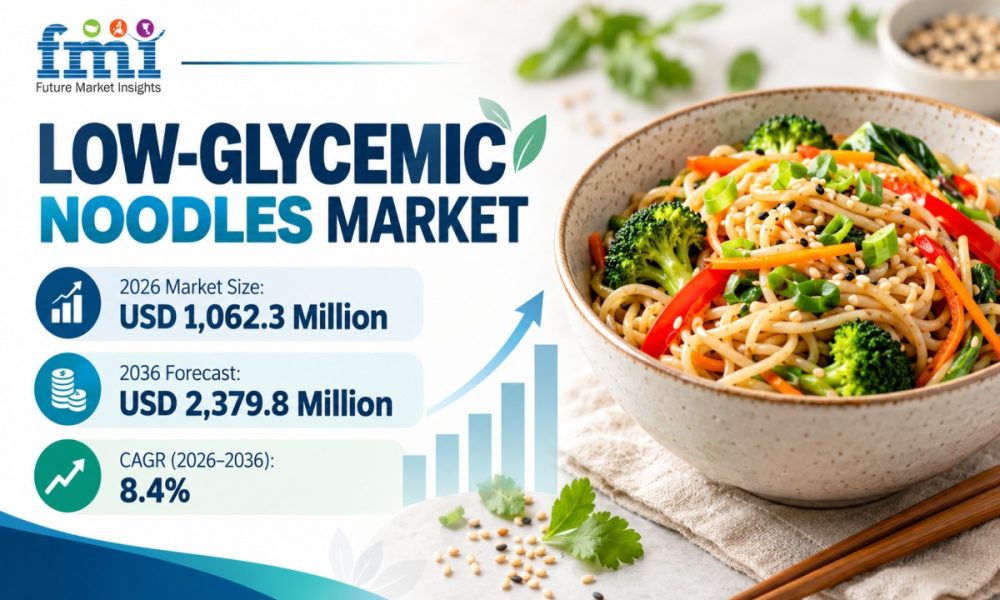
Summary: The global low-glycemic noodles market is projected to grow from USD 1,062.3 million in 2026 to USD 2,379.8 million by 2036, registering a CAGR of 8.4%. Rising interest in glucose management, demand for carbohydrate-conscious meals, and the expansion of convenient, pantry-stable alternatives are supporting market growth. Konjac/Shirataki, dried noodles, and diabetic-friendly products represent key market segments.
The global low-glycemic noodles market is expected to expand steadily as consumers seek practical ways to manage carbohydrate intake without abandoning familiar noodle-based meals. According to Future Market Insights (FMI), the market is forecast to increase from USD 1,062.3 million in 2026 to USD 2,379.8 million by 2036, at a CAGR of 8.4%. After reaching USD 980.0 million in 2025, the market is projected to add USD 1,317.5 million in value over the forecast period.
Global Low-Glycemic Noodles Market Snapshot
- Market size (2026): USD 1,062.3 million
- Forecast value (2036): USD 2,379.8 million
- CAGR (2026–2036):4%
- Leading base ingredient: Konjac/Shirataki, with a 30.9% share in 2026
- Leading product type: Dried noodles, with a 34.7% share in 2026
- Leading diet claim: Diabetic-friendly, with a 28.6% share in 2026
- Leading glycemic index category: GI ≤40, accounting for 44.2% in 2026
- Leading sales channel: Supermarkets and hypermarkets, with a 32.6% share in 2026
- Fastest-growing profiled country: South Korea, at an 8.5% CAGR
Request a sample report: https://www.futuremarketinsights.com/reports/sample/rep-gb-34746
What Is Driving Growth in the Low-Glycemic Noodles Market?
Increasing Demand for Glucose-Conscious Food Choices
Growing interest in metabolic health is creating opportunities for noodles formulated with lower available carbohydrates, higher fiber content, or alternative ingredient structures. Consumers who monitor blood glucose often want to maintain familiar meals while making more informed dietary choices.
This demand encourages manufacturers to explore konjac, legume flours, resistant starch, and other alternatives to conventional starch-heavy formulations. Products must communicate their nutritional benefits clearly while remaining practical for regular meals. Credible glycemic evidence, transparent ingredient information, and appropriate portion guidance can help consumers compare products and make purchasing decisions.
Konjac/Shirataki Strengthens Its Position
Konjac/Shirataki is estimated to account for 30.9% of the base ingredient category in 2026. Its position is supported by the use of konjac, which provides a fiber-based structure compatible with low-available-carbohydrate formulations.
Brands such as Miracle Noodle, Slendier, Better Than Foods, and NOoodle compete in this space through konjac-centered products. However, texture, aroma, sauce absorption, and preparation requirements remain important considerations. Improving these characteristics can help close the sensory gap between alternative noodles and conventional wheat or rice noodles.
Dried Noodles Support Mainstream Adoption
Dried noodles are projected to hold a 34.7% share of the product type category in 2026. Their shelf stability supports conventional grocery merchandising, pantry storage, online delivery, and repeat purchasing.
Dried formats also allow manufacturers to develop products using legume flours, protein-rich blends, and other alternative ingredients while retaining familiar cooking routines. Their commercial advantage depends on delivering reliable cooking performance and acceptable texture alongside the intended nutritional profile.
Diabetic-Friendly Positioning Creates a Clear Purchase Cue
The diabetic-friendly segment is expected to represent 28.6% of diet claims in 2026. This positioning directly addresses shoppers seeking to manage carbohydrate intake and post-meal glucose response.
Nevertheless, a claim alone is not sufficient to build consumer confidence. Brands need clear nutrition panels and substantiated product information. Where appropriate, product-level glycemic-index testing can provide additional evidence and help distinguish products in an increasingly competitive better-for-you food category.
Key Opportunities and Challenges
The market’s main opportunity is to make lower-glycemic noodles convenient enough for routine consumption. Ready-to-eat products and pantry-stable dried noodles can appeal to different meal occasions, from quick lunches to planned family dinners. Wider supermarket distribution and online availability can further improve product discovery and replenishment.
Sensory performance remains a key restraint. Some alternative noodles can have unfamiliar mouthfeel, distinctive odors, or preparation steps that differ from conventional products. These differences may discourage repeat purchases even when consumers recognize the nutritional proposition.
Country-Wise Growth Outlook
FMI identifies different growth trajectories across five key markets between 2026 and 2036:
- South Korea — 8.5% CAGR: The fastest-growing profiled market, with opportunities to adapt noodle texture, seasoning compatibility, and product instructions to familiar local meals.
- USA — 8.0% CAGR: Mainstream grocery, e-commerce, and health-oriented retail provide routes to consumers seeking carbohydrate-conscious alternatives.
- UK — 7.3% CAGR: Brands must communicate nutritional value clearly while competing with existing high-fiber, gluten-free, and low-carbohydrate products.
- Germany — 6.8% CAGR: Transparent nutrition information and cooking performance close to conventional pasta may support adoption.
- Japan — 6.2% CAGR: Localized noodle formats, texture, and recipe versatility are important to fitting established eating preferences.
These CAGRs indicate forecast growth rates rather than the absolute size of each country’s opportunity. Retail access, consumer preferences, product pricing, and evidence supporting nutritional positioning will also influence commercial performance.
Competitive Landscape: Key Companies
Competition is shaped by ingredient choices, preparation convenience, glycemic-positioning evidence, and distribution reach.
Notable companies profiled in the market include Miracle Noodle, Slendier, ZENB, Banza, Explore Cuisine, It’s Skinny, Better Than Foods, NOoodle, Liviva, and Palmini.
Konjac-focused brands emphasize fiber-based formulations and texture improvements. ZENB, Banza, Explore Cuisine, and Liviva offer legume- or protein-led alternatives in pantry-stable formats. It’s Skinny and Palmini target convenience-oriented or vegetable-based substitution occasions.
What This Means for Industry Decision-Makers
Food manufacturers and retailers can evaluate opportunities by focusing on three priorities: substantiated glycemic positioning, improved sensory performance, and accessible formats. Products that communicate their nutritional attributes clearly while cooking and tasting like familiar noodles may have a stronger chance of converting initial interest into repeat purchasing.
Retailers can also assess whether packaging makes ingredient composition, carbohydrate information, preparation requirements, and product benefits easy to understand. For manufacturers, the challenge is to reduce the practical differences between alternative noodles and conventional products without compromising the intended formulation.
Get the Complete Story—Read More About Our Latest Report
https://www.futuremarketinsights.com/reports/low-glycemic-noodles-market
Related Industry Reports
- High-Protein Noodles Market
- Dietary Fibers and Prebiotic Fiber Market
- Sustainable Alt-Protein Taste and Texture Solutions Market
- Post-GLP-1 / Appetite-Aware Nutrition Ingredients Market
About Future Market Insights (FMI)
Future Market Insights, Inc. is an ESOMAR-certified, ISO 9001:2015 market research and consulting organization trusted by Fortune 500 companies. With a global presence across the U.S., UK, India and Dubai, FMI delivers data-driven insights across 30+ industries and 1,200 markets worldwide.



